To find out which states deliver the most, the Holafly research team ranked all 50 states across six metrics: mountain elevation, river and waterway coverage, forest cover, national parks, volcanoes, and waterfalls.
Key Findings
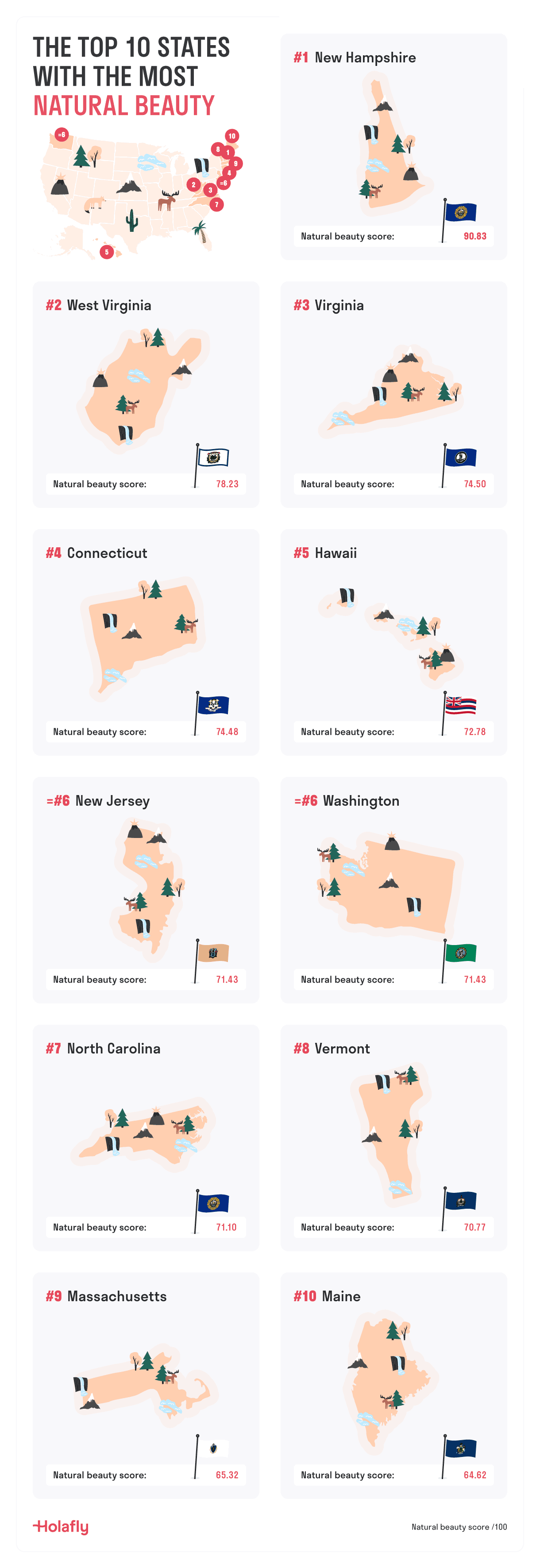
- New Hampshire tops the ranking with a score of 90.83/100, driven by high numbers of waterfalls and forest cover.
- West Virginia ranks in second place (78.23). It is the only state in the top 10 to score consistently across every single category.
- Hawaii has 25 volcanoes, the highest waterfall density of all states and a peak mountain point of 13,803 ft.
- Washington has more waterfalls in absolute terms than any other state: 3,057.
The Top US states For Natural Beauty
1. New Hampshire — 90.83/100
At just under 15,000km², New Hampshire is one of the smaller states in the US, but don’t let its size fool you. 83% of its land is forested, and its peaks rise to 6,288ft at Mount Washington. And with 353 waterfalls distributed across its terrain at a higher rate per km² than most other states in the index, it’s clear to see why New Hampshire ranks number one.
2. West Virginia — 78.23/100
West Virginia has the most well-rounded natural landscape in America. It is the only top-10 state to score strongly across every metric, featuring 78% forest cover, 6,647 miles of rivers, six national parks, 174 waterfalls, and a mountain landscape anchored by Spruce Knob at 4,863ft. It consistently outperforms states with bigger reputations and louder press.
3. Virginia — 74.50/100
Virginia has 25 national parks, and five volcanoes, giving it one of the widest varieties of protected natural landscape in the ranking. The Blue Ridge Parkway cuts through a state that’s 63.5% forested, with over 11,000 miles of rivers.
4. Connecticut — 74.48/100
Connecticut nearly ties Virginia for third. One of the smallest states in the country, its score is almost entirely density-driven: 26.82 mountain elevation points per km², 21.78 river miles per km², 1.54 waterfalls per km². At 58.3% forested with four national parks packed into a tight geography, it makes the case that natural beauty doesn’t require vast open space.
5. Hawaii — 72.78/100
Hawaii is home to 25 active or dormant volcanoes and 543 waterfalls. Mauna Kea, at 13,803ft, is the second tallest mountain point of the top-10 state. Where Hawaii loses ground is forest cover (35.8%) and river mileage, both modest relative to its size. For sheer geological spectacle, nothing else on this list compares.
How Much Natural Beauty Does Each State Have?
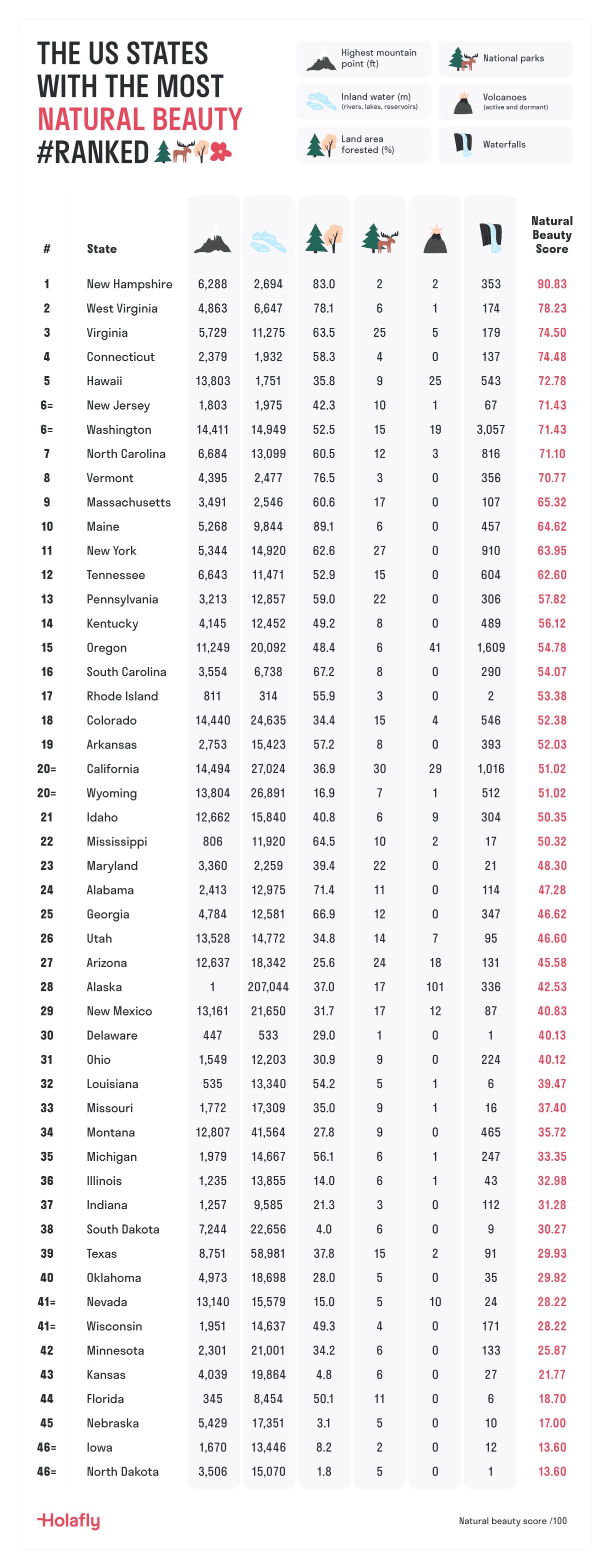
America has 50 states, and the gap between first and last is wider than most people would guess; a score of 90.83 for New Hampshire against 13.60 for North Dakota tells its own story. Whether you’re planning your first US road trip or looking for somewhere closer to home that you’ve been overlooking, here’s how every state stacks up.
Tips For Making The Most Of America’s Natural Beauty
Whether you’re road-tripping through New England’s forested hills or chasing waterfalls in North Carolina, a little preparation goes a long way. Here are three tips to help you make the most of your trip.
- Plan around the seasons, not just the destination
The US is a big country, and natural beauty looks very different depending on when you visit. New Hampshire’s forests are spectacular in fall foliage season (late September to mid-October), while Hawaii’s waterfalls are at their most dramatic after winter rainfall. Vermont’s peaks are best hiked in summer, and Washington’s volcanoes are most accessible from July onward. Checking the optimal season for your chosen state before you book can make the difference between a good trip and an unforgettable one.
- Go beyond the national parks
National parks are a key part of what makes a state naturally beautiful, but they’re also the most crowded. Many of the top-scoring states in this index have remarkable landscapes that sit just outside park boundaries; state parks, national forests, and wilderness areas that see a fraction of the footfall. West Virginia’s Monongahela National Forest and North Carolina’s Pisgah National Forest, for example, offer trail access to some of the most dramatic terrain on the East Coast without the crowds. Researching state parks and national forests alongside the headline parks will open up a far richer experience.
- Prepare your connectivity for use in remote areas
Some of the most beautiful parts of the US, like Hawaii’s volcanic coastlines or New Hampshire’s forested trails, also have the weakest mobile signal. Remote valleys and mountain terrain, combined with limited tower capacity, can make it hard to maintain a strong connection. One effective way to get around this is to use a travel eSIM. Unlike a traditional SIM tied to one provider, eSIMs often support multiple networks, automatically switching to the strongest one available (or letting you pick manually). This flexibility is especially useful in remote areas, helping you stay connected enough to check directions, send a message, or make an emergency call.
Natural Beauty in All Shapes and Sizes
America’s natural beauty isn’t reserved for the states with the biggest reputations. New Hampshire proves that a small, forested state can outrank almost everything else in the country, whereas Connecticut shows that density matters as much as scale. But that’s part of what makes the US worth exploring. Whether you’re heading to Hawaii for volcanic coastlines, Washington for its waterfalls, or somewhere you’ve never considered before, the landscapes are there. The question is just where to start.
Methodology
To create our ranking, we used six measurable factors that best capture the landscape diversity, ecological richness, and geological drama of each state. Each factor was given a score and summed together out of 100.
Data sources: World Population Review was used to collect data on the size of each state, the number of volcanoes and the percentage of land forested. World Waterfall was used to find the number of waterfalls, National Parks were found from the official National Parks website and river miles collected from mapscaping.com. The data was then calculated per kilometer for a fairer representation.