


When planning to study abroad, international students often overlook the significant hidden cost of mobile data. Traditional telecommunications infrastructure is designed for short-term travel, meaning home-country roaming plans frequently enforce restrictive data caps or suspend service entirely during long-term stays. Alternatively, purchasing a local SIM card introduces severe bureaucratic friction, requiring tax IDs, biometric registration, or proof of a local address during the crucial first weeks of relocation. Holafly’s Study Abroad Connectivity Cost Index reveals that a lack of planning can cost students hundreds of dollars more per semester. Securing an eSIM with Unlimited Data before departure eliminates these barriers, providing the seamless, cross-border digital access essential for modern academic and social life.

When people think about the cost of studying abroad, they usually focus on the obvious expenses, and tuition fees, accommodation, flights, insurance, food and transport are all carefully budgeted long before departure, but mobile data rarely makes the list.
But as these international travellers are part of digital-native generations, staying connected is as vital as breathing and has become a surprisingly significant expense for their families, even adding hundreds of dollars to the cost of a semester and, in some cases, creating barriers that extend far beyond price.
The latest Study Abroad Connectivity Cost Index released by Holafly examined the world’s largest international student corridors, and suggests that the real challenge is not the cost of mobile data itself, but that the infrastructure is designed for short-term travel, while international education increasingly involves months or years of cross-border living. The result is a mismatch between how people move and how telecommunications services are structured.
This mismatch is becoming more important because studying abroad is no longer just an academic experience; universities now operate through digital platforms, coursework is increasingly cloud-based, lectures are streamed, research resources are accessed online and international students often depend on video calls to maintain relationships with friends and family back home. Internet access is no longer a convenience layered on top of the student experience, but it is part of the educational infrastructure itself.
How do international students get online?
What stands out from all the research is how frequently students end up choosing options that are dramatically more expensive than necessary simply because they do not have the information needed to compare alternatives before departure.
According to the research, students can pay up to $153.70 more per month than necessary for mobile access, depending on the route they take. Over the course of a standard five-month semester, that can translate into hundreds of dollars in avoidable costs. In other words, many students are paying significantly more than they should simply because connectivity planning remains an afterthought compared with other aspects of studying abroad.
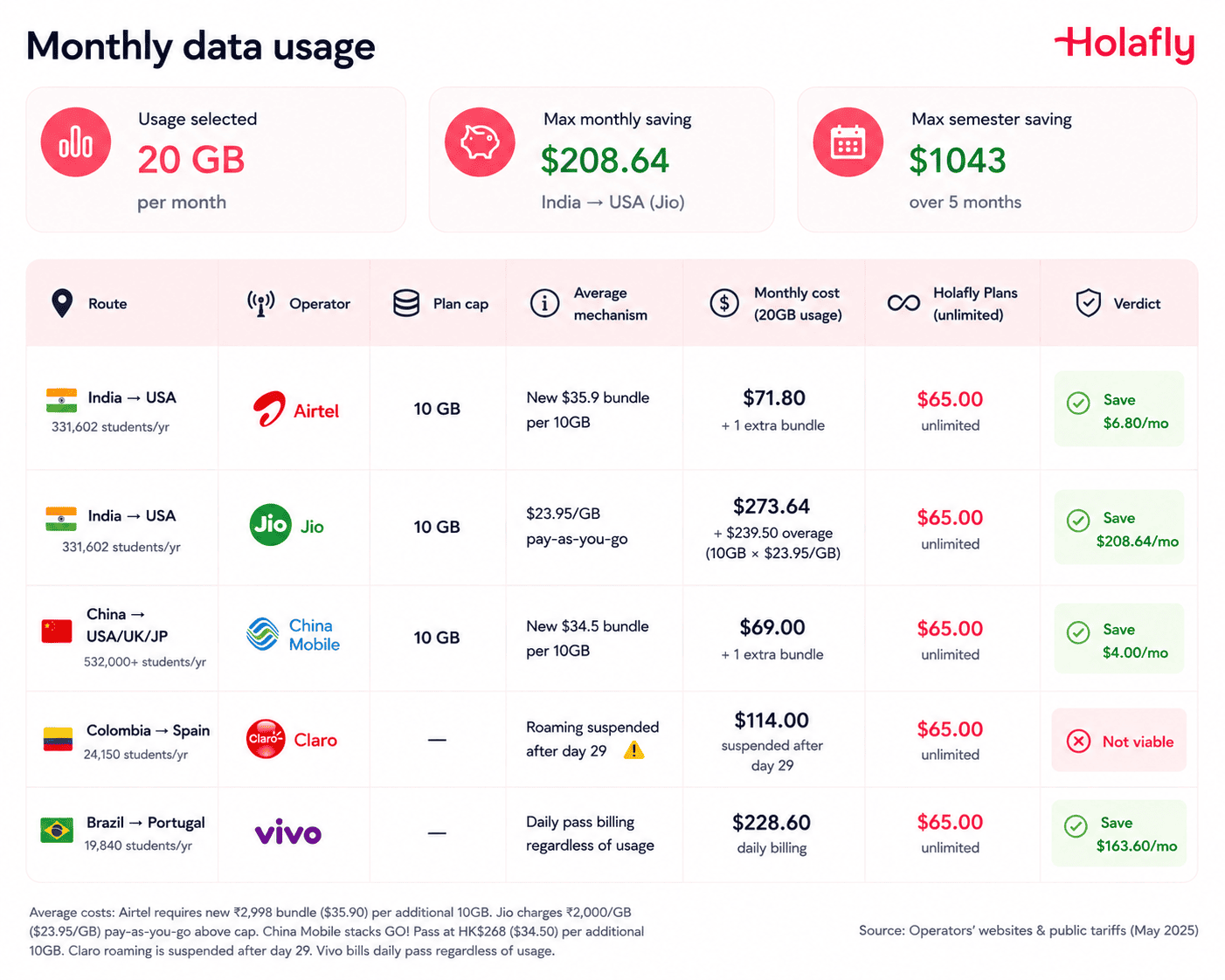
One example is the route between Brazil and Portugal, where nearly 20,000 Brazilian students travel to Portugal each year, making it one of the most established academic migration corridors in the Portuguese-speaking world. Despite the maturity of this route, a student relying on roaming through Vivo Brasil can face monthly costs of approximately $228.60. An alternative eSIM solution for the same destination costs $65 with unlimited data. Over a five-month semester, that difference reaches almost $770.
What makes this finding significant is that students are not paying more because they are receiving dramatically better service or access to a fundamentally different network. They are paying more because connectivity decisions are often made at the last minute, after months of careful planning around far larger expenses. Universities provide extensive guidance on visas, housing and enrollment procedures, but mobile access remains one of the few critical parts of the relocation process that many students navigate largely on their own.
The consequence is that digital access becomes an invisible tax on international education. Unlike tuition increases or rising rental costs, it rarely attracts attention because the expense is fragmented into monthly charges.
The local plan that requires a stack of paperwork
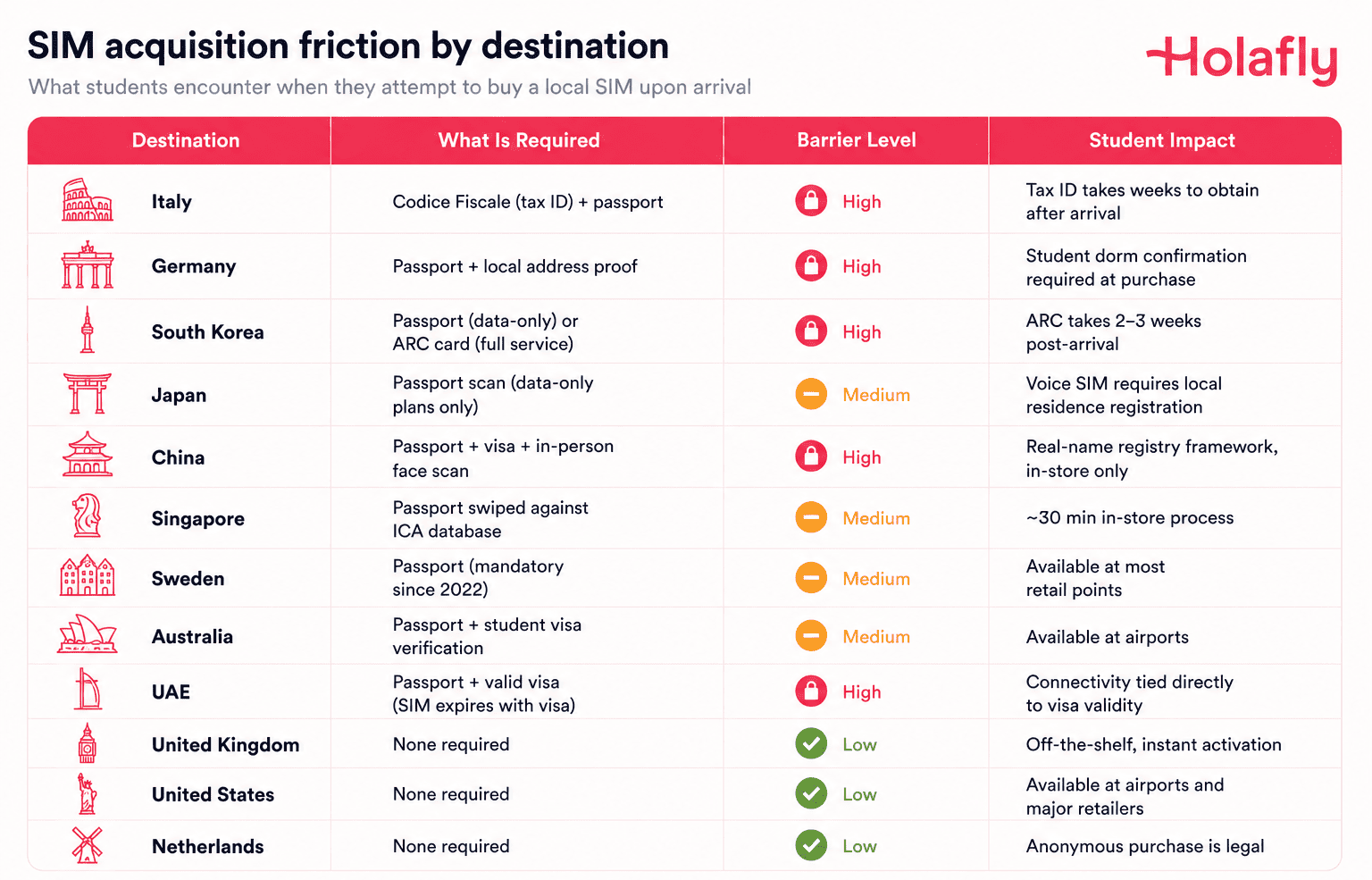
Conventional advice for international students is straightforward: avoid roaming and buy a local SIM card after arrival. That might make sense on paper, as local prepaid plans remain the cheapest solution available across many study destinations.
But our research highlights how that assumption breaks down in practice. In Italy, obtaining a SIM card requires a Codice Fiscale, the national tax identification number that many students do not receive until weeks after arrival. South Korea requires an Alien Registration Card for many full-service mobile plans, a document that typically takes several weeks to process. China requires passport verification, visa validation and in-person biometric registration. Germany frequently requires proof of a local address before activation.
These requirements may appear minor from a regulatory perspective, but they create a significant challenge during the first days and weeks in a new country, as international students arrive needing immediate access to maps, banking applications, university portals, accommodation contacts and transportation services. So the competitive advantage in digital services is not price alone, but the ability to eliminate friction.
When data caps change the equation
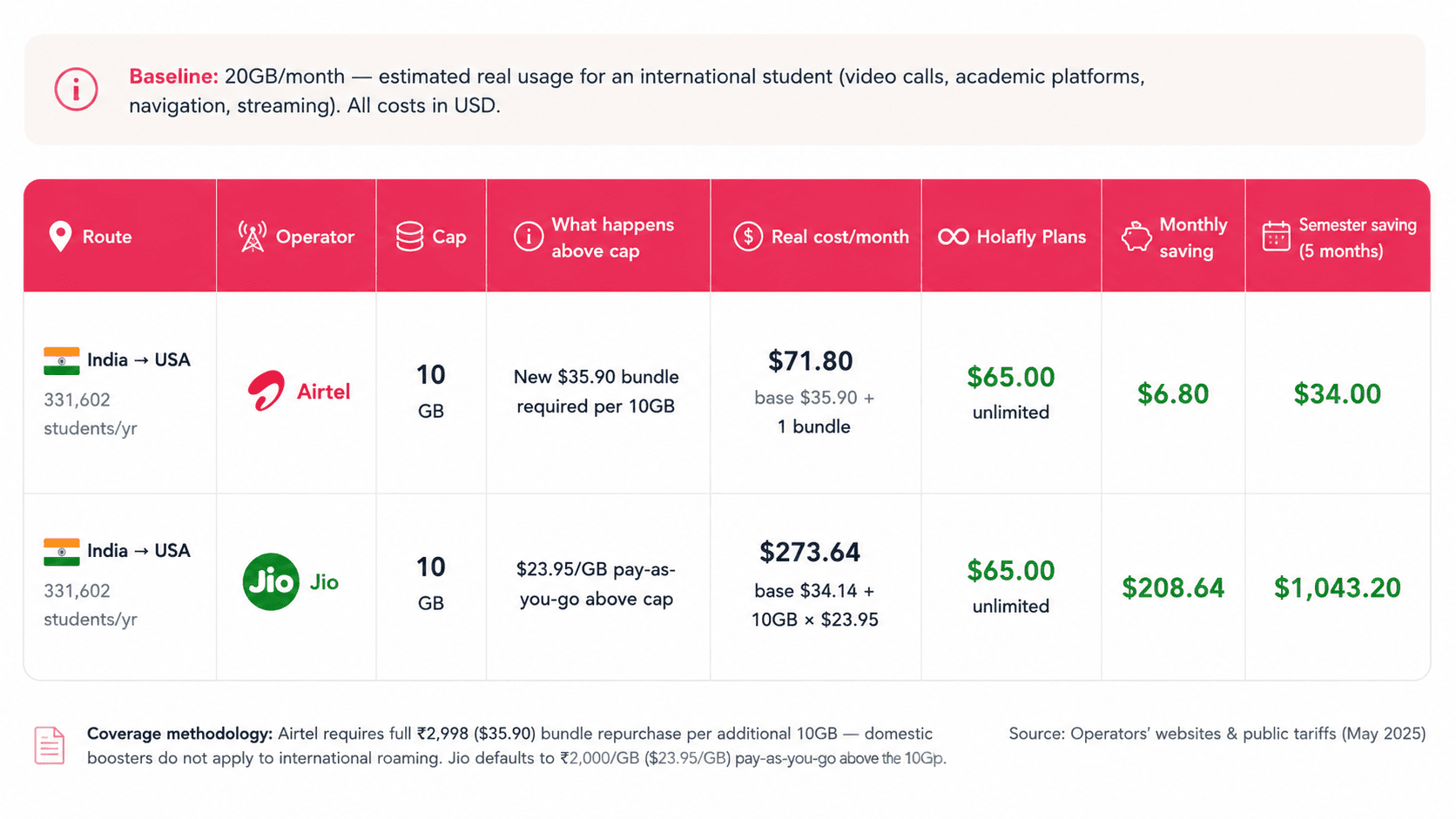
More than 331,000 Indian students travel to the United States each year, making it the biggest bilateral student mobility route globally. For these students, traditional roaming packages from operators such as Airtel and Jio can initially appear more attractive than eSIM alternatives, costing around $35 per month.
But the picture changes when actual student behaviour is taken into account, as those roaming packages include data caps of around 10GB per month; what may have been sufficient a decade ago is no longer enough for modern student life. Video lectures, cloud storage, collaborative software, streaming services, navigation tools and frequent international video calls quickly push consumption beyond those limits. Once usage rises toward 20GB or 30GB per month, the cost advantage begins to disappear and unlimited alternatives become increasingly competitive.
This highlights that connectivity is no longer limited to messaging, maps and occasional browsing, and for many international students, it has become the primary gateway to academic resources, entertainment platforms, banking services and communication with family back home. As digital consumption grows, plans that appear cheaper on paper can quickly become more expensive once real usage patterns are taken into account.
Are mobile roaming plans built for international students?
The study identifies a particularly striking example among Colombian students studying in Spain, where roaming through Claro Colombia appears to be a good option on paper, but the operator’s policy suspends service for customers who remain outside the country for more than 29 consecutive days. For students enrolled in a full semester abroad, this effectively removes roaming as a viable long-term option regardless of price.
This finding reveals a structural problem that extends far beyond a single operator; roaming products were originally designed around short-term travel, but international students occupy a different category. They remain connected to their home countries while simultaneously building temporary lives elsewhere. They are neither tourists nor permanent residents, but telecommunications products often force them into one category or the other.
As global mobility continues to expand, this distinction is likely to become increasingly difficult to maintain. Students, digital nomads, remote workers and internationally mobile professionals are all creating demand for services that function seamlessly across borders for extended periods of time. Traditional roaming models were never designed for this reality.
The cost of not planning ahead
Chinese students represent three of the ten largest study abroad routes analysed, and they are exposed to one of the sharpest pricing cliffs in the research. China Mobile’s default daily roaming structure accumulates to $146.10 per month if used continuously, more than twice the cost of Holafly Plans for the same destinations.
The carrier’s alternative 30-day GO! Pass reduces that figure dramatically to $34.50 for 10GB, but it requires students to activate the plan before departure and still imposes a hard data cap. The result is that the final cost depends less on where students travel and more on whether they understand the available options before boarding their flight.
This highlights another recurring theme across the study: planning matters. For many international students, mobile access remains one of the last elements organised before departure, despite becoming one of the most essential services during their time abroad.
Being online is the new essential for international students
The broader significance of these findings lies in what they reveal about the future of international education; every day, more universities and schools spend considerable effort making academic mobility easier. Visa processes are digitised, application systems are centralised, and student services increasingly operate through integrated online platforms. At the same time, one of the most basic requirements for being able to succeed in that ecosystem (reliable mobile access) often remains fragmented, expensive and unnecessarily complex.
What emerges from the study is that students are becoming more digitally dependent at precisely the moment when international mobility is accelerating, and the old assumption that connectivity is a secondary travel expense no longer holds. For many students, online access is now as essential as accommodation or transportation because it underpins almost every aspect of daily life abroad.
The most important question raised by the data is therefore not which plan is cheapest, but whether the telecommunications industry has fully adapted to the realities of international students. The 11 study abroad routes analysed in this index collectively represent more than 1.5 million student journeys every year, and on every one of these routes students face the same challenge: choosing between expensive roaming charges, bureaucratic SIM registration processes or data-capped plans that may not meet the demands of modern student life. Millions of them now cross borders carrying their academic lives, social networks and financial activities on their phones, and they expect digital access to work instantly, seamlessly and without bureaucratic obstacles. Increasingly, that expectation is shaping the future of international travel itself.
The hidden cost of studying abroad, it turns out, is not simply the money students spend to get online. It is the friction they encounter when something as fundamental as digital access still depends on systems built for a much less mobile world.
Methodology
The Study Abroad Connectivity Cost Index analyses the real cost of staying connected for international students across the world’s largest study abroad routes. The study compares three common options available to students: roaming with a home-country mobile operator, purchasing a local SIM card after arrival, and using an eSIM before departure.
The analysis covers 11 major international student corridors representing approximately 1.5 million students annually. Routes were selected based on official enrollment data from sources including the IIE Open Doors Report, HESA, the Australian Department of Education, IRCC Canada, JASSO, DAAD, South Korea’s Ministry of Education, Spain’s Ministerio de Universidades and Portugal’s DGEEC.
Pricing data was collected from the official websites of major mobile operators, local prepaid mobile providers and publicly available market sources. Holafly’s unlimited data plans were used as the eSIM benchmark. Local SIM registration requirements were verified through operator documentation and national telecommunications regulations.
All cost comparisons are based on an estimated monthly usage of 15GB of mobile data, reflecting the typical digital needs of international students, including video lectures, research platforms, navigation apps and international video calls. Additional analysis was conducted for higher-consumption users where plan limits significantly affect overall costs.
Prices and policies reflect publicly available information as of June 2026 and may be subject to change.