


Holafly’s Always On report demonstrates how a simple 5 MB connection at a critical moment can prevent up to $4,800 in airline operational delays. Discover why having a secure data backup through your international eSIM is more vital than accumulating gigabytes, ensuring travelers, digital nomads, and crew members maintain control of their trip in the face of any disruption at no extra cost. The key to success abroad is no longer just volume, but constant availability.
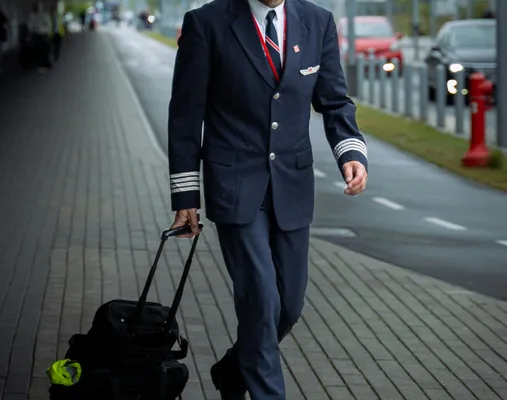
Airline crews operate inside one of the most technologically advanced industries in the world, yet some of the most important moments in their day still depend on something incredibly fragile: whether their phone stays connected at exactly the right time. Not during a Netflix session or while uploading photos from a layover, but during those small transitions that barely consume any data at all, like receiving a gate reassignment while leaving the hotel, opening Google Maps in an unfamiliar terminal, or booking a car at 3 AM before sign-on in a city they landed in only a few hours earlier.
That contrast sits at the center of Holafly’s new Always On report, which explores the tiny moments of staying connected that quietly hold modern travel together. What makes the findings interesting is not the amount of data airline crews actually use during operationally critical moments, but how little they need for things to either go smoothly or start falling apart very quickly. A roster sync usually consumes between 2 and 5 MB. A rideshare booking often requires about the same. Even a disruption alert from an airline operations app is practically weightless in data terms, yet missing one can trigger reserve crew activation and delays that cost airlines thousands of dollars downstream.
For years, the industry competed mostly around scale: gigabytes, speeds, unlimited data plans. But as unlimited data increasingly becomes the baseline expectation for modern travelers, a different kind of value is starting to matter more quietly in the background: the reassurance that the connection will still work during the moments where stress, uncertainty, or disruption suddenly appear.
Most travel problems start with a lost connection
Airline crews happen to live inside that reality permanently. Their entire job exists in motion, moving between airports, terminals, hotel rooms, crew buses, immigration lines, and unfamiliar cities where WiFi quality changes constantly and reliability can disappear without warning. A delayed pickup before dawn compresses sign-on times, a missed operational update forces last-minute coordination, and a navigation problem inside a large international hub can easily ripple into the rest of the duty day.
What makes these situations interesting is that none of them actually require large amounts of data. Most only depend on having access to the connection immediately, exactly when something unexpected happens.
One of the clearest examples in the report is something almost every traveler has experienced at some point: arriving late at a hotel, assuming the connection problem is already solved, and then suddenly realizing a few hours later that you still need data at the worst possible moment.
Imagine landing after midnight with a one-day eSIM package already exhausted after a full day using Maps, WhatsApp, airport apps, and transfers, only to realize at 4 AM that you still need to book an Uber back to the airport before sign-on. The ride itself usually consumes around 5 MB, but the stress attached to the situation feels disproportionately large because there is no real margin for error anymore.
That is precisely where the idea behind Always On becomes relevant, not as a replacement for unlimited data, but as a built-in safety layer that quietly covers those small but critical moments when travelers suddenly need the connection to still be there.
The same asymmetry appears during disruption windows, which the report identifies as some of the highest-risk moments in modern airline operations. A push notification warning a crew member about a gate change, reassignment, or operational delay consumes virtually no data at all, yet missing it can force airlines to activate reserve crew and create delay chains worth thousands of dollars. What becomes interesting here is not the technology itself, but how much of the industry quietly depends on continuous low-level data access that passengers almost never see.
What 1 GB really covers
One of the most surprising findings in the report is how little data most critical travel moments actually require. In practical terms, 1 GB is often enough to cover hundreds of the interactions that determine whether a trip stays smooth or suddenly becomes stressful.
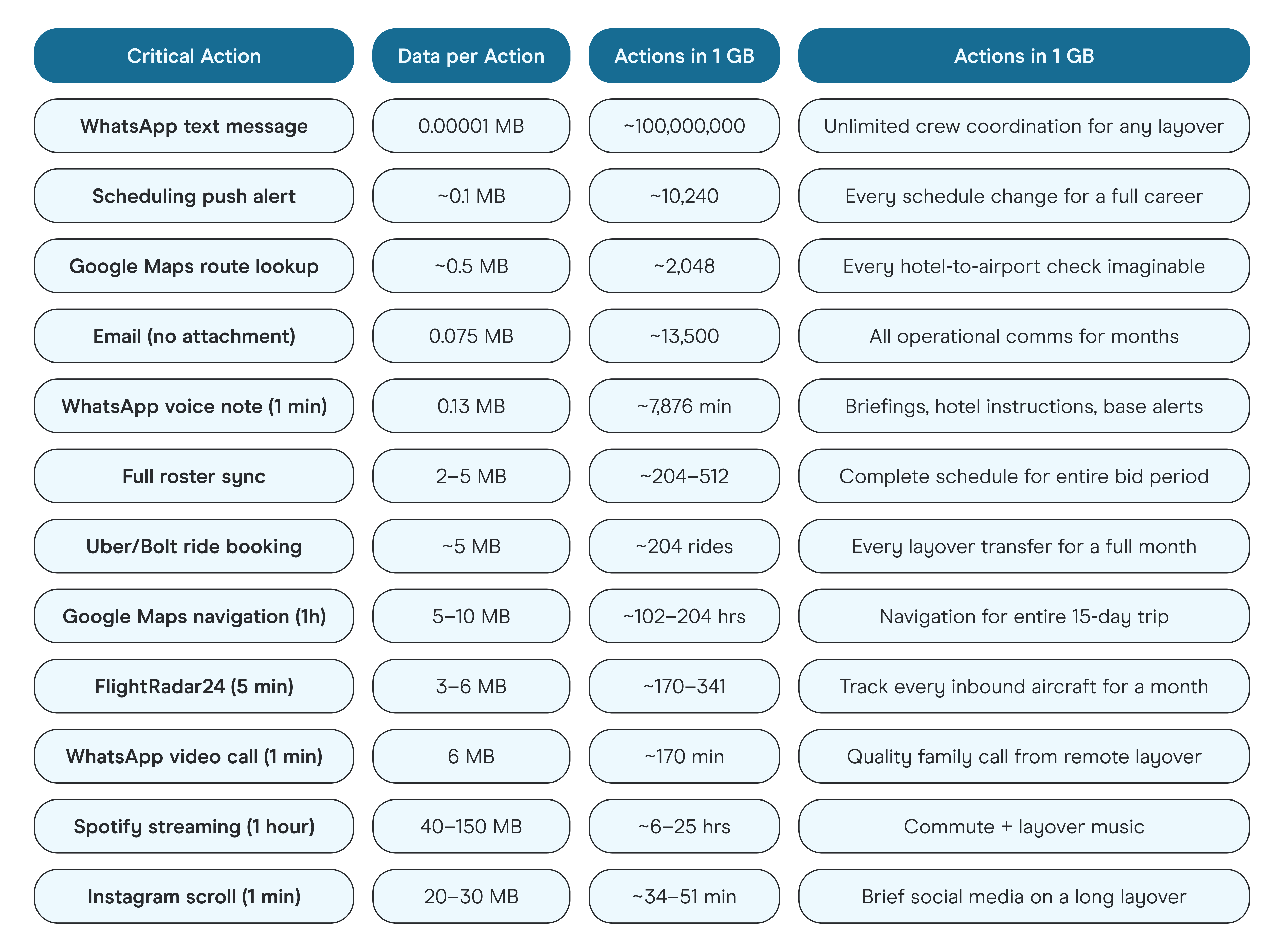
The numbers reveal something surprisingly simple: most operationally important travel moments consume almost no data at all, so the issue is rarely volume, but the availability.
Where a Backup Plan really matters
The report identifies eight recurring moments where a lost connection can create disproportionately large operational and emotional consequences for airline crews constantly moving between airports, hotels, transfers, and unfamiliar cities.
Some happen before dawn, while trying to book a ride back to the airport before sign-on. Others appear during disruption windows, when a missed operational notification can force last-minute crew coordination or delay an entire rotation downstream. Many are much smaller and more human: navigating an unfamiliar terminal after a delayed arrival, staying connected to a WhatsApp crew thread during a layover, or being reachable during a family emergency while operating across multiple time zones.
The eight critical windows to stay connected identified in the report include:
- Pre-departure roster confirmations before sign-on
- 3 AM hotel-to-airport rideshare bookings
- Delay and disruption notifications during standby windows
- Navigation inside unfamiliar international hubs
- Crew-to-crew WhatsApp coordination during layovers
- Monthly roster bidding and schedule swaps
- Currency conversion and utility apps abroad
- Emergency communication with family during long-haul layovers
Individually, most of these moments consume almost no data at all. But they are often the moments where losing connection creates the most stress, uncertainty, and operational disruption during a trip. The full Always On report explores each window in depth, including operational impact estimates, app-level data benchmarks, and real-world airline crew workflows.
Travelers don’t remember gigabytes
The most revealing section of the report focuses on communication during long-haul layovers, where staying online stops functioning as a productivity tool and starts becoming something much more personal. A WhatsApp message or a short FaceTime call consumes almost no meaningful amount of data compared to modern mobile plans, yet those interactions often become psychologically essential after crossing multiple time zones and spending long periods away from home. In those moments, travelers are not really thinking about gigabytes anymore. They are thinking about reassurance.
The same logic increasingly applies far beyond aviation itself. Airline crews simply represent the most extreme version of a much broader shift already happening across modern travel, where a reliable connection has quietly become part of navigation, coordination, safety, logistics, and emotional stability all at once. Losing connection abroad no longer feels like losing internet access for a few minutes. It feels like temporarily losing control over the trip itself.
That may be the biggest insight behind the entire report. The future of staying connected while traveling may have less to do with how much data people consume and far more to do with whether the connection survives the moments where disruption suddenly appears. Because travelers rarely remember how much data they bought for a trip, but they remember very clearly the exact moment their connection stopped working when they needed it most.