



Valentine’s Day has quietly become one of the most telling moments in the global travel calendar. Beyond flowers and dinner reservations, it offers a unique lens into how couples choose destinations, how they value experiences over distance, and how digital habits shape romantic travel.

Using Holafly internal data, combined with a proprietary Romantic Experience Density Index, this article uncovers where love travels, how far couples are willing to go, and what these choices reveal about evolving traveler behavior across global markets.
What emerges is a clear picture: modern romance is mobile, experience-led, and increasingly shaped by the need to stay reliably online throughout the journey.
Valentine’s Day as a travel behavior signal
Unlike peak summer travel or end-of-year holidays, Valentine’s trips are often shorter, more intentional, and emotionally driven. Couples are not optimizing for school calendars or extended vacations. They are optimizing for atmosphere, intimacy, and shared moments.
Holafly’s data highlights how this emotional motivation translates into real travel decisions. Across markets, Valentine’s travelers consistently gravitate toward destinations that combine dense romantic experiences, walkability, and strong urban infrastructure.
This makes Valentine’s Day a powerful moment to analyze how travelers balance emotional value with practical considerations such as digital access and seamless mobility.
Global cities still define the language of romance
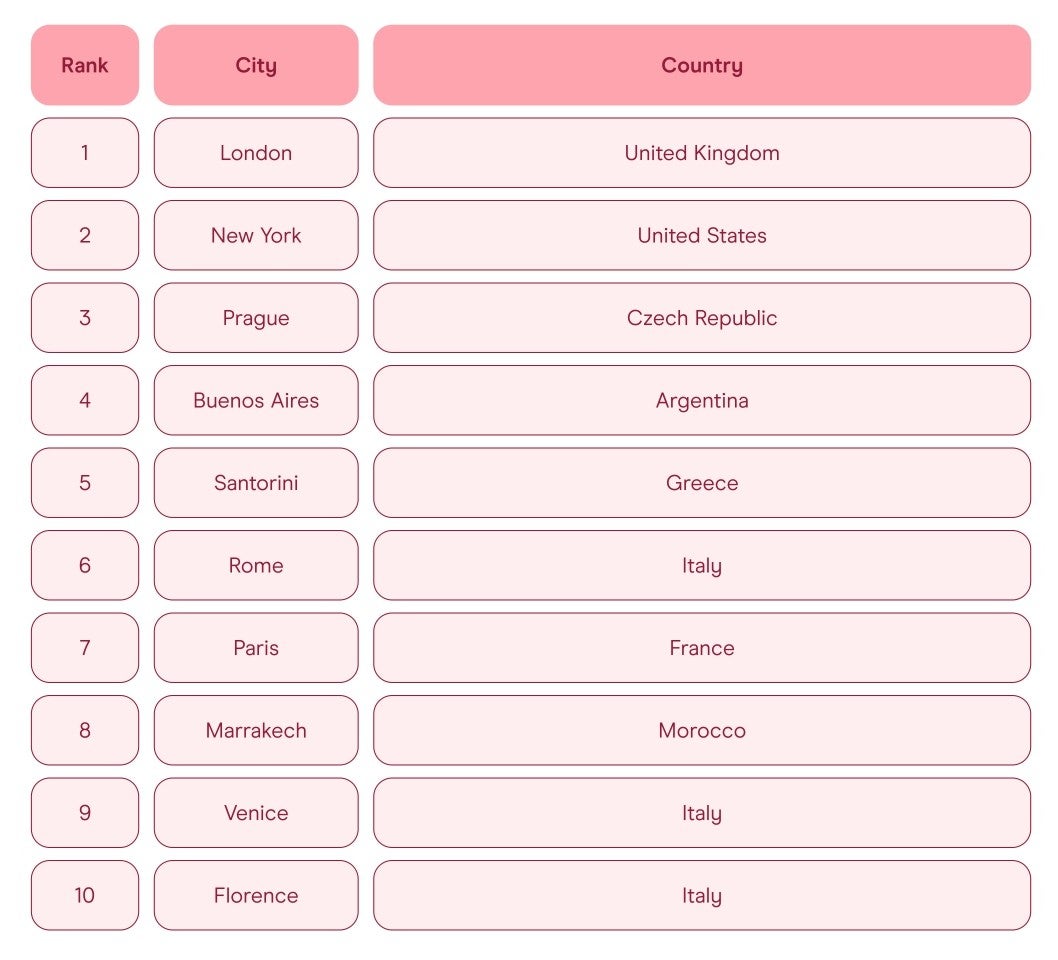
When looking at the world’s most popular Valentine’s destinations, a familiar but revealing pattern appears. Cities continue to dominate global rankings, with London, New York, Prague, Buenos Aires, Santorini, Rome, and Paris leading worldwide.
These cities share a few defining characteristics:
- They offer a high concentration of romantic experiences within compact urban areas.
- They blend cultural symbolism with everyday lived romance.
- They allow couples to move easily between dining, sightseeing, and intimate moments.
Prague’s rise to the top in Europe, for example, reflects how scale matters. A walkable historic center, dense viewpoints, and intimate dining options create a setting where romance feels effortless rather than scheduled.
Meanwhile, cities like New York and London demonstrate that scale does not dilute romance when experiences are layered densely enough. From skyline dining to cultural performances and iconic public spaces, these cities allow couples to curate their own version of Valentine’s Day without friction.
Long-haul romance is alive and well
One of the most striking insights from the data is how willing couples remain to travel long distances for Valentine’s Day, particularly from English-speaking markets.
For UK travelers, the top Valentine’s destinations include New York City, Honolulu, Rio de Janeiro, Montreal, and Quebec City. This mix of North American cities and long-haul escapes suggests that romance justifies distance when the destination promises emotional impact.
Rio de Janeiro’s strong performance among British travelers is especially telling. Its appeal lies not in traditional European romance but in emotional intensity, landscape, and cultural expression. Valentine’s in Rio is not quiet or understated. It is vibrant, sensual, and memorable.
Similarly, Australian travelers show a clear preference for Asia-Pacific destinations, with Bali and Kyoto leading the rankings, followed by New York and Honolulu. Proximity and seasonality play a role, but so does the desire for meaningful, immersive experiences rather than classic postcard romance.

Romance is becoming more experience-dense, not more traditional
The Romantic Experience Density Index used in this report combines two signals: highly rated romantic venues on Google Maps and couple-focused activities on TripAdvisor.
This methodology reveals an important shift. Valentine’s travelers are not simply choosing destinations because of reputation. They are choosing places where multiple romantic moments can happen naturally, often within walking distance.
Cities like Vienna, Stockholm, Budapest, and Seville rank highly in Europe not because they are traditionally associated with Valentine’s Day, but because they offer concentrated, emotionally rich experiences that feel authentic rather than staged.
This suggests that modern romance favors depth over spectacle. A thermal bath at night, a quiet riverside walk, or a neighborhood restaurant with atmosphere can matter more than iconic landmarks alone.
North America blends comfort with emotion
In North America, New York City remains the clear leader, but the broader ranking reveals how romance adapts to different travel styles.
Honolulu combines tropical landscapes with city-level comfort. Montreal and Quebec City offer European charm with North American accessibility. New Orleans delivers mood and cultural intensity over polished luxury.
Even destinations like Las Vegas appear in the top ten, highlighting how modern couples embrace playful, unconventional expressions of romance alongside traditional ones. What unites these destinations is not a single aesthetic, but the ability to support emotional experiences without logistical friction.

What this means for digital-first travelers
Across all markets, one underlying behavior remains consistent. Valentine’s travelers expect to stay digitally enabled throughout their journey.
Sharing moments, navigating cities, booking last-minute experiences, and staying in touch with loved ones are no longer separate from the romantic experience. They are part of it.
Holafly’s data reinforce this reality. As couples travel across borders, they increasingly rely on digital tools to enhance spontaneity rather than plan everything in advance.
In this context, staying connected is not about productivity. It is about peace of mind. It allows romance to unfold naturally without interruptions, stress, or unnecessary trade-offs.