Language

Switzerland Christmas traditions: Food and celebrations
Experience Christmas in Switzerland like a local. Learn about Advent calendars, Samichlaus Day, festive markets, and top regional holiday traditions.

Christmas in Switzerland is a blend of Alpine charm, rich regional customs, and delicious culinary traditions. Switzerland’s traditions may differ across its four language regions, yet several key festive customs are enjoyed nationwide.
This guide covers everything about Swiss Christmas traditions, including regional customs, Christmas food, gift-giving, decorations, and ways travelers can experience Christmas in Switzerland.
Travelers can also consider Holafly eSIM to stay connected in Switzerland with unlimited data, 5G speeds, and 24/7 customer support.

Peace of mind before you fly
Set up your eSIM before travel and get unlimited data on arrival.
TL;DR: How do people celebrate Christmas in Switzerland?
Christmas in Switzerland is a weeks-long celebration blending family gatherings, festive food, and unique regional traditions. Here’s what to know:
- December 1–24 (Advent): Families light Advent candles, open calendars, and enjoy festive village traditions.
- December 6 (Samichlaus Day): Swiss St.Nicholas (called Samichlaus) visits children with his helper, Schmutzli, bringing nuts, mandarins, and chocolate.
- December 24 (Christmas Eve): Families share a special meal, such as Fondue Chinoise, exchange gifts, and may attend church services.
- December 25–26 (Christmas holidays): Families enjoy festive treats, visit relatives, and spend time together.
8 Swiss Christmas traditions
Influenced by its German, French, and Italian-language regions, the country observes a mix of nationwide holiday traditions and distinct local folklore. Celebrations center on the Advent countdown, traditional festive meals, outdoor processions, and gift-giving on Christmas Eve.
While Switzerland shares some traditions with other European countries, such as Finland’s Christmas customs, it also has unique national customs, such as:
- Klausjagen in Küssnacht: A December 5th procession featuring whip-crackers, cowbell ringers, and marchers wearing large illuminated parchment headpieces.
- Fondue Chinoise: A traditional December 24th meal where families cook thin slices of meat in a shared pot of broth with dipping sauces.
- Weihnachtsgüzi (Christmas cookies): Spiced Advent cookies like Mailänderli (lemon butter), Zimtsterne (cinnamon star), and Brunsli (chocolate almond).
- Real candles on the Christmas tree: Fresh pine trees decorated with real wax candles and lit on Christmas Eve.
- Christkind and Père Noël: The angelic Christkind delivers gifts in German-speaking regions, while Père Noël brings them in French-speaking areas.
- Trychlen processions: Late-December marches in the Bernese Oberland where locals shake heavy cowbells to ward off spirits.
Samichlaus and Schmutzli
Samichlaus and Schmutzli are traditional holiday figures in German-speaking Switzerland who arrive on Saint Nicholas Day (Chlaustag).
Unlike the North American Santa Claus, who arrives on Christmas Eve, Samichlaus visits on the evening of December 6th. So, he is not the Swiss name for Santa Claus. He wears a traditional bishop’s robe and red cloak and is accompanied by Schmutzli, a dark-robed helper, who carries a broom of twigs and a sack of treats.
On the evening of December 6th, Samichlaus and Schmutzli visit homes or meet families in nearby forests. Children sing a short poem for them, and Samichlaus hands out bags filled with clementines, peanuts, walnuts, gingerbread, and chocolate.
Advent calendars and Advent windows
Swiss Christmas traditions focus on the Advent season and the countdown to Christmas Eve. This is very similar to Christmas in Denmark, which also centers around the Advent season. This tradition includes:
- Advent calendars: Beginning on December 1st, children and adults open a door each day on Advent calendars, which contain chocolates, small gifts, or pictures, to count down to December 24th.
- Advent wreaths (Adventskranz): Families place an evergreen wreath with four candles in their home. They light one additional candle on each of the four Sundays leading up to Christmas.
- Advent windows (Adventsfenster): In many villages and neighborhoods, 24 local homes or businesses decorate a window in secret. One new window is unveiled each evening from December 1st to 24th, bringing neighbors together outside to socialize over hot drinks and snacks.
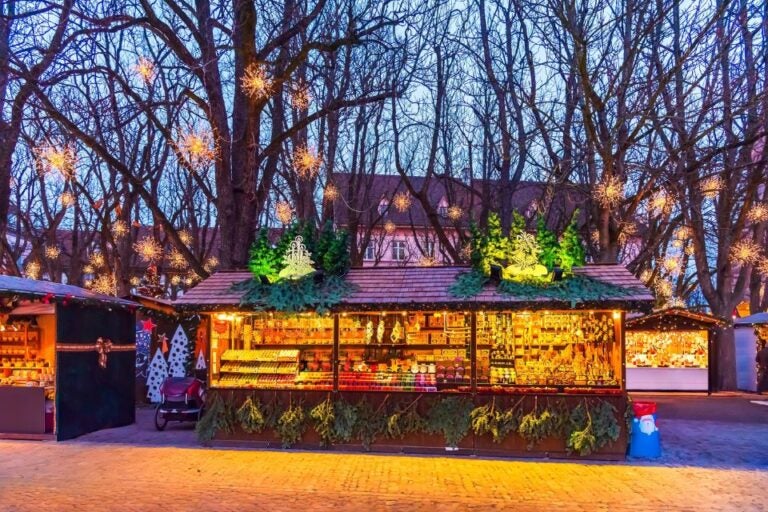
- Christmas markets (Weihnachtsmärkte): Towns host outdoor markets filled with decorated wooden stalls selling handmade crafts, local foods, and hot mulled wine.
Travelers can enjoy the most beautiful Christmas markets at:
- Zurich: As one of the best places to visit in Switzerland, Zurich features Europe’s largest indoor Christmas market inside the main train station (Hauptbahnhof). The market is centered around a massive Christmas tree, complemented by the enchanting “Singing Christmas Tree” on Werdmühleplatz.
- Basel: Widely considered one of the most picturesque markets in Europe, held on Barfüsserplatz and Münsterplatz.
- Montreux: Located along Lake Geneva (Montreux Noël), complete with a floating Santa in a sleigh over the lake.
Christmas Eve and family celebrations
Christmas Eve (Heiligabend) is the main focus of Swiss Christmas celebrations, centered around family, traditional food, and quiet evening festivities.
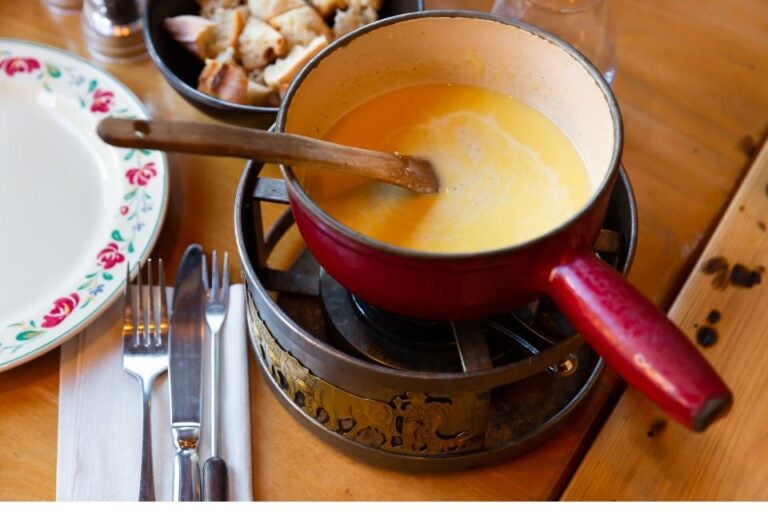
- Family gatherings and meals: Families come together on the evening of December 24th for a festive dinner. The most popular Christmas Eve meal across Switzerland is Fondue Chinoise, where thin slices of meat are cooked at the table in a pot of simmering broth and served with various dipping sauces, French fries, or rice.
- Decorations and trees: Families decorate fresh evergreen trees with glass ornaments, lights, and, in many traditional homes, real wax candles that are carefully lit on Christmas Eve while carols are sung.
- Gift-giving: Gift-giving typically occurs on the evening of December 24th. In German-speaking regions, presents are brought by the angelic Christkind, while in French-speaking regions, Père Noël delivers them. While most Swiss families open gifts on December 24th, some families or regions wait until the morning of December 25th.
- Church services: Many families attend a midnight mass (Mitternachtsmesse) or an early evening church service on Christmas Eve, often followed by hot tea or chocolate together at home.
Swiss Christmas food and sweets
Christmas food traditions in Switzerland center on warm, social dining and sweet holiday treats, though exact menus vary widely by family and region. Here are the popular foods for Christmas in Switzerland:
- Fondue Chinoise: While there is no single national Christmas dish, Fondue Chinoise is the most widely served meal on Christmas Eve. Thin slices of meat, such as beef, pork, chicken, or veal, are dipped into a central pot of simmering broth using long forks. This dish is typically served with various dipping sauces, as well as fries or rice.
- Cheese Fondue: A shared pot of melted Swiss cheese (typically Gruyère and Vacherin) mixed with white wine and garlic, eaten by dipping cubes of crusty bread into it.
- Raclette: Wheels of cheese melted over an open flame or individual tabletop grills, scraped over boiled potatoes, gherkins, and pickled onions.
- Schinken im Brotteig: A whole smoked ham encased in bread dough and baked until golden, often served with potato salad.
- Mailänderli: Traditional butter cookies lightly flavored with lemon zest and brushed with egg yolk for a golden sheen.
- Zimtsterne: Naturally gluten-free star cookies made with ground almonds, cinnamon, and a white egg-white icing layer on top.
- Brunsli: “Basler Brunsli” are chewy chocolate-almond cookies spiced with clove and cinnamon.
- Anisgüzi: Pale, firm aniseed-flavored cookies featuring embossed designs on top, dried overnight before baking to form a crisp base.
- Tirggel: Crisp, thin honey cookies from Zurich stamped with detailed historical or winter scenes.
- Magenbrot: Soft, spiced gingerbread-style cubes coated in a dark chocolate and sugar glaze, commonly sold at Christmas markets across northern Switzerland.
- Birnenbrot: A dense, sweet bread filled with dried pears, nuts, figs, and raisins soaked in spirits or spices. It originates in the Alpine regions of eastern and central Switzerland.
Christmas trees, candles, and decorations
Swiss Christmas decorations center on natural elements, warm lighting, and traditional festive symbols.
- Advent wreaths (Adventskranz): Made from evergreen fir branches, these wreaths feature four candles placed in homes during early December. Families light one candle on each of the four Sundays leading up to Christmas Eve.
- Christmas trees (Weihnachtsbaum): Households decorate fresh fir trees with glass ornaments, wooden figures, tinsel, and strings of warm lights. Trees are traditionally brought into the home and decorated shortly before Christmas Eve.
- Real candles on trees: Lighting real wax candles directly on the tree is one of the main Christmas traditions in Switzerland. While electric string lights are more common today for convenience and safety, some families still maintain the old custom of carefully lighting genuine candles on Christmas Eve.
- Lights and greenery: Homes, balconies, and public streets are decorated with evergreen garlands, window lights, wooden nutcrackers, and illuminated stars throughout December.
Christmas gifts and gift-giving traditions
Christmas gift-giving traditions in Switzerland reflect the country’s diverse language regions and cultural heritage. Presents are typically exchanged on the evening of December 24th (Christmas Eve). However, in some regions, families wait until the morning of December 25th to open the presents.
Customs also vary between households. In some families, children leave the room while adults prepare the presents under the tree, ringing a small bell to announce that the gift-bringer has visited. In others, family members simply exchange gifts directly with one another.
The figure associated with bringing gifts depends on the language region:
- In German-speaking Switzerland, gifts are traditionally brought by the Christkind, a fair-haired, angel-like child figure.
- In French-speaking Switzerland, Père Noël (Father Christmas) delivers presents.
- In Italian-speaking Ticino, traditions are influenced by both Babbo Natale (Santa Claus) and La Befana, who brings treats on Epiphany in January.
Unique regional Christmas traditions in Switzerland
In Switzerland, local communities celebrate unique Christmas traditions that are inspired by old local stories and the region’s history.
- Klausjagen in Küssnacht: Held on Lake Lucerne in Küssnacht on December 5th, hundreds of whip-crackers lead marchers wearing massive, candle-lit parchment headpieces (Iffelen). They are followed through the streets by Samichlaus and over a thousand cowbell ringers.
- Nünichlingler in Ziefen: On December 24th (Christmas Eve) at 9:00 PM, men wearing six-foot-tall black top hats march through dark streets in total silence. They swing heavy livestock bells to create a rhythmic, echoing din.
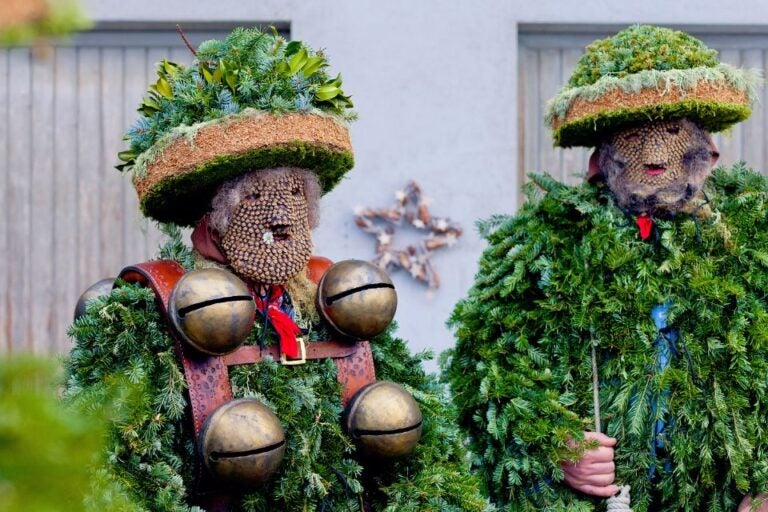
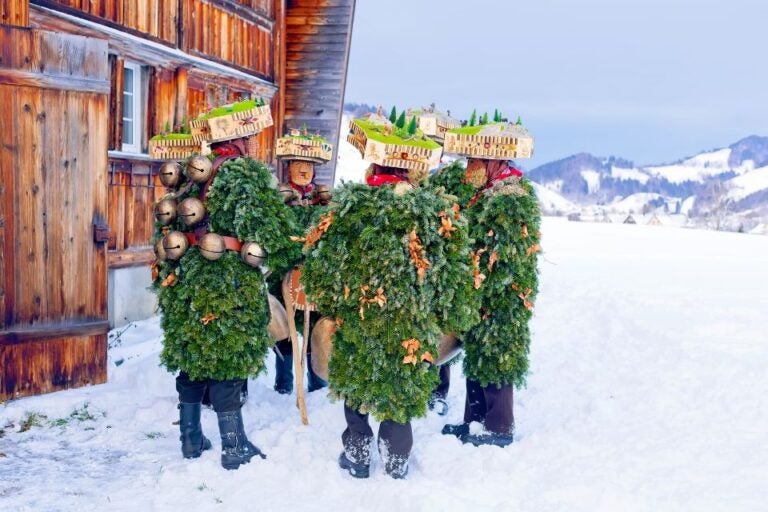
- Silvesterchlausen in Appenzell: On December 31st and January 13th (Old New Year’s Eve), costumed men in elaborate natural or artistic disguises go from farm to farm singing wordless harmonies and ringing heavy bells.
- Trychlen processions and Chlauschlopfen: Throughout Advent and late December, Alpine groups in Central Switzerland and the Bernese Oberland process through villages swinging heavy cowbells (Trychlen) and cracking long whips to chase away winter spirits.
- Appenzeller Chlausenschapp: Instead of a traditional fir tree, households in parts of Appenzell assemble a decorative wooden pyramid frame called a Chlausenschapp. Families decorate it over the four weeks of Advent with gingerbread, apples, and meringue cookies.
- Bell-ringing in Morcote (Ticino): Nine days before Christmas, villagers gather in local church bell towers to manually ring festive melodies on church bells while sharing wine and regional treats.
Christmas traditions for children
Swiss children experience the holiday season through several unique cultural traditions, including:
- Samichlaus visits and verses: On December 6th, children meet Samichlaus and Schmutzli to recite a short poem in exchange for peanuts, clementines, and gingerbread.
- Advent calendars and windows: From December 1st, children open daily calendar doors and attend evening unveilings of decorated village windows.
- Tree decorating: Shortly before Christmas Eve, children help trim the family fir tree with traditional wooden ornaments, glass baubles, and real wax candles.
- Gift-giving: On December 24th, children await the ring of a small bell signaling that Christkind or Père Noël has visited and left presents under the tree.
How to experience Christmas traditions in Switzerland as a traveler
Here are practical tips for travelers to experience Swiss Christmas traditions respectfully:
- Plan around key festival dates: Visit Küssnacht on December 5th for Klausjagen whip-cracking and Iffelen lanterns, or Appenzell on December 31st to see the costumed Silvesterchläuse.
- Join village Advent windows: Check local village notice boards or tourism websites for evening window unveilings, where travelers can gather with locals over hot tea or Glühwein.
- Explore local Christmas markets: Visit markets in Basel, Zurich, or Montreux to sample seasonal treats.
- Taste seasonal dishes: Book a traditional restaurant or Gasthof to try a communal Fondue Chinoise or classic cheese fonduAppenzell e.
- Respect local etiquette: Observe quiet hours (Nachtruhe), keep a respectful distance during traditional singing circles (Zäuerli), and follow local guidelines during night processions.
Stay connected while experiencing Christmas in Switzerland
Christmas in Switzerland spans several weeks and varies widely across different language regions. A reliable internet connection is essential for your journey. It allows you to check online maps, book rideshares, share photos on social media, and stay connected as you explore.
Holafly Switzerland eSIM is a convenient option for travelers, offering unlimited data, 5G speeds where available, and 24/7 customer support.
Additionally, the Always On feature provides 1GB of backup data, ensuring you remain connected even after your eSIM plan has ended. It’s available for up to one month as long as the eSIM remains installed.

Connect to the fastest networks
International eSIMs, local networks. Enjoy the best of both worlds with Holafly.
Plans that may interest you


Formerly a travel journalist turned marketing copywriter, I found my way back to the travel world with Holafly—my dream company that made remote work possible. My motto? “Dream big and make it happen.” I’m passionate about writing, exploring the world, and staying active through walking, running, swimming, and hiking. I also love learning, reflecting, and connecting with inspiring minds.