Language
Traveling in Asia? Here are 8 laws you’re probably breaking without realizing it: know these rules before your trip
Don't let an unfamiliar law ruin your trip. Discover 8 rules tourists commonly break when traveling in Asia, and how to stay on the right side of them.

Travelers adore Asia for its laid-back pace, peaceful culture, and sense of freedom. But that doesn’t mean Asia is somewhere you can get away with doing what you like.
Many everyday habits that feel normal back home can carry severe consequences in certain Asian countries. And breaking the law in Asia can result in more than a slap on the wrist and a small tourist fine. Sometimes, it can turn your freeing adventure into a shackling nightmare.
So to help you stay out of unexpected trouble, here are eight real laws across Asia you need to know about, including what they can cost you and how to avoid them.
| Country | Law you might not know | What it can cost you |
|---|---|---|
| Thailand | Vapes are fully illegal to carry or use | Fines up to ~30,000 THB, confiscation, possible detention |
| Vietnam | Zero-tolerance drink driving, even one beer | Scooter seized, fines into the millions of VND |
| Indonesia (Bali) | Pre-paid tourist levy, no climbing sacred sites | Deportation risk for sacred-site stunts |
| Singapore | Gum isn’t banned to chew, but durian on the MRT and unflushed toilets are offences | On-the-spot fines for public-conduct breaches |
| Sri Lanka | Buddha tattoos and back-to-Buddha selfies | Arrest and deportation |
| Cambodia | Covered shoulders and knees at Angkor | Turned away until you change |
| Maldives | Alcohol, pork, non-Islamic items, vapes banned at the border | Confiscated at customs |
| Malaysia | Insulting royalty or religion, including online | Arrest under the Sedition Act, up to 3 years |
1. Thailand: That vape in your pocket is illegal
Vaping may be legal in many parts of the world, but it’s not in Thailand. It is against the law to bring a vape or e-cigarette into the country, to use it, or even to be in possession of it.
There is no tourist exemption, and enforcement is active at airports and in tourist zones. The punishment goes beyond confiscation, too. You’ll likely get a large fine, and prison sentences are possible in certain situations.
Therefore, it’s not worth the risk. Leave the device at home, and add nicotine gum or patches to your Thailand packing list instead, as these are fully legal alternatives.
2. Vietnam: One beer before the scooter is one too many
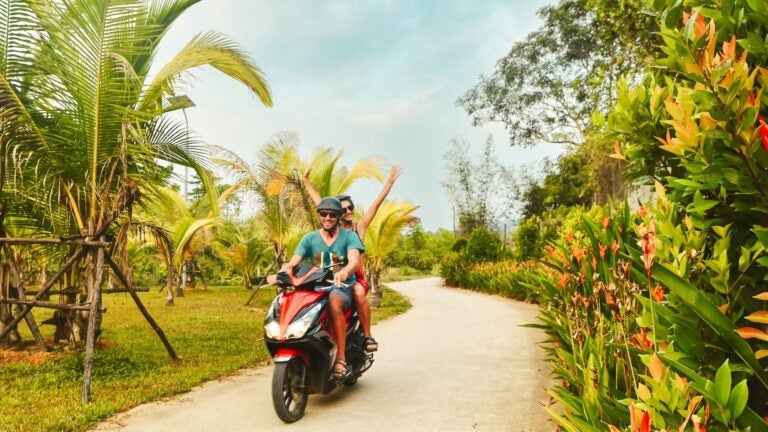
Exploring the rice paddies and vibrant cities by scooter is one of the most exciting things to do in Vietnam. But what most travelers don’t realize is that Vietnam has a zero-tolerance drink-driving law.
This means if you have a beer with your dinner and then drive home, you are breaking the law. If the police pull you over, you’ll be fined (from VND 2 million / $75 to VND 10 million / $380), and your scooter will be seized.
This catches many tourists off guard, as they assume the law is the same as in their home country. Or they think they won’t get caught because they’re just driving “around the corner.”
3. Bali: Pay the levy, and never climb the sacred stuff
In 2024, Bali introduced a small mandatory tourist tax of IDR 150,000 ($10) per person. You can pay this levy online before you enter or at the airport upon arrival.
Payment is currently not being enforced. If you skip paying the small fee, you won’t get arrested or fined. However, as the tax goes directly towards maintaining Bali’s culture and natural environment for tourists, paying the levy is always the right and most respectful thing to do.
You should also be aware of Bali’s sacred-site rules. Visiting the temples is among the most popular things to do in Bali, but you must treat these holy places as places of worship, not as Instagram backdrops.
Along with wearing a sarong and sash while visiting the sights, there is a firm ban on climbing or sitting atop sacred structures or holy mountains. Breaking this law can lead to heavy fines and even deportation.
4. Singapore: Forget the gum myth, these are the rules that actually catch tourists
You may have heard that chewing gum is banned in Singapore, and it is, to a certain degree.
Selling or exporting gum is illegal, so you won’t be able to buy it there. While it’s listed as a prohibited item on the ICA website, in reality, taking a pack or two with you in your luggage won’t get you in any trouble, as it’s for personal use, not commercial importation.
Moreover, it’s not illegal to chew gum in Singapore, as long as you dispose of it in a trash can. You could get fined for throwing it on the street, but not for chewing it.
But there are some more serious rules that most tourists don’t know about. For example, durian is strictly banned on the MRT and other Singapore public transport because of its overpowering, lingering smell.
And the most unexpected rule? Not flushing a public toilet is a finable offense. If you don’t flush, you could face a fine starting from SGD 150 ($120).
5. Sri Lanka: Mind your tattoos and your selfie angle
While having a Buddha tattoo isn’t explicitly illegal in Sri Lanka, displaying it in public can get you in a lot of trouble. Buddha tattoos are seen as highly disrespectful, so they should be covered at all times. There have been cases where tourists with visible Buddha tattoos have been arrested and deported.
Posing for a photo or selfie with your back to a Buddha statue is also seen as a cultural insult. So, out of respect for the country’s religion, always stand beside or face it when snapping photos during temple visits in Sri Lanka.
6. Cambodia: Dress for the temple, not the pool, at Angkor

Angkor Wat, Cambodia’s most famous tourist attraction, has a strict dress code. You must cover your shoulders and knees to enter. If you wear a sleeveless top, shorts, or a dress above the knees, you’ll be turned away, even if you already have tickets.
That’s why lightweight long trousers like linen, and t-shirts that fully cover the shoulders are essential for your Southeast Asia packing list.
7. Maldives: What customs will quietly take off you
As an Islamic country, the Maldives has several restricted items that you cannot bring into the country, including:
- Alcohol (even duty-free)
- Pork products
- Non-Islamic religious items
- Vapes
Customs will inspect your luggage at the airport, and if they find any restricted items, they won’t fine you, but they will confiscate them. They’ll hold your items and give you a claim receipt to collect on departure.
While you can’t have alcohol on your Maldives packing list, it’s legal to buy and drink alcohol in the Maldives, but only in resorts and tourist areas.
8. Malaysia: Watch what you say, and what you post
In Malaysia, insulting the country’s monarchy or religion is an offense under the Sedition Act. This applies to social media posts as well as in-person remarks. This law is strictly enforced, and even a casual joke can get you arrested, resulting in a fine or even a prison sentence of up to 3 years.
Public decency and modesty are also taken seriously in Malaysia. While you can wear normal Western-style dresses and shorts in the major cities and beach resorts, it’s best to dress more conservatively in local areas.
How to stay out of trouble anywhere in Asia
The easiest way to avoid these common travel mistakes is to check the rules and restricted items of the country you’re visiting. Things like vaping, alcohol, dress codes, and photography are what catch tourists out the most.
Also, don’t assume neighboring countries will have similar laws. Just as US laws vary between states, rules can differ sharply across Asia because of varying religions and cultures. A quick Google search before you fly will help you stay a respectful guest and avoid unexpected fines that could ruin your trip.
Stay on the right side of the law, and online, across Asia
Local rules move fast, and the last thing you want is to be hunting for Wi-Fi to check whether your vape is legal or how much a temple entry fee really is. A Holafly eSIM keeps you connected the moment you land, with unlimited data, 5G speeds, and 24/7 customer support. No physical SIM to swap, no roaming bills to dread.
Hopping between several countries on one trip? Holafly Plans gives you pay-monthly coverage across 160+ destinations with a single eSIM, so you stay online from Bangkok to the Maldives without changing a thing.
Every Holafly eSIM also comes with Always On: 1 GB of backup data at no additional cost that switches on automatically as long as the eSIM stays installed, renews every month, and works in 150+ destinations. If your main data runs low at the worst possible moment, when you need to check a local rule or message your hotel, it quietly has your back.

Unlimited data. Peace of mind.
Make sure you have travel data that's there when you need it most.
Plans that may interest you

Hi, I'm Mika, a South Korean writer living in the US. I cover travel and live events, focusing on the practical stuff that makes your trip smoother, whether you're navigating a new city or heading to a major international event.I'm also the founder of Search SEOul, South Korea's leading SEO conference, bringing together search marketing experts and speakers from around the world.