Language

Best time to see the northern lights in Norway
The best time to see northern lights in Norway is from September to March. Find the best months, locations, and viewing tips.
The best time to see the northern lights in Norway is from September to March, with September–October and March standing out for strong aurora activity and sufficiently dark skies. If you want one practical window to aim for, March offers a strong balance of darkness, aurora activity, and more usable daylight for sightseeing.
In Arctic Norway, timing is only part of the equation. Where you stay, cloud cover, solar activity, and how many nights you allow can all affect your chances of seeing the aurora borealis in Norway. This guide covers everything you need to know about when and where to see the northern lights in Norway, plus the conditions and practical tips that can improve your chances.

An eSIM you can rely on
Join over 10 million Holafly customers and get connected with our trusted, global services.
When is the best time to see the northern lights in Norway?
The best time to see the northern lights in Norway is generally between September and March, although the viewing season can stretch from late August into early April in places like Tromsø. For the best odds, plan several nights in Northern Norway rather than relying on a single evening.
| Factor | Best option |
|---|---|
| Main aurora season | September to March |
| Wider Tromsø season | Late August to early April |
| Best months for activity | September–October and March–April |
| Best all-round month | March |
| Best time of night | Around 11 PM–2 AM |
| Best places | Tromsø, Alta, Lofoten, Senja, Kirkenes |
Northern lights season in Norway
The main northern lights season in Norway runs from September to late March, when Northern Norway has enough darkness for the aurora to become visible. Visit Tromsø uses a slightly broader local season of late August to early April, provided the sky is dark and clear.
The aurora occurs year-round, but you need darkness to see it. This makes autumn, winter, and early spring the useful travel window above the Arctic Circle.
Midwinter brings exceptionally long nights. Around Tromsø and Alta, the polar night lasts from roughly late November to mid-January, when the sun does not rise above the horizon.
Best months to go
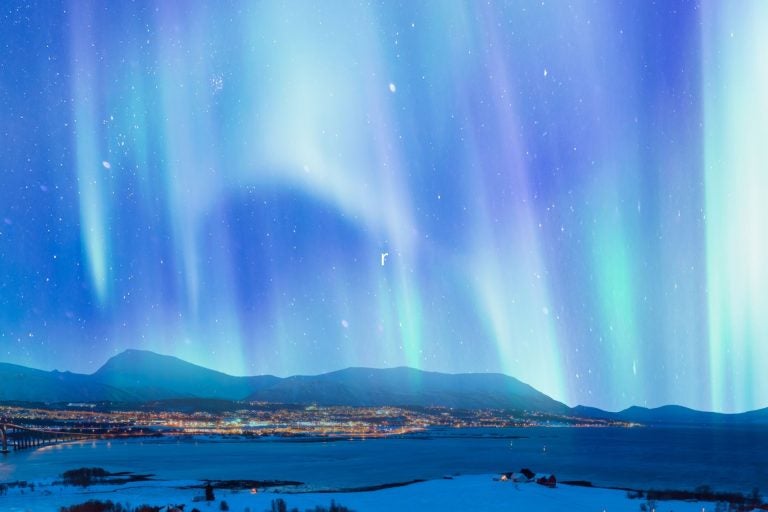
If you are choosing the best month to see the northern lights in Norway, there is no single month that guarantees a sighting. However, VisitNorway.com notes statistically higher aurora activity around the spring and autumn equinox periods, particularly September–October and March–April.
Here is how the main periods compare:
- September–October: Dark nights return, temperatures are generally milder than in midwinter, and autumn is statistically associated with strong aurora activity.
- November–January: These months provide the longest hours of darkness. They are useful if your itinerary also includes snow-based Arctic activities, although winter weather can bring cloud cover.
- February–March: You still get long, dark evenings while gaining more daylight for daytime activities. March is particularly useful if you want a balanced winter itinerary.
- Early April: Aurora viewing may still be possible in far northern areas such as Tromsø, but nights become shorter quickly.
For most first-time visitors, March is one of the strongest all-round choices. You still have dark nights, while longer daylight hours make it easier to combine aurora hunting with fjord trips, dog sledding, or other Arctic activities.
Best time of night
The northern lights can appear at almost any time once the sky is dark enough. Visit Tromsø says displays are often most active between around 8 PM and 2 AM, while Visit Norway identifies roughly 11 PM to 2 AM as a common peak period.
But don’t treat those hours as a fixed schedule. An aurora can appear earlier, later, or only briefly, so staying outside for several hours gives you a better chance than heading out for a short viewing window.
Can you see the northern lights in Norway all year?
No. Although aurora activity happens throughout the year, you generally cannot see the northern lights in Arctic Norway during summer because the sky does not get dark enough.
Above the Arctic Circle, the midnight sun keeps the sky bright for much of late spring and summer. In Tromsø, this near-continuous daylight is part of the summer experience and even sets the scene for events such as the Midnight Sun Marathon. As a result, the practical northern lights viewing season runs from late August to early April, when darker nights return.
Where are the best places to see the northern lights in Norway?
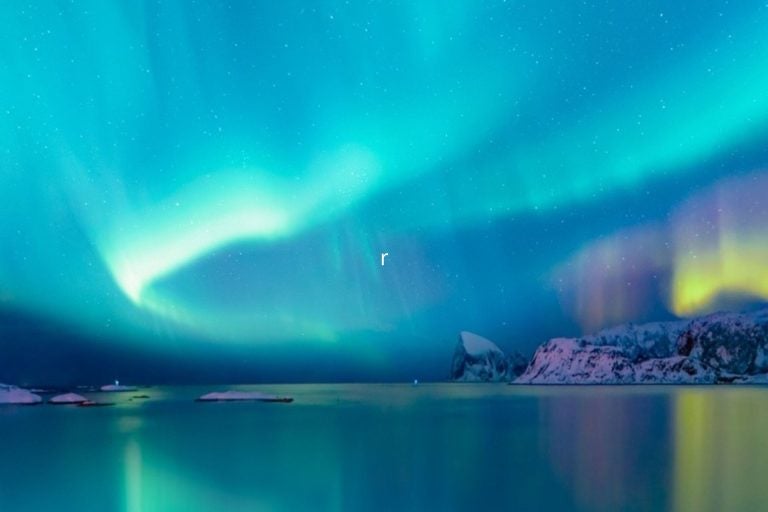
The best place to see the northern lights in Norway is usually somewhere in the north with dark skies, frequent access to the auroral oval, and enough transport flexibility to move away from cloud or city lights. Tromsø is the easiest base for many visitors, while Alta, Lofoten, Senja, and Kirkenes offer different trade-offs.
| Destination | Why choose it | What to consider |
|---|---|---|
| Tromsø | Easy flight access, wide choice of aurora tours, and sits beneath the auroral oval | More urban light and high visitor numbers |
| Alta | Far north, long winter darkness, and easy access to open landscapes outside town | Fewer big-city amenities than Tromsø |
| Lofoten Islands | Dramatic mountains, beaches, and fjords make strong photography locations | Coastal weather can change quickly |
| Senja | Dark landscapes and fewer urban areas, with mountain and coastal scenery | A car or organized tour is useful |
| Kirkenes | Long winter nights and remote Arctic surroundings | More isolated and generally requires more planning |
For a first aurora trip, northern lights in Tromsø is one of the easiest bases to plan around because you can stay in a well-connected city, join tours that drive away from local cloud and light pollution, and it lies directly beneath the northern lights oval.
Note that if you plan to chase clearer skies independently, it’s worth understanding the practicalities of driving in Norway, especially in winter conditions and remote northern areas.
Lofoten is particularly appealing if photography and scenery are priorities. Its aurora season is roughly September to March, with mountain, fjord, and coastal landscapes throughout the islands.
If your aurora trip also includes Sweden, Finland, or Denmark, a Scandinavia eSIM or Europe eSIM can be more practical for a multi-country Nordic itinerary than setting up separate plans in each destination.
What conditions do you need to see the northern lights in Norway?
Seeing the aurora in Norway requires more than choosing the right month. Darkness, auroral activity, and clear skies all need to line up, which is why conditions can vary significantly from one night to the next.
The main factors are:
- Darkness: Head out after nightfall and move away from strong street lighting where possible.
- Clear skies: Aurora activity takes place above the clouds, so heavy cloud can completely block your view even during a strong display.
- Solar and geomagnetic activity: The KP index measures global geomagnetic activity on a scale from 0 to 9. Higher values generally indicate stronger geomagnetic disturbance, but a high KP number is not essential for seeing the aurora in far northern Norway, which sits close to the auroral oval.
- Moonlight: A bright moon does not prevent the northern lights from appearing, but darker skies can make weak displays easier to see.
- Time: Allowing three or more nights gives you more opportunities for clear skies and aurora activity to coincide.
For forecasts, check both weather and aurora conditions. NOAA’s Space Weather Prediction Center provides geomagnetic and aurora forecasts, while Visit Norway recommends its NorwayLights forecast tool for local planning.
Tips for seeing the northern lights in Norway
The best way to improve your odds is to stay flexible. Conditions can change quickly in Northern Norway, so plan enough time to move locations, wait for clouds to clear, or try the following night again.
- Stay for several nights: Three to five nights gives you much more flexibility than a one-night stop.
- Check cloud forecasts first: A moderate aurora forecast under clear skies may be more useful than strong activity hidden behind cloud.
- Get away from artificial light: Even a short drive outside Tromsø, Alta, or another town can significantly darken the sky.
- Dress for waiting, not walking: Wear thermal base layers, an insulated mid-layer, a windproof outer layer, winter boots, gloves, and a warm hat. You may spend long periods standing still.
- Use reliable forecasts: Compare local weather with aurora forecasts rather than relying on the KP number alone.
- Prepare your camera before going outside: Use a tripod, start with a wide aperture and high ISO, and experiment with exposures of a few seconds. Brighter auroras usually need shorter exposures than faint ones.
- Keep your phone charged and warm: Cold temperatures drain batteries faster, so carry a power bank inside an inner pocket.
- Stay connected: If you’re starting or ending your trip in the capital, an eSIM for Oslo or eSIM for Norway can keep you connected for airport transfers, bookings, and onward travel before heading north.
Stay connected in Norway with Holafly
Chasing clear skies means checking aurora and weather forecasts from the road, not from your hotel Wi-Fi. Install a Holafly eSIM for Norway before you leave and connect the moment you land, with unlimited data, speeds up to 5G, and 24/7 customer support.
When your trip ends, keep the eSIM on your phone. Holafly eSIMs are reusable, so next time you only need to add a new plan. Until then, Always On: 1 GB of monthly backup data keeps you connected at no extra cost, which helps if a delayed flight changes your plans.
Traveling for longer, or heading north more than once a season? Holafly Plans gives you monthly global data, and Holafly Ultra adds extra travel perks on top of unlimited data in one plan.

Get an unlimited data eSIM
Use code MYESIMNOW5 for 5% off at checkout
Plans that may interest you


哈囉我是來自台灣的 Wen,平常最喜歡旅遊,也喜歡將旅遊的種種化成文字跟大家分享,希望大家能在我的文章中找到有用的資訊,加上 Holafly 的 eSIM,讓你的旅程更美好!✈️✈️✈️ Hi! I'm Wen, a passionate content writer and travel enthusiast from Taiwan. I transform my wanderlust adventures into engaging stories and practical guides, helping fellow travelers make the most of their journeys.Through my articles, I strive to provide travel tips while introducing how our eSIM technology can enhance your travel experience - keeping you connected wherever your adventures take you!