Language
You won’t see the total eclipse from Madrid or Barcelona, so head here instead
Planning to watch the 2026 eclipse in Spain? Madrid and Barcelona only get a partial eclipse. Here's where to head for the full experience.

You’ve got a trip booked to Spain, have just heard about the eclipse happening next month, and are chuffed your summer trip aligns with such a monumental event.
The problem is, if you’re in Madrid or Barcelona, you won’t see what you’re expecting to see.
Both major cities won’t experience a total eclipse on August 12th, but a partial eclipse, and that changes the whole experience.
Read on to learn why a 99.9% solar eclipse coverage isn’t enough, and where to go to get 100% totality.
99% covered sounds close enough, but it isn’t
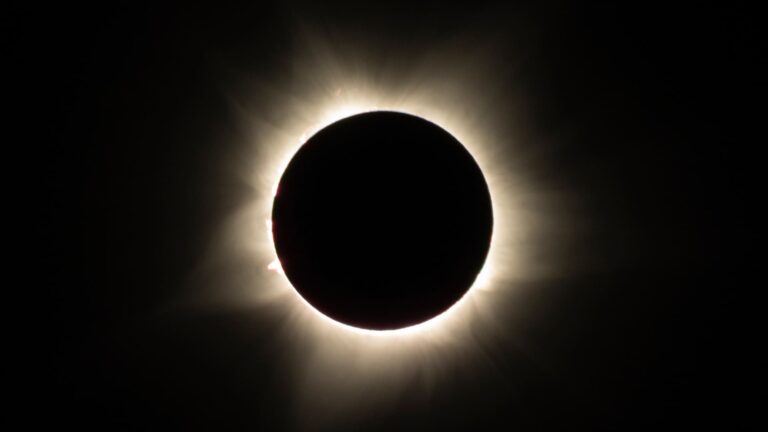
You might assume a 99.9% eclipse is the same as a 100% total eclipse, but it’s not at all. That 0.01% is the difference between light and day, quite literally.
The exposed sunlight of that final 0.01% is still overwhelmingly bright, resulting in a slightly dimmed sky (similar to a stormy day) rather than near-complete darkness.
The dramatic “day turns to night” experience happens only within the path of totality. During a total eclipse, stars and planets also become visible, and the sun’s corona (the glowing outer atmosphere that’s normally hidden by its intense brightness) appears around the darkened Moon.
According to Instituto Geográfico Nacional:
- Madrid will have 99.98% coverage
- Barcelona will have 99.81% coverage
Therefore, both major cities will have a partial eclipse. This is because the eclipse path passes between Madrid and Barcelona, rather than directly over them. So if you want to experience a total eclipse as part of your Spain itinerary, you’ll need to head somewhere else.
Where the path of totality actually falls in Spain
What’s notable about the 2026 eclipse is that the path of totality is exceptionally wide. While usually 150 to 190 kilometers, the 2026 total solar eclipse path spans about 290 kilometers.
It enters from the Atlantic coast near Galicia, then sweeps over south-east Spain across Asturias, Cantabria, the Basque Country, Burgos, La Rioja and Aragón. It then exits over the Mediterranean near Valencia and the Balearics.
The center line runs close to the Asturias coast and the Castellón coast, so the duration of the eclipse will be the longest in these regions.
With this in mind, here’s where you can go to experience a 100% total eclipse for at least a minute. Many of them are close to the capital, requiring no more than a day trip from Madrid.
| Where to watch | Totality (approx.) | Getting there |
|---|---|---|
| Gijón, Asturias | 1 min 46 sec | Flight or train to Oviedo, then a short hop |
| Burgos, Castilla y León | 1 min 44 sec | Under 2 hours by train from Madrid |
| Peñíscola, Castellón | 1 min 39 sec | 2 hours by train from Barcelona or Valencia |
| Zaragoza, Aragón | 1 min 24 sec | 90 min by AVE from Madrid or Barcelona |
| Valencia city | About 1 min | 2 hours by AVE from Madrid |
The sunset problem nobody warns you about
Finding yourself inside the path of totality is only half the challenge. The other is making sure you can actually see the eclipse.
In Spain, the eclipse will occur just before sunset, between 7:30 pm and 8:30 pm, depending on the region. The sun will be very low in the sky in a west-northwest direction. This means relatively small obstacles could obstruct your view of the eclipse, such as a row of buildings or tall trees in that direction.
Because of this, the best eclipse viewpoint will be an elevated location like a hilltop or clifftop, or wide open countryside, rather than a city plaza or your hotel balcony.
If you’re hoping to watch from the coast, it’s crucial to choose a beach that faces west rather than east.
Some beaches along the Asturias coastline face Northwest, providing good views if you position yourself carefully. But Spain’s eastern coast is more challenging. Although popular European summer destinations, Peñíscola and Alcossebre’s beaches face east, so if you’re in this area, seek out viewpoints on higher ground.
Another effect of the sunset-timed eclipse is that the temperature will drop by several degrees. The sudden loss of sunlight will cause temperatures to fall to 10–12°C in many locations. So bring a warm layer.
How to get from your city into the path
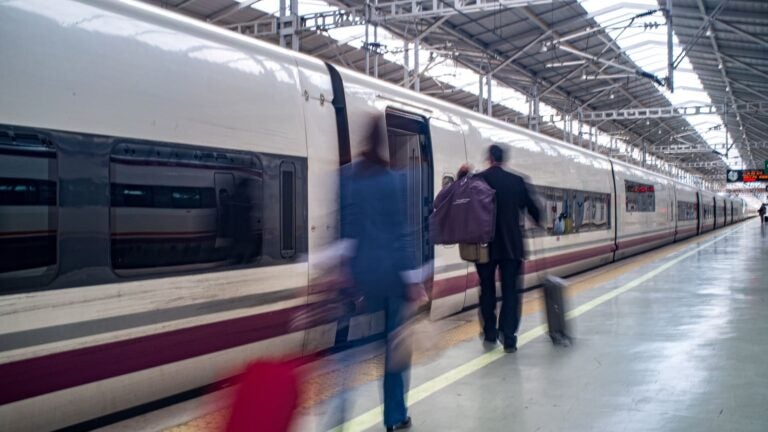
Spain has some of the best train travel in Europe. The AVE high-speed train will bring you from Madrid to many of the cities and towns under the eclipse path in less than 2 hours. Similarly, from Barcelona, you can reach several towns on the east coast, such as Peñíscola and Zaragoza, in under 2 hours.
Driving is also an option. However, as many people will be traveling on August 12th to see the eclipse, the roads will be busy, increasing journey times.
Whether you choose to drive or take the train, give yourself plenty of travel time and aim to arrive a few hours early. The eclipse window is less than two minutes, so there is no leeway for being late.
And while you’re focusing on how to get there, don’t forget to plan your return journey. Returning to Madrid or Barcelona the same evening might be possible if the journey time is less than a few hours. But check the train schedule to see what time the last train is.
What is still bookable with just over a week to go
Hotels in many towns and cities along the eclipse path will likely already be full. So the most realistic way to see the total eclipse is to take a day trip from where you’re already staying.
If a day trip is not possible, look for available accommodation in small inland towns rather than coastal towns.
Since the eclipse path is 290 km wide, approximately 40% of Spain will see a total eclipse, so there are plenty of options outside the popular cities. You can check the coverage of a specific town on the Instituto Geográfico Nacional eclipse viewer.
Also bear in mind that weather conditions (clouds in particular) can affect eclipse coverage. Check the cloud forecast in the final 48 hours and have a plan B in mind.
Finally, if you do miss this year’s total eclipse, you won’t have to wait long until the next one.
Southern Spain is getting another total eclipse on August 2, 2027. Next year, popular August travel hotspots like Cádiz, Málaga, and the southern parts of Granada and Almería will enjoy the total eclipse.
Stay connected wherever the clouds send you with Holafly
Eclipse day plans change fast. A cloud bank over your chosen spot at 7pm can mean an hour on the road to somewhere clearer, and that call depends on live forecasts, maps and group chats.
A eSIM for Spain from Holafly keeps you online for all of it. Install it before you fly, activate it when you land, and travel with unlimited data, 5G speeds and 24/7 customer support. No physical SIM, no roaming charges, no queue at an airport kiosk.
What’s more, every Holafly eSIM includes 1 GB of Always On backup data at no additional cost. It activates as soon as the eSIM is installed on your device, renews every month, and works across 150+ destinations. So if your main plan is running low while you are parked on a hillside, refreshing the satellite view, you still have what you need to check the map and find your way back.

Unlimited data. Peace of mind.
Make sure you have travel data that's there when you need it most.
Plans that may interest you


Hi, I'm Mika, a South Korean writer living in the US. I cover travel and live events, focusing on the practical stuff that makes your trip smoother, whether you're navigating a new city or heading to a major international event.I'm also the founder of Search SEOul, South Korea's leading SEO conference, bringing together search marketing experts and speakers from around the world.