



 Language
How to get around Kyoto in 2026: Buses, trains, JR pass, and more
Learn how to get around Kyoto by bus, subway, train, taxi, bike, or IC card, plus when to use the JR Pass and how to avoid crowded routes.
Getting around Kyoto is straightforward once you know how the system fits together. The city has an excellent public transport network, but first-timers often get tripped up deciding between buses, the subway, the JR Pass, and IC cards.
This guide breaks down every option clearly so you can plan before you land.

An eSIM you can rely on
Join over 10 million Holafly customers and get connected with our trusted, global services.
Kyoto’s transportation at a glance
Kyoto’s network covers every major tourist area. Here’s a quick snapshot of what’s available and when each option makes sense.
| Transport mode | Best for | Typical fare | Accepts IC card |
|---|---|---|---|
| City bus | Temples, Gion, Fushimi Inari | ¥230 flat fare | Yes |
| Subway | Fast cross-city travel | From ¥220 | Yes |
| JR trains | Arashiyama, Uji, day trips | From ¥150 | Yes |
| Private trains | Gion, Uji, Arashiyama | From ¥170 | Yes (most lines) |
| Taxi | Groups, late nights, luggage | From ¥500 | Yes (most) |
| Bicycle | Temple districts, riverside | ¥1,000–¥2,000/day | — |
| Walking | Higashiyama, Gion, Arashiyama | Free | — |
Ways to get around Kyoto
Kyoto has a well-connected network of buses, trains, and subway lines that reach every major sight — all covered in detail in the Japan travel guide. For shorter distances or scenic areas like Higashiyama, cycling and walking are often the better choice.

Bus
The city bus is the most widely used transport option for visitors and covers virtually every major attraction: Kinkakuji, Kiyomizudera, Gion, and Fushimi Inari are all reachable by bus. The flat fare is ¥230 per ride regardless of distance, paid by IC card tap or exact coins.
Board from the rear door and pay at the front upon exiting. Routes 100 and 101 are the most useful tourist circuits, running from Kyoto Station through the main temple and shrine districts. Route 205 loops around the city’s main sights, including Kinkakuji. During major events like the Gion Matsuri festival in July, expect buses in the central areas to be significantly busier than usual.
If you’re planning a full day of sightseeing across multiple areas, the Subway and Bus 1-Day Pass (¥1,100 adult / ¥550 child) covers unlimited rides on all subway lines, all Kyoto City Bus routes, Kyoto Bus (most routes), Keihan Bus (Yamashina and Daigo areas), and West Japan JR Bus (select lines).
The 1-Day pass is valid for one calendar day from activation, not 24 hours, and also includes discounts at select museums and shops. Pick it up at any subway station, Kyoto City Bus Management Center, most Kyoto City buses, or select convenience stores.
One important note: during cherry blossom season (late March to early April) and autumn foliage season (mid-November), buses in the Higashiyama area can be extremely crowded and slow. In those periods, taking the subway or walking is a better option.
Subway
Kyoto’s subway has two lines and is significantly faster than buses for cross-city travel, especially when tourist traffic clogs the roads.
Karasuma Line (green): Runs north to south through the city, connecting Kyoto Station to Shijo (Gion area) and Kitaoji (Golden Pavilion bus stop).
Tozai Line (red): Runs east to west, with stops at Higashiyama (Nanzenji area) and Nijo Castle.
The two lines connect at Karasuma-Oike Station, which is the main transfer hub. Fares start at ¥220 and increase with distance. All station signage and announcements are in English, and ticket machines have English menus.
A ¥800 subway one-day pass covers both lines for the day. A combined bus and subway one-day pass (¥1,100) is worth considering if your itinerary spans multiple areas.
Taxi
Taxis in Kyoto are plentiful and easy to flag down near major stations and sightseeing areas. The base fare starts at around ¥500 for the first kilometres. Some taxis accept IC card payment, though it’s worth checking before you get in.
Taxis are a practical option for groups of three or four, late-night journeys, or reaching spots that aren’t well served by public transport. For example, travelling between Arashiyama and Kinkakuji. For solo travellers, they’re rarely the most economical choice.
For solo travellers, they’re rarely the most economical choice, and if you’re keeping an eye on the cost of traveling to Japan, they’re best reserved for when other options aren’t practical.
Note that central Kyoto streets can be extremely congested during peak tourist seasons. In areas like Gion or around Nishiki Market, a short taxi ride can take significantly longer than walking.
Bicycle
Kyoto is one of Japan’s best cycling cities; it’s mostly flat, the streets follow a grid pattern, and drivers are generally considerate of cyclists. Bike rental shops are clustered around Kyoto Station and in major tourist districts, with prices typically ranging from ¥1,000 to ¥2,000 per day for a standard bike or ¥2,000 to ¥2,500 for an electric one.
Cycling is particularly good in Arashiyama (riverside paths and the bamboo grove area), along the Philosopher’s Path, and in the quieter streets of Nishijin. Avoid cycling in the narrow lanes of Higashiyama and around Kiyomizudera, where pedestrian crowds make it impractical. A passport or a deposit is usually required at rental shops.
Walking
Many of Kyoto’s most famous sightseeing areas are compact enough to explore entirely on foot. The Higashiyama district, from Kiyomizudera north to Nanzenji, is walkable end to end in under an hour, with quiet stone-paved lanes connecting most of the major temples and shrines along the way.
The walk from Gion to Kiyomizudera takes around 20 to 25 minutes. In Arashiyama, the bamboo grove, Tenryuji, and the riverside area are all within easy walking distance of each other.
During the cherry blossom and autumn foliage seasons, walking is not only the most practical way to get around but also one of the most enjoyable things to do in Kyoto.
Getting around Kyoto with the JR Pass
The JR Pass is a nationwide rail pass for foreign visitors covering most Shinkansen and JR local lines across Japan. When you plan a trip to Japan, it’s easy to assume the JR pass will cover most transport needs, but within Kyoto city, its coverage is limited– something many travellers don’t realize until they arrive.
Because most sightseeing within Kyoto relies on buses and the subway, which the JR Pass doesn’t cover, many travellers find it better value to pay as they go with an IC card or other tourist card in Japan while exploring the city. The JR Pass becomes much more cost-effective once you start travelling between cities, such as onward to Osaka, Hiroshima, or Tokyo.
If you’re planning to use the JR Pass primarily for intercity travel, consider delaying activation until the day you leave Kyoto for your next destination. Each day of the pass is counted consecutively from the date you activate it, so activating it a day or two late in Kyoto, when you mostly won’t need it, extends its usability for the legs of your trip where it adds the most value.
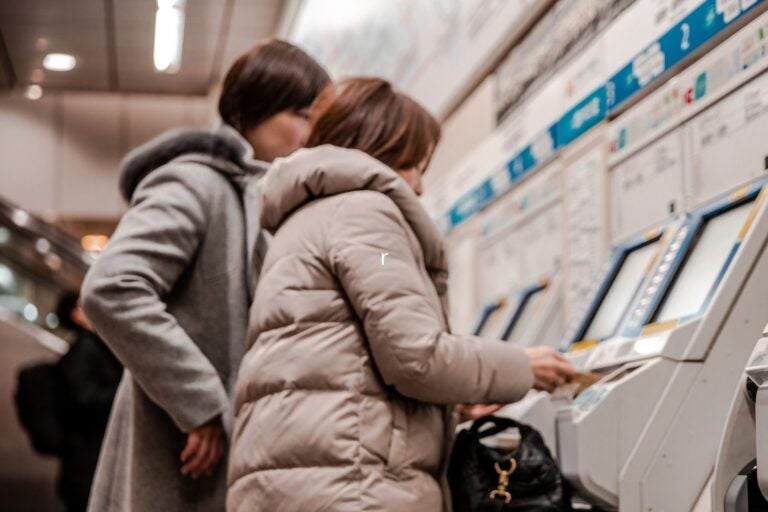
Using an IC card in Kyoto (Suica or ICOCA)
An IC card is a rechargeable contactless card that works like a tap-to-pay transit pass. It’s the single most useful thing to carry when getting around Kyoto, simpler than buying individual tickets, and accepted on city buses, the subway, JR local trains, most taxis, and at convenience stores and vending machines.
Suica (issued by JR East) and ICOCA (issued by JR West) are the two most common IC cards, and they work interchangeably across Kyoto’s entire transport network. Either will do the job. There is no need to buy both.
How to get one:
- At ticket machines at Kyoto Station or Kansai Airport on arrival
- Loaded digitally onto an iPhone (XR or later) or most NFC-enabled Android phones via Apple Pay or Google Pay, this is the most convenient option as you can set it up before you leave home.
How to top up:
- At any JR station ticket machine (accepts cash and most credit cards)
- Via the Suica app or Apple Wallet on iPhone
- At convenience stores such as 7-Eleven, FamilyMart, and Lawson
The card requires a ¥500 deposit, which is fully refundable when you return it at a JR station. If you load Suica onto your phone via Apple Pay, no deposit is required.
One practical tip: if you’re arriving during the cherry blossom or autumn foliage season, the queues at Kyoto Station IC card machines can run long. Setting up mobile Suica before you travel saves considerable time on arrival.
Practical tips for navigating Kyoto
A few habits that make getting around Kyoto much easier:
- Download a dedicated transit app. Japan Transit Planner (Jorudan) and Navitime handle transfers across buses, subways, and private rail lines well, and both work offline once a route is loaded.
- Keep mobile data active. You’ll need it for maps, real-time bus tracking, translation, and mobile Suica top-ups. Travel eSIM providers like Holafly offer a Japan eSIM that keeps you connected from the moment you land, no SIM swapping required.
- Buy your IC card early. Kansai Airport has JR ticket machines where you can pick up an ICOCA on arrival, so you’re ready to tap straight onto the Haruka Express to Kyoto Station.
- Kyoto is well suited to solo travel in Japan. The city’s compact layout, reliable public transport, and walkable districts make it easy to explore at your own pace.
- Walk where it makes sense. Higashiyama, Gion, and Arashiyama all reward slow exploration. Combining one or two transit legs with a longer walk is often the best approach.
- Avoid buses and taxis in congested areas during peak seasons. During cherry blossom and autumn foliage, the subway and walking are more reliable in the Higashiyama area. Budget extra transit time either way.
Stay connected in Kyoto with Holafly
A Holafly eSIM for Japan keeps you connected from the moment you land — no SIM swapping at the airport, no roaming charges, and no hunting for a convenience store SIM. With unlimited data and up to 5G speeds, you can use Google Maps for temple-to-temple navigation, check real-time bus arrivals, top up your mobile Suica, and run translation apps without worrying about data limits.
Plans are available at the Holafly eSIM shop and can be installed before you leave home, so you’re online as soon as you step off the plane.
If your plan lapses mid-trip or you forget to set one up before you arrive, Holafly’s Always On feature provides backup data automatically, so you’re never left without a connection when you need maps or transit apps most.
Get an unlimited data eSIM
Use code MYESIMNOW5 for 5% off at checkout
Plans that may interest you

哈囉我是來自台灣的 Wen,平常最喜歡旅遊,也喜歡將旅遊的種種化成文字跟大家分享,希望大家能在我的文章中找到有用的資訊,加上 Holafly 的 eSIM,讓你的旅程更美好!✈️✈️✈️ Hi! I'm Wen, a passionate content writer and travel enthusiast from Taiwan. I transform my wanderlust adventures into engaging stories and practical guides, helping fellow travelers make the most of their journeys.Through my articles, I strive to provide travel tips while introducing how our eSIM technology can enhance your travel experience - keeping you connected wherever your adventures take you!