







 Language
Gion Matsuri 2026: The complete guide to Kyoto’s greatest festival
Gion Matsuri fills all of July in Kyoto, with main parades on July 17 and 24. Get the full 2026 schedule, float parade details, and how to plan your visit.
Gion Matsuri is one of Japan’s Three Great Festivals. A month-long celebration held in Kyoto every July since 869 AD, it is centered on Yasaka Shrine in the city’s historic Gion district.
Each year, the festival draws over a million visitors for towering float processions, lantern-lit pedestrian evenings, and traditional music performed live in the streets. Whether you’re planning a group trip or traveling solo in Japan, July in Kyoto is hard to beat.
This guide covers the 2026 Gion Matsuri festival dates, the full event schedule, both float parades, the yoiyama evenings, and the practical details you need to plan a visit, including where to stand, how to get there, and what to bring.

An eSIM you can rely on
Join over 10 million Holafly customers and get connected with our trusted, global services.
Gion Matsuri at a glance
When planning a trip to Japan to attend the Gion Matsuri, the key dates, the two float parades and the yoiyama evenings, are what most visitors plan around. Here’s a quick overview before diving into the details.
| Detail | Info |
|---|---|
| Festival dates | July 1–31, 2026 |
| Main parades | July 17 (Saki Matsuri) and July 24 (Ato Matsuri) |
| Parade start time | 9:00 AM (July 17) / 9:30 AM (July 24) |
| Yoiyama evenings | July 14–16 and July 21–23 |
| Location | Central Kyoto; parade route along Shijo, Kawaramachi, and Oike streets |
| Nearest stations | Karasuma (Hankyu), Gion-Shijo (Keihan), Karasuma-Oike (Subway) |
| Free to attend | Yes, the parade route and yoiyama streets are free |
| Paid seating | Available along Oike-dori (book in advance) |
What is Gion Matsuri?
Gion Matsuri is the main annual festival of Yasaka Shrine, held every July across the entire city of Kyoto. Rooted in Shinto tradition, it originated in 869 AD as a purification ritual, a ceremony called Goryo-e held to appease the gods during a devastating plague that had spread across Japan.
The festival has continued for over 1,150 years, surviving interruptions from wars and disasters, only to be restored each time by the people of Kyoto. In 2009, it was designated a UNESCO Intangible Cultural Heritage. Open to visitors of all backgrounds, Gion Matsuri remains a living piece of Japanese cultural history, not simply a performance staged for tourism.
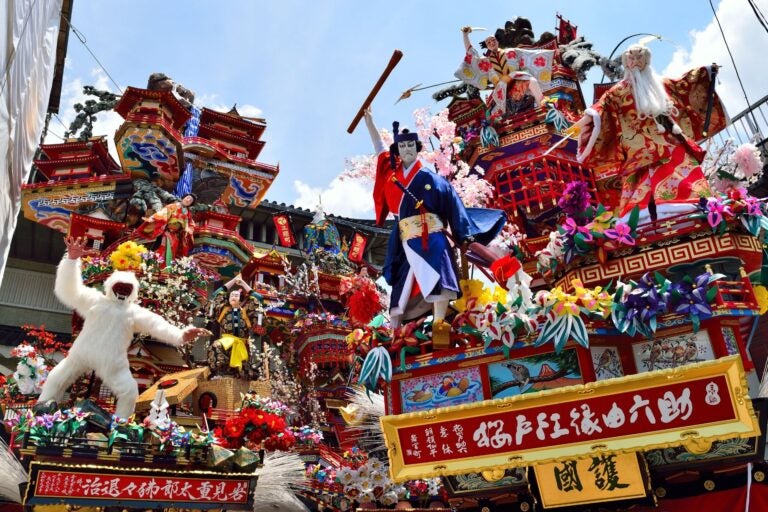
What makes it distinctive is community ownership. The enormous yamaboko floats are built, maintained, and paraded by local townspeople from the neighborhoods surrounding the shrine. Each float belongs to a specific district, and the craftsmanship, some using techniques and decorative textiles centuries old, is passed down through generations.
Gion Matsuri 2026 dates and schedule
As one of the best places to visit in Japan, Kyoto is home to many famous cultural events, including Gion Matsuri. The festival runs for the full month of July, with events spread across both halves. The table below covers the key milestones, but check the official Yasaka Shrine website closer to your visit for any updates to times or locations.
| Date | Event |
|---|---|
| July 1 | Kippu-iri: opening ceremonies in yamahoko neighborhoods |
| July 5 | Chigo-mai dance performance at kaisho meeting hall (3:30 PM) |
| July 10 | Mikoshi-arai: portable shrine purification at Shijo Ohashi Bridge (6:00 PM) |
| July 13 | Chigo ceremony at Yasaka Shrine; sacred messenger boy begins his ritual period |
| July 14–16 | Yoiyama evenings: streets close to traffic from 6:00 PM; food stalls, illuminated floats, Gionbayashi music |
| July 16 | Iwami Kagura traditional dance at Yasaka Shrine (6:30 PM) |
| July 17 | Saki Matsuri: Former Festival float parade (9:00 AM–1:00 PM); Shinkosai mikoshi procession (4:00 PM) |
| July 21–23 | Yoiyama evenings: second round of pedestrian evenings (6:00 PM); calmer atmosphere than the first half |
| July 23 | Abare Kannon ritual: sacred Kannon statue carried through the streets (~11:00 PM) |
| July 24 | Ato Matsuri: Latter Festival float parade (9:30–11:50 AM); Hanagasa Procession; return mikoshi procession (5:00 PM) |
| July 28 | Kanko-sai closing ceremony at Yasaka Shrine |
| July 31 | Summer purification ritual (10:00 AM): official close of the Gion Matsuri festival |
The yamaboko floats — heart of the parade
The yamaboko floats come in two types: hoko, which are multi-story wheeled structures up to 25 meters tall and weighing as much as 12 tons, pulled by teams using thick ropes; and yama, which are smaller and carried on platforms by participants.
Both are elaborately decorated with centuries-old tapestries, lacquerwork, and carvings. Some of the textiles were imported from as far as Persia and Belgium, and many of these decorative elements are now treated as national treasures.The floats are built from scratch each year using rope lashing instead of nails, a technique called nawagumi.
Saki Matsuri – July 17
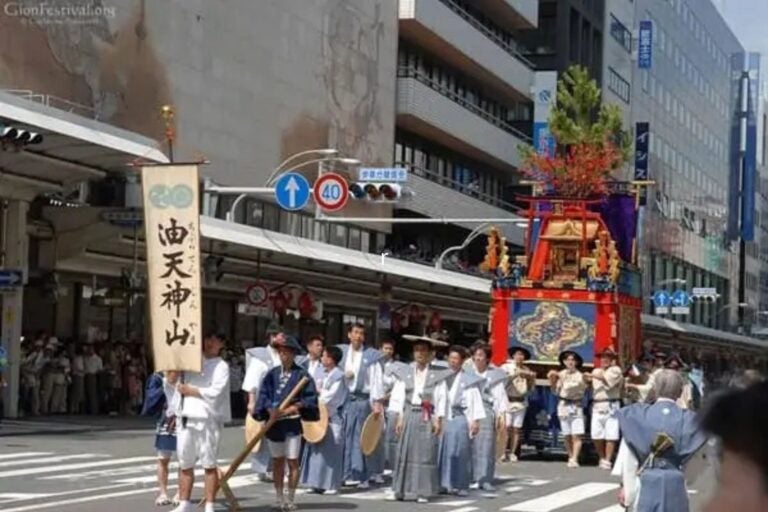
The Saki Matsuri parade is the larger of the two, featuring 23 yamaboko floats. It begins at 9:00 AM from the intersection of Shijo-dori and Karasuma-dori, then moves along Kawaramachi-dori before turning onto Oike-dori, finishing around 1:00 PM.
The most dramatic tsujimawashi corner turns happen at the Shijo-Kawaramachi intersection, making it one of the best free viewing spots along the route.
The stretch of Oike-dori in front of Kyoto City Hall is where paid reserved seating is set up, ticketed areas that offer a guaranteed front-row view. Exact seat locations, prices, and booking dates for 2026 will be announced by the Kyoto City Tourism Association. Check their official site for more information as the festival date approaches.
Arrive at least 30 to 60 minutes before the 9:00 AM start to secure a good standing position. By 9:30 AM, crowds along the main route are dense.
Ato Matsuri – July 24
The Ato Matsuri parade features 11 floats and starts at 9:30 AM from the Karasuma-Oike intersection, finishing around 11:50 AM. It is smaller in scale than the July 17 parade, but that is part of the appeal. Crowds are noticeably thinner, the atmosphere is more relaxed, and it is considerably easier to get a clear view from the roadside without arriving extremely early.
The float selection on July 24 includes some that don’t appear on July 17, notably the Ofune Hoko, a boat-shaped float carrying an ornate golden phoenix figurehead, making it worth attending even if you catch the first parade. For travelers who prefer a less crowded experience while still seeing a full procession, Ato Matsuri is the better choice.
Yoiyama — the evening festival
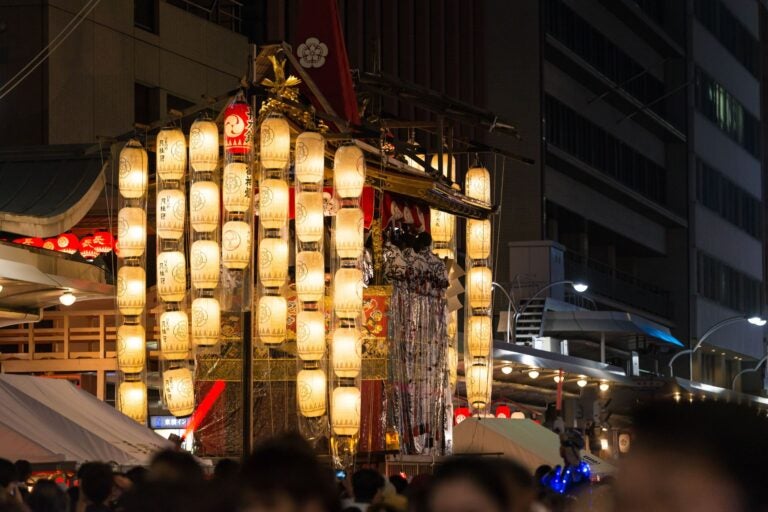
The yoiyama evenings take place across six nights: July 14 to 16 before Saki Matsuri, and July 21 to 23 before Ato Matsuri. From around 6:00 PM, roads in central Kyoto close to traffic and the streets around Shijo, Karasuma, and Kawaramachi fill with food stalls and residents in yukata. The assembled floats remain in their neighborhoods, lit by paper lanterns after dark.
Two highlights are worth seeking out specifically. The Byobu Matsuri sees townspeople open the ground floors of their machiya townhouses to display heirloom folding screens and antiques, free to view from the street. Chimaki charms are bamboo grass amulets sold from each float’s neighborhood, believed to ward off illness and disaster for a year.
Many visitors find the yoiyama evenings more atmospheric than the parades themselves. If you can only attend one evening, July 15 or 16, the nights immediately before the main parade, typically have the most energy.
How to watch the parade and practical tips
Planning your visit to the Gion Matsuri festival comes down to a few key decisions: where to stand, how to get there, and what to bring.
Viewing the parade
- The full parade route is free to watch from the street.
- Best free spots: Shijo-dori near the start, and the Shijo-Kawaramachi intersection for the tsujimawashi turns.
- Paid reserved seating is available along Oike-dori: book in advance via Kyoto City Tourism Association.
- Arrive 30 to 60 minutes before the 9:00 AM start on July 17; 15 to 20 minutes is enough for July 24.
Getting there
- Getting around Kyoto is easy. The city has an extensive subway, train, and bus network, and many major attractions are within walking distance of each other.
- Nearest stations: Karasuma and Kawaramachi (Hankyu), Gion-Shijo (Keihan), Karasuma-Oike (Subway).
- Do not drive — roads across central Kyoto close on parade days and yoiyama evenings.
Practical tips
- July in Kyoto is hot and humid (30°C+). When considering what to pack for Japan, wear lightweight clothing, bring water, and sunscreen.
- Use the station or convenience store restrooms before heading to your spot; portable toilets along the route are scarce
- Download navigation, translation, and transit apps before you arrive. If this is your first time visiting Japan, it’s helpful to have apps for travel in Japan and a Japan travel guide saved on your phone before your trip.
- Bring small change for food stalls since most vendors are cash only. Food and festival purchases can add up over the course of your trip, so it’s worth factoring these expenses into your overall cost of travelling to Japan budget.
- Pack a compact umbrella or rain poncho, July rain is common
- A Japan eSIM keeps you connected for maps, translation, and transport apps throughout the festival. Staying online is straightforward with the right mobile internet setup in Japan.
Stay connected during Gion Matsuri with Holafly
A Holafly eSIM for Japan gives you unlimited data on local networks from the moment you land — no SIM swapping, no roaming charges, and nothing to sort out at the airport when you’d rather be on your way to Kyoto.
With coverage across Japan and up to 5G speeds, you can navigate parade routes, check real-time train departures, and translate signage on the go throughout the entire festival month. Plans are available at the Holafly eSIM shop and can be set up before you leave home.
If your plan runs out mid-trip or you arrive without having set one up, Holafly’s Always On feature provides backup data automatically, so a lapsed or forgotten plan never leaves you disconnected when you need it most.

Get an unlimited data eSIM
Use code MYESIMNOW5 for 5% off at checkout
Plans that may interest you

哈囉我是來自台灣的 Wen,平常最喜歡旅遊,也喜歡將旅遊的種種化成文字跟大家分享,希望大家能在我的文章中找到有用的資訊,加上 Holafly 的 eSIM,讓你的旅程更美好!✈️✈️✈️ Hi! I'm Wen, a passionate content writer and travel enthusiast from Taiwan. I transform my wanderlust adventures into engaging stories and practical guides, helping fellow travelers make the most of their journeys.Through my articles, I strive to provide travel tips while introducing how our eSIM technology can enhance your travel experience - keeping you connected wherever your adventures take you!

