Language
5 Cheapest European countries to visit in 2026
Albania, Bulgaria, Romania, Poland, and Lithuania are the cheapest European countries to visit. Compare daily costs, flights, and what to see in each.

The cheapest European countries to visit are Albania, Bulgaria, Romania, Poland, and Lithuania. Daily costs run $30 to $75 for meals, local transport, and accommodation, against $130 or more a day in Paris or Amsterdam.
Eurostat backs it up: Bulgaria, Romania, and Poland have the three lowest consumer price levels in the European Union.
Seeing Europe doesn’t have to mean Western European prices. These five deliver beaches, castles, mountains, and old towns for a fraction of the cost. Wherever you land, an eSIM for Europe keeps you online without roaming fees eating into the budget.

Avoid excessive roaming fees
Don't get caught out by data roaming charges in Europe. Use local networks at local rates.
Cheapest European countries to visit at a glance
Here’s how the five compare on daily cost, flights, and what each one is best for.
| Country | Best for | Average daily cost | Return flight from the US |
|---|---|---|---|
| Albania | Ionian beaches and Ottoman hill towns | $30 to $50 | $600 to $1,100 |
| Bulgaria | The lowest prices in the EU, plus a coastline | $35 to $60 | $650 to $1,200 |
| Romania | Castles, mountains, and Europe’s cheapest food | $30 to $70 | $600 to $1,300 |
| Poland | Two great cities and the Tatra mountains | $40 to $75 | $650 to $1,400 |
| Lithuania | Baltic old towns, forests, and sand dunes | $45 to $75 | $600 to $1,200 |
For an even bigger discount, try purchasing flights, accommodations, and tours during the holiday booking season and Black Friday and Travel Tuesday sales.
1. Albania
Why go there: Ionian beaches without the Mediterranean price tag
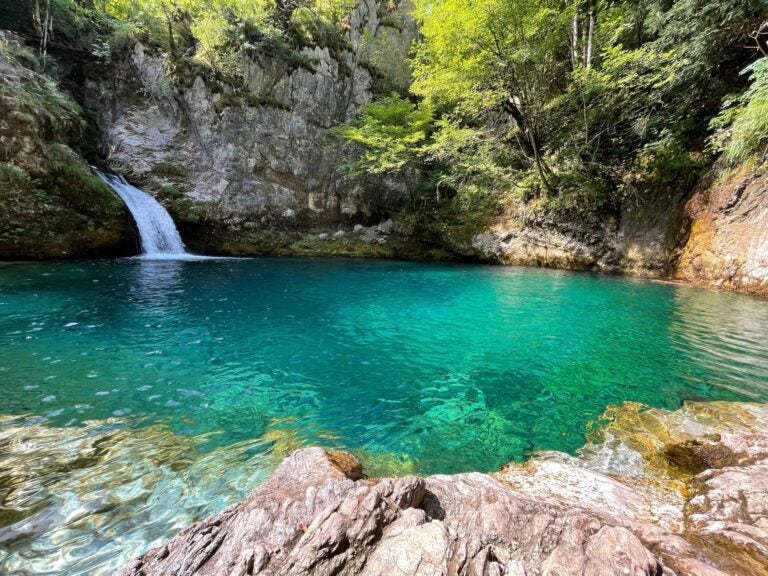
Albania has the coastline Greece and Croatia are famous for, without 30 years of tourism development behind it. The Albanian Riviera runs along the Ionian Sea in the south, where the water is the same clear turquoise and a beach day costs a fraction of what it costs across the water in Corfu.
Inland, the country turns mountainous and Ottoman. Stone-roofed towns climb the hillsides, and the Albanian Alps in the north hold some of the least developed hiking in Europe.
It’s the cheapest country in Europe to visit right now, and the one most likely to stop being cheap.
What to see
- Ksamil beaches. A cluster of small islands sits a short swim off a white-sand shore in the far south, close enough to Corfu to see it on a clear day. The beaches themselves are free to access, and the water stays swimmable well into October.
- Butrint National Park. A UNESCO-listed archaeological site that layers Greek, Roman, Venetian, and Ottoman ruins onto one lakeside peninsula. Entry is 1,000 lek, and the full circuit takes a morning to walk.
- Gjirokastër. A hillside town of stone Ottoman houses, known as the city of a thousand steps, with a castle at the top looking out over the Drino valley. The old bazaar below it is still working, not staged for visitors.
- The Albanian Alps. The Valbona to Theth hike crosses a mountain pass between two glacial valleys and takes most of a day. Guesthouses at either end include dinner and breakfast.
What it costs
- Average daily cost: $30 to $50
- Return flight from the US: $600 to $1,100, depending on dates and departure city
- Butrint National Park entry: 1,000 lek
- Restaurant meal: $5 to $10
- Intercity bus, Tirana to Sarandë: around $12
Money-saving tip: Travel by furgon, the shared minibuses that connect most towns. They leave when full rather than on a timetable and cost a fraction of a private transfer on the same route. Cash only, so carry lek.
2. Bulgaria
Why go there: The cheapest country in the EU, with a coastline to remember
Bulgaria has the lowest consumer prices in the European Union. Eurostat puts household consumption at 37% below the EU average, cheaper than Romania and Poland, and roughly half what you’d pay in France.
What that money buys is unusually varied for one small country. Black Sea beaches in the east, the Rila and Pirin mountains in the west, Roman ruins under the streets of Plovdiv, and Orthodox monasteries in the hills.
One thing to know before you go: Bulgaria joined the euro on 1 January 2026. Prices are in euros now, and the lev is gone.
What to see
- Rila Monastery. The country’s most important Orthodox monastery, set in a mountain valley two hours from Sofia, with striped arcades and frescoes covering every exterior surface. The grounds are free to enter, and a combined ticket to all four museum collections costs 12 euros.
- Plovdiv old town. One of the oldest continuously inhabited cities in Europe, where a Roman amphitheater still hosts concerts and the old town is a climb past 19th-century merchant houses.
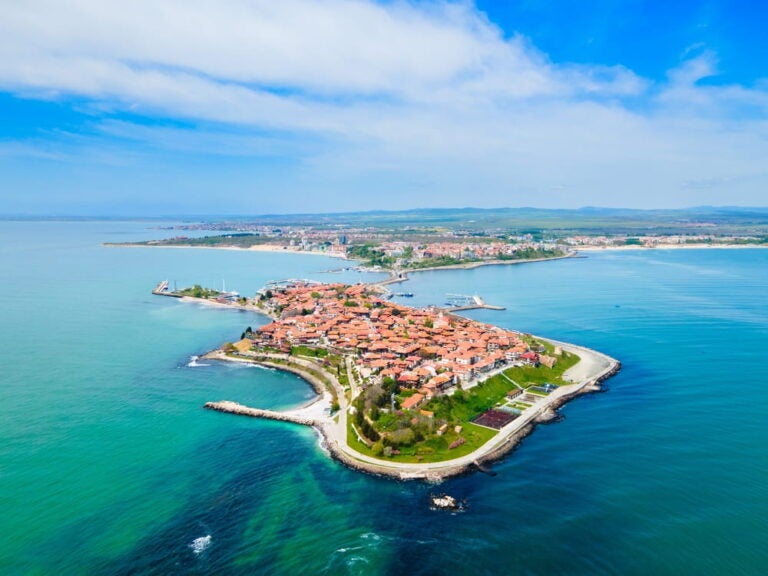
- The Black Sea coast. Sozopol and Nessebar are walled seaside old towns on rocky peninsulas, and the beaches between them cost a fraction of Greek or Croatian prices.
- The Seven Rila Lakes. Glacial lakes linked by a day hike above the treeline, reachable by chairlift from the valley floor.
What it costs
- Average daily cost: $35 to $60
- Return flight from the US: $650 to $1,200, depending on dates and departure city
- Rila Monastery museums, combined ticket: 12 euros
- Consumer prices: 37% below the EU average
Money-saving tip: Sofia’s public transport runs a single flat fare across buses, trams, and the metro, and a day pass costs less than two single rides in most Western European capitals. Buy at the metro station machines rather than onboard.
3. Romania
Why go there: Castles, mountains, and the cheapest food in Europe
Romania is the second-cheapest country in the EU, and the cheapest place on the continent to eat: food and non-alcoholic drinks run 20% below the EU average.
The draw is the strangeness of it. Painted monasteries in the north, fortified Saxon churches in Transylvania, brown bears in the Carpathians, and a capital that mixes Belle Époque boulevards with the largest administrative building in Europe.
Distances are real and roads are slow, so pick one region rather than trying to cross the country.
What to see
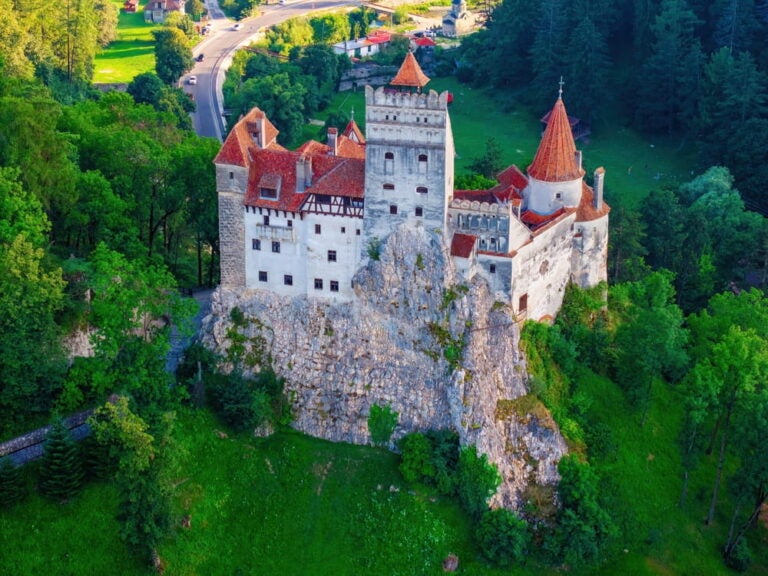
- Bran Castle. The castle sold to the world as Dracula’s, perched on a rock above a mountain pass in Transylvania. Bram Stoker never visited, and the real connection is thin, but the building is genuinely medieval and the mountain setting delivers. The Royal Tour with priority access costs 190 lei.
- Brașov and Sibiu. Two Saxon towns with pastel squares, defensive walls, and mountain backdrops. Walking both costs nothing, and they sit an hour apart by train.
- The Carpathian Mountains. Europe’s largest population of brown bears lives here, along with the Transfăgărășan, a mountain road that closes under snow for half the year.
- Bucharest. Free walking tours run daily, and the National Museum of Art of Romania opens free on the first Wednesday of every month.
What it costs
- Average daily cost: $30 to $70
- Return flight from the US: $600 to $1,300, depending on dates and departure city
- Bran Castle, Royal Tour with priority access: 190 lei
- Food prices: 20% below the EU average
Money-saving tip: Eat where the office workers eat. Bucharest and Cluj have a lunchtime menu culture where soup, a main, and bread run a few dollars, and the same dishes cost triple in the evening tourist restaurants.
4. Poland
Why go there: Two great cities and a mountain range, at two-thirds of EU prices
Poland is the third-cheapest country in the EU, at 73% of average consumer prices, and the easiest of the five to reach from the US, with direct flights into Warsaw and Kraków.
Kraków carries the history: an intact medieval old town, Europe’s largest market square, and the weight of Auschwitz an hour away. Warsaw is the opposite, a city rebuilt from rubble that has turned into the region’s most confident capital.
South of both, the Tatras rise into a proper alpine range without alpine prices.
What to see
- Auschwitz-Birkenau Memorial. Admission to the grounds is free, but entry cards must be reserved in advance online, and only online. Guided tours are charged separately. The standard tour of both camps runs about three and a half hours.
- Wawel Royal Castle. Kraków’s hilltop castle above the Vistula, where Polish kings were crowned and buried. A State Rooms ticket costs 57 zloty and includes the Royal Gardens in summer.
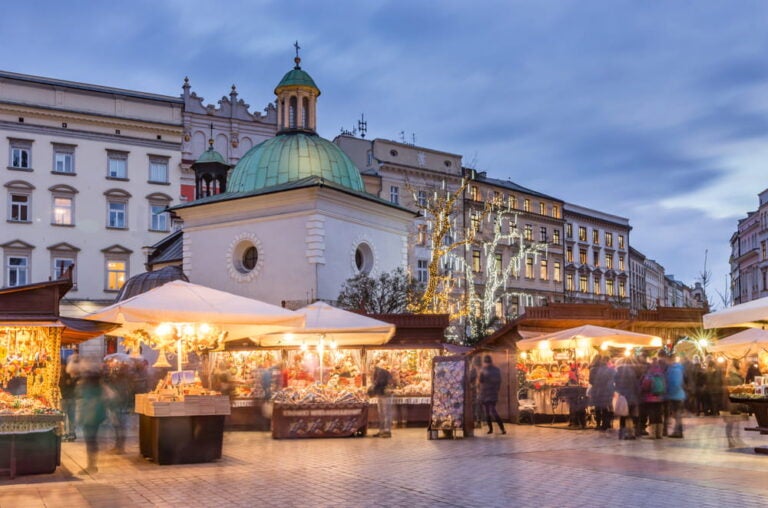
- Kraków’s main square. Rynek Główny is the largest medieval square in Europe, ringed by cafés and free to sit in for as long as you like.
- Zakopane and the Tatras. Wooden mountain architecture, a cable car up Kasprowy Wierch, and hiking trails that run to the Slovak border.
What it costs
- Average daily cost: $40 to $75
- Return flight from the US: $650 to $1,400, depending on dates and departure city
- Wawel Royal Castle, State Rooms: 57 zloty
- Auschwitz-Birkenau Memorial: free, reservation required
- Consumer prices: 27% below the EU average
Money-saving tip: Eat at a bar mleczny, the state-subsidized milk bars that have survived since the communist era. Pierogi and a bowl of soup run a few dollars. Bar Prasowy and Bar Bambino in Warsaw are the best known.
5. Lithuania
Why go there: Baltic old towns, deep forests, and the strangest pilgrimage site in Europe
What to see
- Vilnius old town. A UNESCO World Heritage Site of baroque churches, courtyards, and narrow lanes, free to walk and small enough to cross in an afternoon. The Užupis district next door declared itself an independent republic in 1997 and has a constitution nailed to a wall.
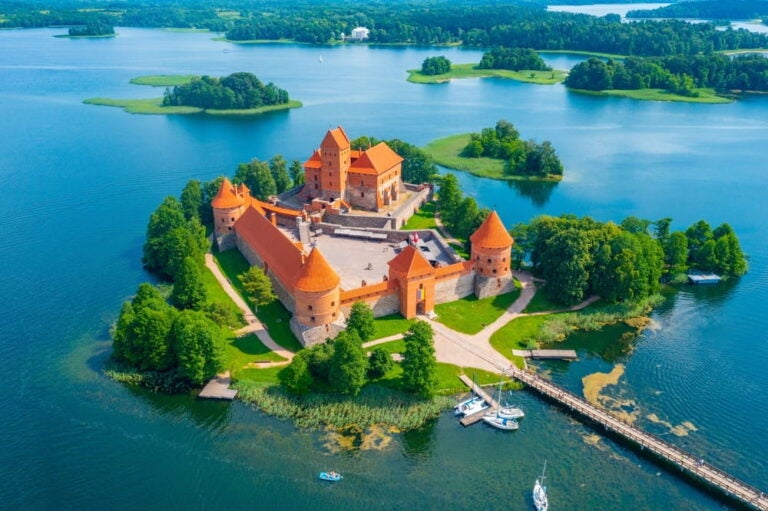
- Trakai Island Castle. A red-brick fortress on an island in a lake, reached by footbridge, an hour from Vilnius. Adult entry is 14 euros between April and September, and 12 euros the rest of the year.
- The Hill of Crosses. A mound near Šiauliai where pilgrims have left crosses for two centuries. Soviet authorities bulldozed it three times and it came back each time. There’s no ticket booth, just a field and hundreds of thousands of crosses.
- The Curonian Spit. A 60-mile sand dune peninsula shared with Russia, with pine forest, a bird migration corridor, and villages of wooden fishermen’s cottages.
What it costs
- Average daily cost: $45 to $75
- Return flight from the US: $600 to $1,200, depending on dates and departure city
- Trakai Island Castle, adult ticket: 14 euros April to September, 12 euros October to March
- Vilnius old town and the Hill of Crosses: free
Money-saving tip: Eat cepelinai, the potato dumplings that are the national dish, at a neighborhood eatery rather than a restaurant on Pilies Street. Look for places with a lunch menu written on a board in Lithuanian only.
Tips to save money in Europe
Picking a cheap country is the first move. These four habits keep costs down once you’re there.
- Buy mid-week flights. Fares tend to drop for Tuesday and Wednesday departures. Flying into Sofia or Bucharest mid-week often beats the weekend price, and flexible dates unlock better deals still.
- Get a rail pass. A Eurail pass for non-EU residents pays off across multiple countries, while regional passes cover a single area for less. Booking single journeys in advance also cuts the fare, and routes like Kraków to Warsaw are markedly cheaper when booked early.
- Shop at local supermarkets. Ready-to-eat items and regional specialties from supermarkets, bakeries, and delis cost a fraction of restaurant prices. In Romania, staples like cozonac and fresh cheese from a Lidl or a Carrefour turn into a picnic lunch for a couple of dollars.
- Head for a free beach. Most European coastline is free to access. Albania’s Ionian shore and Bulgaria’s Black Sea beaches both have long public stretches, so bring a towel, snacks, and drinks and skip the resort entry fee.
Strategic choices, not sacrifices, are what make Europe affordable.
Stay connected in Europe with a Holafly eSIM
A cheap trip stops being cheap the moment a roaming bill lands. A Holafly eSIM keeps that off your budget.
Our eSIM for Europe gives you unlimited data across 33 European destinations, so you can navigate, book trains, and upload photos without watching a data counter. Heading to Albania or elsewhere in the region? The eSIM for the Balkans covers it.
Plans run from 1 to 90 days, with the daily price dropping the longer you travel, and our support team is available 24/7. You can also share 1 GB of data per day over hotspot with the people you’re traveling with, so a 7-day plan includes 7 GB to share.
Every Holafly eSIM includes Always On at no extra cost. It’s 1 GB of backup data every month, valid in 70+ countries. It’s a safety net rather than your main connection, but it means you’re never stranded without a map.
Traveling through Europe more than once a year? Holafly Plans is our subscription option for frequent travelers.
You can install the eSIM before you fly and switch it on when you land.
Avoid excessive roaming fees
Don't get caught out by data roaming charges in Europe. Use local networks at local rates.
FAQs about cheapest countries to visit in Europe
Bulgaria is the cheapest country in the European Union, with consumer prices 37% below the EU average according to Eurostat. Outside the EU, Albania is cheaper still, with daily costs from $30. Both offer a Black Sea or Ionian coastline, mountains, and old towns at a fraction of Western European prices.
Albania’s Ionian coast delivers the best value in Europe: Mediterranean beaches, Ottoman hill towns, and UNESCO-listed ruins for $30 to $50 a day. For a city break rather than a beach trip, Kraków pairs an intact medieval old town with some of the lowest prices in the EU.
Romania stretches a low budget furthest. Food costs 20% below the EU average, the cheapest in Europe, and the country’s best sights cost little or nothing: the medieval towns of Brașov and Sibiu are free to walk, and the Carpathian hiking trails cost nothing at all.
Bulgaria. Rila Monastery sits in a mountain valley two hours from Sofia, the Seven Rila Lakes are a day hike above the treeline, and Sozopol and Nessebar are walled old towns on the Black Sea. It’s also the cheapest country in the EU.
Portugal and Spain are the cheapest Western European countries to visit, with Greece close behind. All three still cost more per day than any country on this list, and Portugal is the only one that comes close to Poland or Lithuania on daily spend.
Sources for our facts and data
All prices and figures accessed July 13, 2026.
- Eurostat. (2026). Comparative price levels of consumer goods and services. https://ec.europa.eu/eurostat/statistics-explained/index.php?title=Comparative_price_levels_of_consumer_goods_and_services
- European Commission. (2026). Bulgaria joins euro area from 1 January. https://ec.europa.eu/commission/presscorner/detail/en/ip_25_3123
- Rila Monastery. (2026). Museums. https://rilskimanastir.org/en/museums/
- Butrint National Park. (2026). Ticket prices. https://culturalsites.myticket.al/butrinti.php?lang=en
- Bran Castle. (2026). Program and tickets. https://www.bran-castle.com/en/program-tickets/
- Auschwitz-Birkenau Memorial and Museum. (2026). Visiting. https://www.auschwitz.org/en/visiting/
- Wawel Royal Castle. (2026). State Rooms. https://wawel.krakow.pl/en/exhibition-constant/state-rooms
- Trakai History Museum. (2026). Prices. https://trakaimuziejus.lt/en/lankytojams/kainos/
- UNESCO World Heritage Centre. Historic Centre of Vilnius. https://whc.unesco.org/en/list/541/
Plans that may interest you


I’m a communications professional with over 17 years of experience in the social justice sector. Eight years ago, I started working as a freelance content writer and strategist. Over the course of my career, I’ve had the chance to work with a mix of social enterprises, NGOs, government agencies, and corporate clients. I have lived and worked in Australia, Austria, Mexico, and Indonesia. I love crafting content that resonates across cultures and tells a meaningful story.