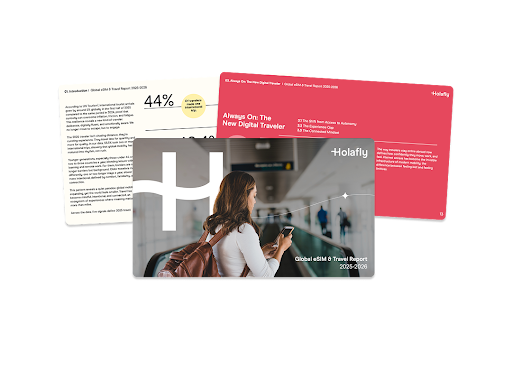




Business travel has continued to grow globally in 2025, not as a rebound phenomenon, but as a normalized and increasingly embedded part of how companies operate. Data from Holafly’s Global eSIM & Travel Report 2025–2026, based on business travelers across regions, shows that corporate mobility worldwide has entered a phase of steady expansion, frequent activity, and forward planning.

In 2025, 49% of business travelers globally report traveling more than they did in 2024, while 31% say their travel levels remained about the same. Only 20% report traveling less, pointing to a clear global growth trend where increases outweigh reductions by a wide margin.
Looking ahead, intent remains strong
73% of business travelers globally say they already plan to travel for work in 2026, while 15% say they do not plan to, and 12% remain undecided. This level of forward planning suggests that business travel is being forecasted, and operationalized well in advance, reinforcing its role as a predictable component of corporate activity rather than a discretionary expense.

Taken together, nearly half of professionals are traveling more year over year, two-thirds having traveled recently, and almost three-quarters already planning future trips; the data shows that business travel in 2025 has moved decisively beyond recovery.
This global normalization has implications that extend beyond airlines and hotels. As travel becomes routine again, expectations around performance rise. Holafly’s research shows that nearly 80% of business travelers globally consider reliable access to the internet abroad very important to feeling productive and safe while traveling. In this environment, connectivity failures are no longer tolerated as friction; they are increasingly viewed as operational risk.
“Globally, the conversation has shifted from whether companies should travel to how they make travel work consistently,” said Alex Bryszkowski, VP of B2B & Partnerships at Holafly.
“When most professionals are traveling regularly and planning ahead, business travel becomes infrastructure. Access to the internet abroad is no longer a convenience, it’s a prerequisite for productivity, coordination, and decision-making across borders.”
As a result, companies worldwide are reassessing how they support employees on the move. Rather than relying on roaming agreements or trip-by-trip solutions, many are turning to permanent models such as Holafly Plans for Business, designed to support continuous domestic and international travel without reconfiguration, billing uncertainty, or coverage gaps.