



To uncover which cities offer the smoothest travel experience and which ones might test your patience, the Holafly research team analyzed cities around the world by average commute times, public transit options, walkability, and other key factors. Additionally, we identified which U.S. cities are easiest to navigate using the same factors.
The Easiest Cities to Navigate Globally
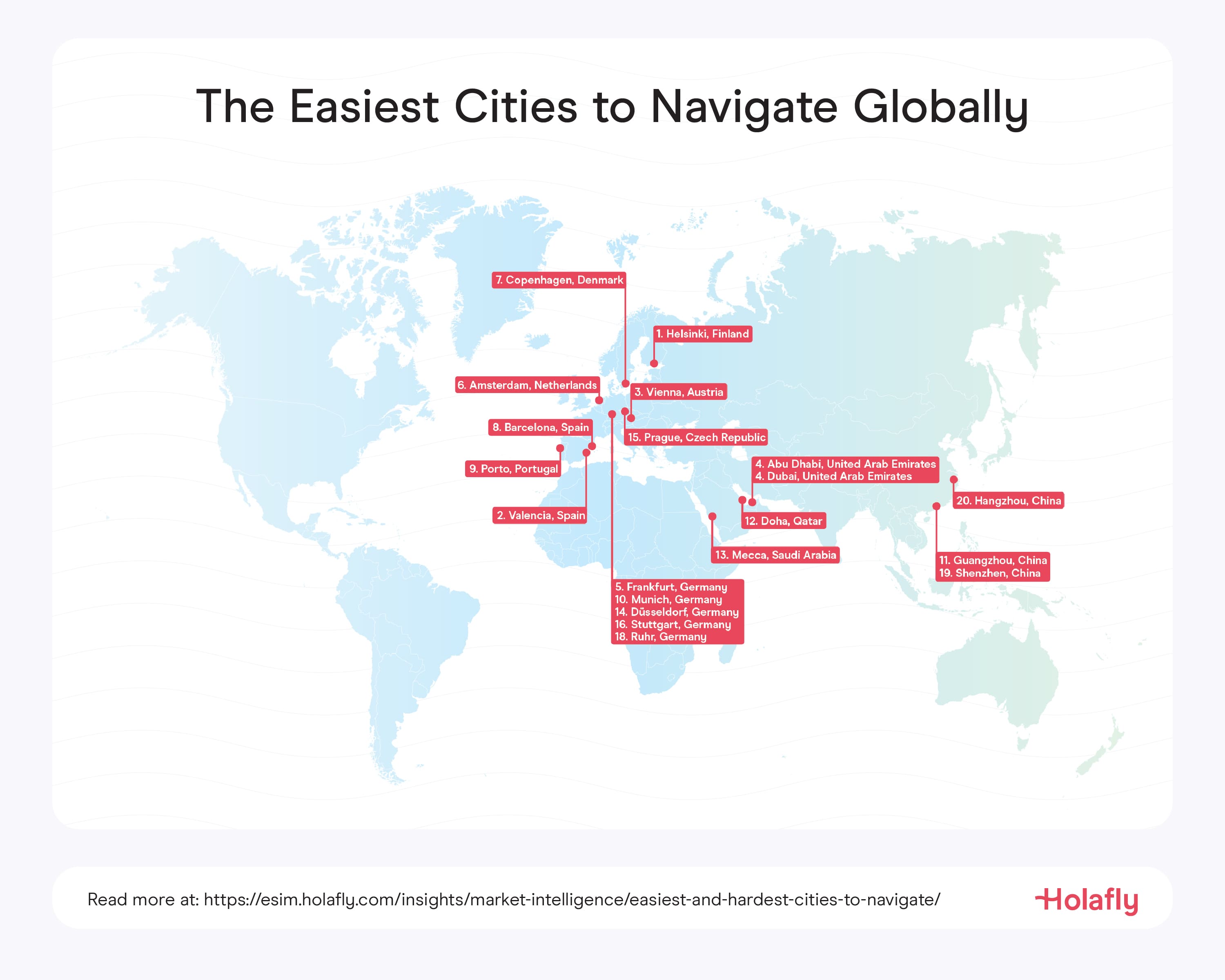
1. Helsinki, Finland
Known for its distinctive design and architecture, Helsinki tops the list as the easiest city to navigate, and it’s not hard to see why. With 16.8% of residents choosing to walk as their mode of transportation, the city is built for those who want to explore on foot. Add in five major public transit options and an average commute time of just 25 minutes, and getting around this Nordic city is stress-free. To make matters better, Helsinki is on the safer end of destinations, thanks to its low crime index of 25.76. Paired with high mobile download speeds of 134.77 Mbps, staying connected feels seamless. Whether you’re a first-time visitor or a local, Helsinki makes navigating the city feel efficient and enjoyable.
2. Valencia, Spain
Thanks to its sunny climate, Valencia also earns a top spot among the world’s easiest cities to navigate. With 26.23% of residents choosing to walk and a crime index of 34.86, the city naturally lends itself to safe exploring on foot. While it offers two public transit options, most people barely need them thanks to breezy coastal pathways and tight-knit neighborhoods. Those who do use transit options get reliable navigation and smooth browsing throughout the city with a mobile download speed of 81.26 Mbps. With an average commute time of just 21 minutes, Valencia allows visitors to enjoy slow, scenic wanderings without worrying about the commute to their next destination.
3. Vienna, Austria
With 22.6% of people choosing to walk to get around, Vienna rightfully earns its reputation as one of the world’s most walkable cities. With a crime index of 28.30, it’s hard not to want to walk around this secure, well-organized city. Locals and visitors don’t have to worry about getting lost since mobile download speeds of 151.33 Mbps allow uninterrupted connectivity, making finding directions quick and easy. For those who prefer not to walk, there are four public transit options that show how the city beautifully blends walkability with reliable transportation. Add in an average commute time of just 21 minutes, and it’s easy to see why getting around Vienna feels effortless.
4. Abu Dhabi, United Arab Emirates
Abu Dhabi is known for not only having impressive cultural landmarks but also a city design for easy movement across long distances. While only 9.37% of people rely on walking, the city’s three public transit options and average commute of 30 minutes keep travel predictable, giving both visitors and locals a structured and accessible way to get around. Abu Dhabi stands out immediately from the other cities with a low crime index of 11.06, making it one of the safest cities on the list. To top it off, the city has incredibly fast mobile download speeds of 726.55 Mbps, making digital navigation feel instant.
5. Frankfurt, Germany
Frankfurt blends business efficiency with everyday ease beautifully. 28% of its population walks, making its streets lively and easily explorable without a car. Additionally, the city’s four public transit options keep commutes smooth, and the 24-minute average travel time makes getting around surprisingly quick. Although the city’s mobile speed may only be 75.67 Mbps, it’s reliable and stable. Frankfurt’s crime index of 44.52 reflects what you’d expect for a major financial hub. It’s a city built for people on the move, and it shows.
6. Amsterdam, Netherlands
Amsterdam might be famous for their bikes, but that doesn’t take away from the fact that the city is built for other types of movement as well. With 12.57% of residents walking and an impressive five public transit options, the city definitely gives travelers endless ways to explore. The 22-minute average commute time and crime index of 25.91 reflect its compact design and easygoing energy. Whether by tram or on foot, Amsterdam keeps everything within reach, and mobile download speeds of 191.29 Mbps allow visitors to stay connected easily.
7. Copenhagen, Denmark
Copenhagen’s organized layout makes getting around feel straightforward and stress-free. 15.34% of people walk, and four transit options help connect each part of the city seamlessly. Its mobile download speeds of 283.88 Mbps ensure that on-the-spot navigation updates are always immediate. Even with Copenhagen’s growing population, there’s a low crime index of 25.69, and a 27-minute average commute stays manageable for all.
8. Barcelona, Spain
The vibrant streets of Barcelona match the ease of navigating them. With 26.25% of residents choosing to walk and six public transit options, the city gives travelers convenient ways and mobile download speeds of 148.86 Mbps to effortlessly explore its neighborhoods. Its popularity and connected layout make the 30-minute average commute reasonable. Although the crime index may be 52.08, the highest in the top 10, it doesn’t take away from how dynamic and navigable Barcelona is.
9. Porto, Portugal
Porto’s known charm parallels how simple it is to get around. 12.79% of locals choose to walk, and its four public transit options help connect each historic and scenic area. With an average commute of 25 minutes and a low crime index of 33.25, the city shows a perfect balance between lively, traditional streets with modern mobility. What truly enhances the experience are impressive mobile download speeds of 303.56 Mbps that give travelers the freedom to explore without worrying if their directions or transit routes will load.
10. Munich, Germany
Munich offers a great combination of structure and ease for travelers. With a crime index of 21.21, Munich is one of the safest cities in Europe, which is why 25.16% of residents choose to walk. Although the city’s mobile download speeds are a modest 75.67 Mbps, it keeps the network reliable so travelers can easily access any travel or transit apps they may need. This helps make using the four reliable public transportation options to get around the city simple and safe. The 29-minute average commute is common for a major European city, reflecting the city’s strong transportation and city layout.
The Hardest Cities to Navigate Globally
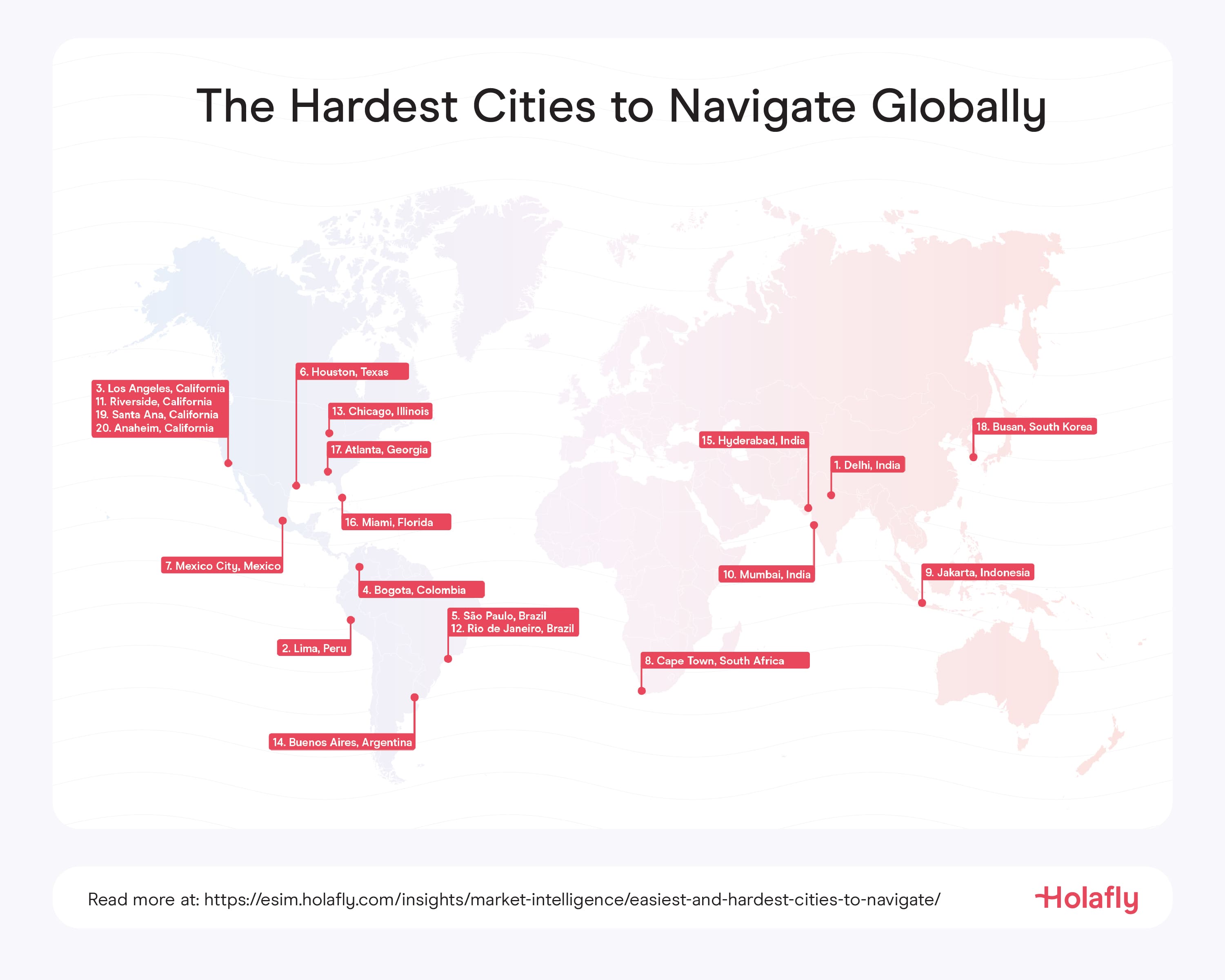
1. Delhi, India
Known as one of the biggest cities in the world, Delhi is the toughest city to navigate, with only 4.27% of its residents walking and a crime index of 59.02. The city only offers three public transit options, but its dense population makes getting around a challenge for most travelers. With an average commute time of 58 minutes, movement across the city can be slow and unpredictable, especially for visitors unfamiliar with its busy roads. Even though movement may be slow, mobile download speeds aren’t, with a strong 160.87 Mbps. This high speed helps balance things out, giving visitors reliable access to maps and transit apps, which can make a city this big feel a little less overwhelming.
2. Lima, Perú
Coming in as the second hardest city to navigate is Lima, where daily commutes are infested by congestion and limited transit reach. Only 6.67% of locals walk, and its three public transit options make it harder to reach destinations easily. Commutes in Lima average 51 minutes, and slow mobile download speeds of 35.04 Mbps, making navigating the city tough for both travelers and locals alike. On top of all of this, Lima’s crime index of 70.25 shows that situational awareness is crucial, especially for those who are new to the city.
3. Los Angeles, California
Although it’s home to iconic landmarks like the Hollywood sign, Los Angeles remains one of the most notoriously difficult cities to get around. With just 2.55% of people walking and only three public transit options, most residents depend on driving, which leads to an average commute of 57 minutes, one of the longest on the list. A crime index of 54.01 is common for a city of this size, but fortunately, its mobile download speeds of 210.27 Mbps are fast enough to keep up with traffic alerts, parking searches, and more.
4. Bogotá, Colombia
Known for its vibrant culture and streets, Bogota is a popular destination for travelers. Unfortunately for them, the crime index is 66.73, which could be why only 12.43% of people walk in the city. There are only three public transit options offered, and mobile download speeds of 56.23 Mbps are useful but not fast enough to rely on for constant, timely updates. With commute times averaging 52 minutes, Bogota’s heavy traffic and steep hills create a tough environment for travelers who want to easily explore.
5. São Paulo, Brazil
While it might not be the largest city in the world, São Paulo is known as the largest in Brazil, and traffic reflects this in its 51-minute average commute time. With 11.21% of its residents choosing to walk and three public transit options, the city offers choices, but daily congestion makes navigating it difficult, especially for those not familiar with the city. Still, the city redeems itself with impressive mobile download speeds of 355.88 Mbps, making it one of the fastest on the list. That level of speed helps offset challenges like a crime index of 69.96 by quickly pulling up routes or alerts to help travelers navigate São Paulo.
6. Houston, Texas
Houston’s car-centric design makes it one of the hardest cities to move through, especially for those who prefer to avoid driving. Only 1.43% of people walk, and although there are two public transit options, travelers usually opt for driving due to the long distance between destinations, making the average commute time 42 minutes. The city also has a crime index of 63.23, which can further influence how travelers choose to navigate the area. Luckily, mobile download speeds of 170.61 Mbps give travelers strong support whether they’re locating parking, planning public transportation options, or just trying to decide where to go next.
7. Mexico City, Mexico
Because it holds the title for the largest city in Mexico, Mexico City’s scale makes mobility complicated for those not local to it. Only 8% of residents walk, and even though the city offers five public transit options, its massive population contributes heavily to long commute times, averaging 53 minutes. Unfortunately, slow mobile download speeds of 44.64 Mbps and a 66.75 crime index can make the streets feel trickier to navigate for first-time visitors.
8. Cape Town, South Africa
Cape Town is known for its stunning scenery between its numerous mountains and beaches, but getting to them might be a bit hard. Just 3.04% of people walk, and the city’s three public transit options can get travelers to most destinations with ease. With an average commute time of 42 minutes, getting around will require travelers some planning and patience. However, the city’s relatively high crime index of 73.63 and slow mobile download speeds of 80.65 Mbps mean visitors may have to rely on planning ahead, especially when moving between varied terrain.
9. Jakarta, Indonesia
If there’s one thing to know about Jakarta, it’s that the congestion is infamous, and the numbers back it up. The city averages a 54-minute commute, with 9.09% of residents commuting by foot and four public transit options. A crime index of 52.85 also plays a role in how comfortable visitors feel while navigating the busy streets. Jakarta’s severe traffic gridlock makes moving through the city for both visitors and locals difficult, especially with slow mobile download speeds of 49.30 Mbps that can lag during peak hours. In a city where movement is already slow, inconsistent connectivity only adds to the challenge.
10. Mumbai, India
Known as the “City of Dreams” and home of Bollywood, Mumbai is one of the most popular cities for travelers, but also one of the hardest to navigate. For a city this popular, a crime index of 44.16 is relatively moderate when in comparison to other cities. With long average commute times of 55 minutes, only 9.73% of people walking, and four public transit options, the city’s dense layout and heavy traffic make getting around a true test of patience. Fortunately, mobile download speeds of 108.52 Mbps help digital tools work smoothly, making getting around crowded market routes and viewing train schedules much easier.
Easiest Cities to Navigate in the U.S.
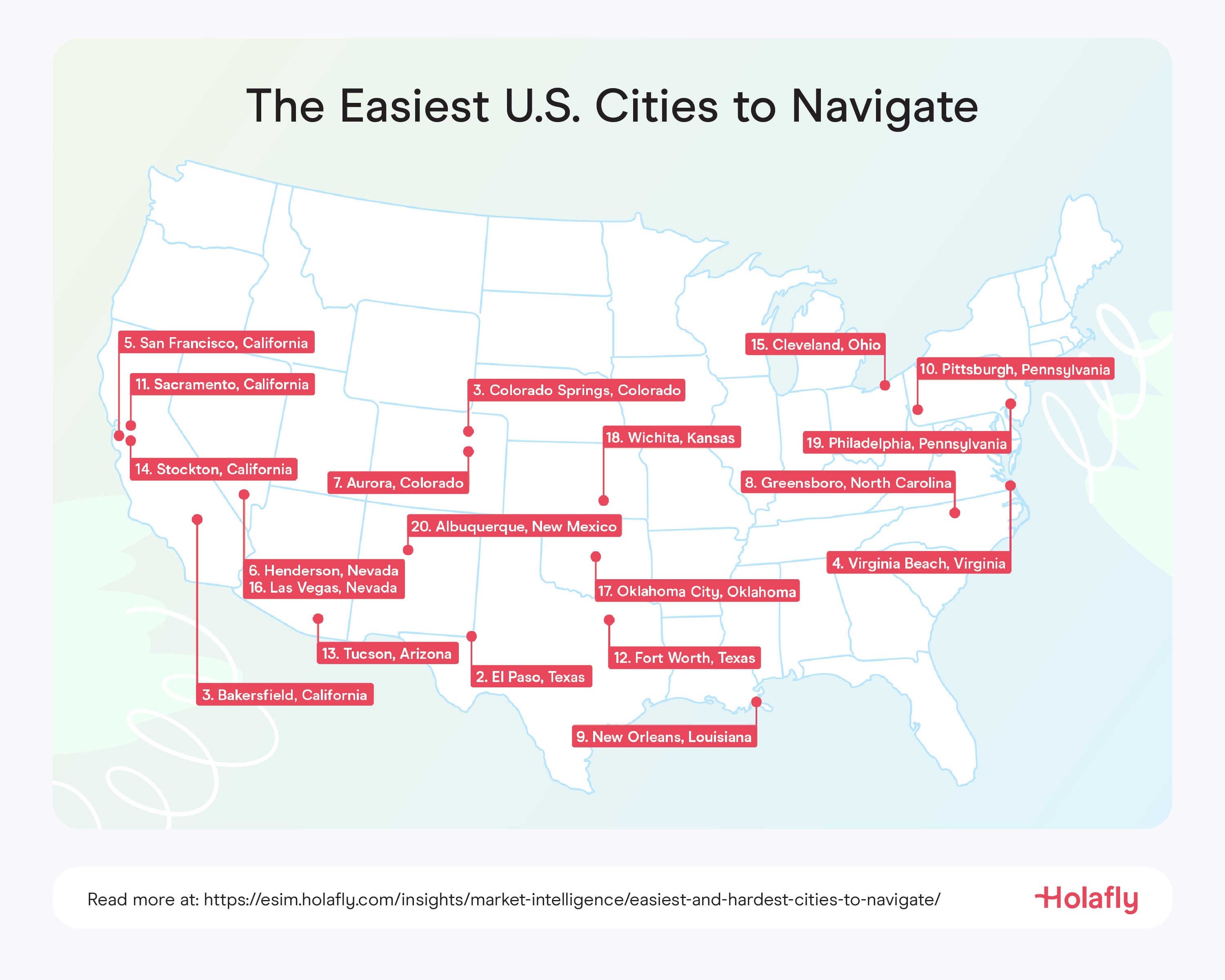
1. Colorado Springs, Colorado
Even though it’s the second-largest city in Colorado, Colorado Springs is still easy to navigate for travelers, ranking as the easiest U.S. city to navigate. With a crime index of 41.45, travelers may still want to stay aware of their surroundings, but with 6.98% of residents choosing to walk and one public transit option, the 18-minute average commute makes it easy and safe for travelers to get to their destination in a breeze — especially with mobile download speeds of 170.61 Mbps to help navigating around the city stay seamless.
2. El Paso, Texas
El Paso ranks as the second-easiest U.S. city to navigate. Thanks to its 16-minute average commute time and two available public transit options, travelers don’t have to worry about the fact that 0% of residents walk. Quick travel times through public transit and a low crime index of 32.57 make navigating the city simple and stress-free. The best part is El Paso’s strong mobile speed of 170.61 Mbps, which makes digital navigation work smoothly no matter where travelers are in the city.
3. Bakersfield, California
Bakersfield stands out from the rest of the group with 7.14% of residents choosing to walk. Although there’s only one public transit option available, the average commute time is only 15 minutes, and the city’s mobile download speed of 170.61 Mbps makes the city easy to get around in for those who are new to it. However, a crime index of 58.38 is an additional factor travelers might want to keep in mind while visiting.
4. Virginia Beach, Virginia
Virginia Beach is a breeze to get around, especially for drivers. With 0% of residents commuting on foot and only one public transit option, most travel happens by car, but it’s fairly easy to get around. Average commute times are just 22 minutes, keeping trips between different neighborhoods, the beach, and local attractions stress-free. Safety is another perk, with a low crime index of 21.79, and ultra-fast mobile download speeds of 170.61 Mbps ensure navigation apps stay working seamlessly.
5. San Francisco, California
Rounding out the top five easiest U.S. cities to navigate is San Francisco, blending scenic exploration with practical conveniences. Nearly 18% of residents walk to work, and the City by the Bay offers five public transit options, giving locals and visitors flexibility in how they move around. While the average commute time is longer at 49 minutes, San Francisco’s relatively high walkability and robust transit network make navigation manageable. Though the crime index ranks higher than some other cities at 60.65, vigilant travelers shouldn’t run into issues. With mobile download speeds of 170.61 Mbps, digital connectivity remains smooth no matter if you’re crossing the Golden Gate or trying a new cafe.
Hardest Cities to Navigate in the U.S.
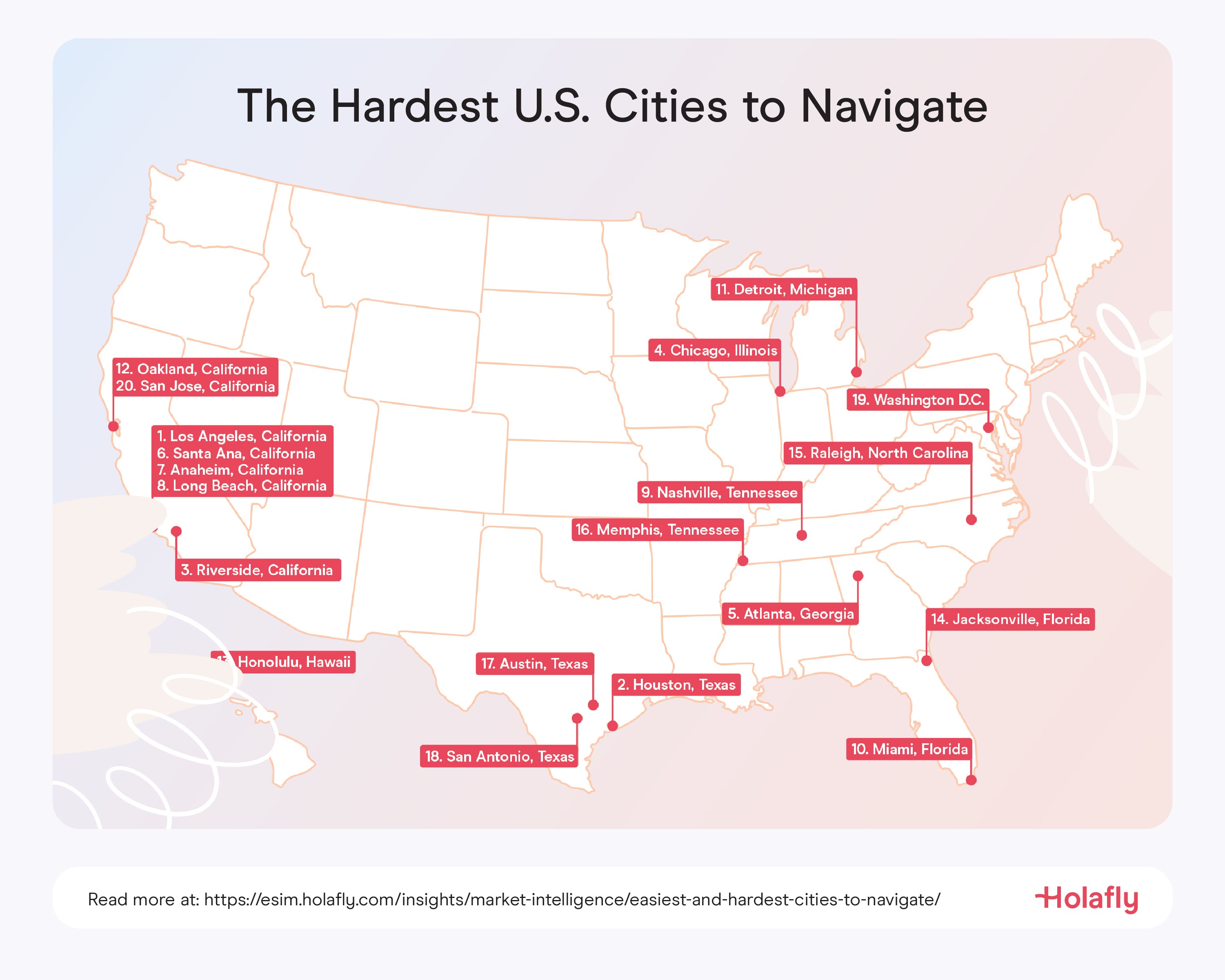
1. Los Angeles, California
Sprawling, congested, and car-dependent, Los Angeles ranks as the hardest U.S. city to navigate. Just 2.55% of residents walk to work, and with three public transit options serving the metro area, most commuters look to driving as their only reliable choice of getting around. This contributes to a demanding 57-minute commute, on average. With a crime index of 54.01 and vast distances between attractions, errand stops, and workplaces, navigating L.A. requires time and planning. Still, its standout 210.27 Mbps mobile download speeds help to support real-time traffic updates and rideshare coordination on the go.
2. Houston, Texas
Houston’s layout and scale prioritize driving, leaving little convenience for those who prefer alternative mobility. With only 1.43% of people walking and two public transit options available, travelers face long stretches between neighborhoods and major hubs, reflected in a 42-minute average commute. Its crime index of 62.33, while common for a city of this size, can also influence travel decisions. While navigation may feel complex, strong mobile download speeds of 170.61 Mbps make it easiest to map out routes or compare transportation options.
3. Riverside, California
Riverside presents unique navigational obstacles due to its reliance on cars and limited transit offerings. With 0% of people opting to walk to work and only two public transportation options, travelers primarily take to the roads to get from point A to point B. Due to this, travelers face average commute times of 52 minutes, while a crime index of 40.24 adds another layer to how people get around. However, mobile download speeds of 170.61 Mbps help people manage navigational challenges more efficiently.
4. Chicago, Illinois
The Windy City offers more walkability than many major U.S. cities, with nearly 12% of people commuting on foot. Though the city is walkable, with only three public transit options to serve such a large metro area, getting around takes about 42 minutes on average. A higher crime index of 65.55 may also influence how travelers get around. Fortunately, reliable mobile download speeds of 170.61 Mbps support safer and more informed navigation, whether tracking transit delays, checking rideshare options, or finding faster walking paths.
5. Atlanta, Georgia
Atlanta’s layout and traffic patterns make it another challenging city for efficient travel. Just 3.53% of people walk, and though the city does offer four public transit options, it’s still not enough to offset the 41-minute average commute. A crime index of 64.33 impacts when and how travelers choose to get around, especially after dark or across unfamiliar neighborhoods. Even so, dependable mobile download speeds of 170.61 Mbps give travelers the bandwidth to stay connected while navigating the bustling city.
Wonder Where Your City Ranks? Check Out the Table Below
Across both global and U.S. rankings, the contrast between the easiest and hardest cities to navigate highlights how thoughtful urban design can shape daily lives. The cities that rise to the top show how planning a town around walkable spaces and reliable transportation can transform everyday routines, while those lacking these features can make a trip feel like an obstacle course.
Now that you know which cities are the easiest and hardest to navigate both worldwide and in the U.S., the next step is learning how to get around. While traveling, checking addresses, information, and recommendations quickly becomes part of your daily routine, making reliable internet access essential. Consider installing your travel eSIM before departure so you can access maps, apps, and even transportation options as soon as you arrive, helping you navigate with confidence as you make the most of your travels in these magnificent cities.
Methodology
We ranked 150 global and U.S. cities by analyzing data such as walkability percentages, available modes of public transportation, average hours lost in traffic, average commute time, crime index scores, Air Quality Index scores, mobile download speeds, and search demand for terms like “directions in [city]” and “Google Maps’” to determine which city around the world is the easiest and hardest to navigate for travelers. Data accurate as of November 21, 2025.