Language
Business travel policy for employees (Guide and template)
What a business travel policy for employees should include, plus a free template.

A business travel policy for employees is the set of rules that governs how a company approves, books, and pays for work trips.
This guide contains:
- Why a written policy is important
- What a travel policy covers and to whom it applies
- An editable business travel policy template
If your team is traveling for work, a business eSIM can keep them connected the moment they land.

Business travel made easy
Want to learn more? Check out these guides:
- Corporate travel budget: How to build and manage one
- Corporate travel planning: How to do it in 10 steps
- Travel policy best practices for your company
What’s a business travel policy for employees?
A business travel policy, sometimes called a travel and expense management (T&E) policy, is a document that sets the rules for company-funded trips. It governs the complete trip lifecycle, including:
- Requesting approval
- Booking
- Spending
- Filing expense reports
Policies normally apply to full-time employees, but some companies extend coverage to part-time staff and, in some cases, contractors.
Why your company needs a travel policy
A written policy pays off in a few ways.
| Reason | Why it matters |
|---|---|
| Cost control | Travel is typically a high cost, and a policy sets spending limits |
| Duty of care | Employers have a legal and ethical obligation to protect traveling staff, and a policy helps translate that obligation into actionable steps |
| Legal and tax compliance | A policy that defines what counts as a business expense gives finance teams the paper trail to support deductions and pass audits |
| Employee experience | A policy prevents inconsistent treatment among traveling staff |
What a good travel policy includes
A business travel policy should cover every stage of a trip:
- Purpose and scope
- Approval process
- Booking procedures and preferred vendors
- Airfare, lodging, and ground transportation rules
- Meals and per diem
- Reimbursable vs. non-reimbursable expenses
- Expense reporting and reimbursement timeline
- International travel protocols
- Safety and duty of care
- Personal time (“bleisure”) rules
- Sustainability
Let’s have a closer look at each one.
Approval process
Every trip should clear a formal approval step.
Who signs off usually depends on cost: a manager can clear a routine trip, while anything above a set dollar threshold (e.g., $2,500) should require sign-off from a department head or finance.
In turn, a travel request should include:
- Dates
- Destination
- Purpose
- Estimated cost
It’s also good practice for companies to ask for 2–4 weeks‘ advance notice, which gives the traveler time to book before fares climb closer to departure.
Pro tip: Routing bookings through a travel management system keeps spend visible in one place and makes the policy easier to enforce.
Booking procedures: Flights, hotels, and ground transportation
Once a trip is approved, booking rules must determine where and how employees can spend the budget.
Air travel
- Economy class is standard for domestic flights.
- Business class is permitted for international or long-haul routes (typically six or more hours) or for medical reasons.
- Frequent-flyer miles and hotel points earned on company-paid trips usually stay with the employee, but the policy should clarify this.
Hotels
- Nightly rate caps work best when tiered by the city’s cost of living.
- GSA per diem lodging rates offer a useful, publicly available starting point for setting that cap.
- Preferred hotel chains should be centrally located and reputable, close to the meeting or client site.
- Stays of five nights or longer are usually cheaper on weekly rates or corporate housing than a standard nightly rate.
- Home-sharing platforms (e.g., Airbnb) should be allowed or excluded in the policy.
Ground transportation
- Rideshares or taxis are standard for airport transfers and local trips.
- Rental cars typically require pre-approval and are reserved for cases where a car beats flying or transit.
- Personal vehicle use is reimbursed at the standard mileage rate, with a mileage log required.
- Public transit is encouraged wherever it’s available.
Some companies route bookings through a dedicated travel management company instead of managing everything in-house. To learn more, check our guides on what a travel management company is, the best corporate travel agencies, and alternatives to traditional travel agencies.
Meals and per diem allowances
A per diem is a fixed daily allowance for meals and small incidental costs, paid regardless of what the employee spends. It’s the simpler of the two common models for covering food on the road.
The second model reimburses actuals: employees submit itemized receipts and get reimbursed for what they spent, up to a stated limit. The two models shouldn’t be mixed within the same trip: pick one and apply it consistently.
Alcohol is worth calling out explicitly. Some policies reimburse a modest amount for meals, while others exclude them, so your policy should state the rule.
What’s reimbursable and what isn’t
A line between what’s covered and what isn’t saves the employee and the finance team from a dispute.
Below are some ideas for your policy:
Covered
- Flights, trains, lodging, and ground transportation booked within policy
- Meals within the per diem or receipt limit
- Conference and registration fees
- Business roaming charges
Not covered
- Seat upgrades, minibar charges, and in-room entertainment
- Alcohol (beyond any limit)
- Personal entertainment, companion costs, and pet or childcare
- Traffic or parking fines
Expense reporting and reimbursement
Employees typically have 5–10 business days after a trip to submit an expense report.
Receipts are usually required above a set threshold, commonly $25–75, with itemized receipts for hotel and meal expenses.
Reimbursement normally happens within 10–15 business days, or “within two pay periods” in policies tied to the payroll calendar. Payment usually runs through payroll, direct deposit, or reconciliation against a company card.
International travel protocols
International trips have a few rules that domestic travel doesn’t:
- The policy should state who covers visa and passport costs, since these are outside the usual booking flow.
- Travel insurance covering medical emergencies, evacuation, and trip cancellation is standard for international travel.
- Currency and foreign transaction fees add up quickly, which is why a company card with low or no foreign transaction fees is worth specifying in the policy.
Safety and duty of care
Business travel duty of care is an employer’s legal and ethical obligation to protect traveling staff. Hence, it’s a good idea to:
- List 24/7 emergency contact information in the policy.
- Run a travel risk assessment against current government advisories before approving a trip to a higher-risk destination.
- Set procedures for natural disasters, medical emergencies, or evacuation, so travelers and managers have an easy-to-follow playbook.
- Track travelers through check-ins or a booking platform’s location feature, so the company can account for everyone during a disruption.
- Include accessibility needs, dietary and religious accommodations, and additional safety guidance for higher-risk destinations to ensure the duty of care remains inclusive.
Companies building out this side of the policy can compare travel risk management software, review travel risk management companies, or read our guide to corporate travel security.
Personal travel and “bleisure” trips
“Bleisure” is business travel extended with personal time, such as staying an extra weekend in a city after a conference.
Employees can typically extend a trip at their own expense (provided they get manager approval), with the company covering only the business portion of the trip.
Sustainability in business travel
Companies should consider environmental impact in their travel rules. Several guidelines should cover most of it:
- Favor direct flights and public transit over layovers or rental cars.
- Choose hotels with recognized sustainability certifications.
- Combine multiple meetings into one trip.
- Offer a carbon offset program as an optional add-on.
Free business travel policy template
For your convenience, we’ve put together this business travel policy template as a ready-to-use Google Doc.
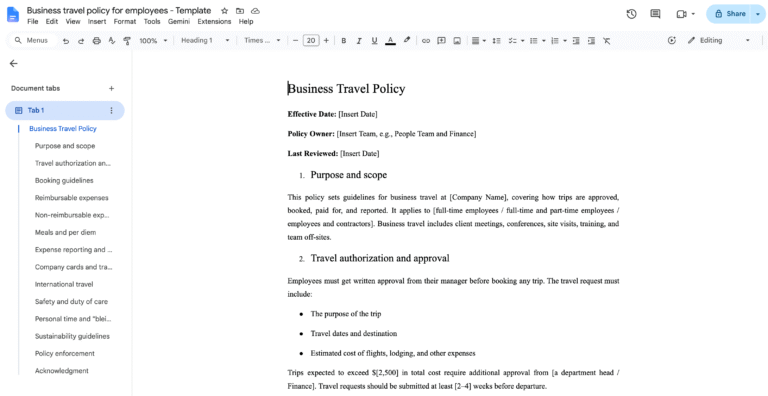
(Screenshot: Google Doc version of the business travel policy template)
Treat it as a starting point.
Copy the structure into your own handbook and customize each section to fit your needs.
Rolling out and maintaining your policy
A policy only works if people see it and follow it.
Below are a few steps to make it stick:
- Get leadership sign-off, so the policy is taken seriously from day one.
- Communicate the policy through multiple channels (e.g., email, Slack).
- Make the policy easy to find when booking.
- Introduce the policy during onboarding for new hires.
- Review the policy every 6–12 months or after new tax regulations, a merger or acquisition, or a shift to remote/hybrid work.
- Track compliance metrics to see where the policy needs adjusting.
For a broader look at this process, see our guide on how to manage corporate travel.
Give traveling employees secure data with Holafly for Business
When your team is on the road, secure mobile data is key.
Holafly for Business is an eSIM provider available in 160+ destinations that activates on your team’s devices, so they don’t have to worry about sourcing local SIM cards or unexpected roaming charges. You also get access to our centralized management platform, the Holafly Business Center, where you can manage individual eSIMs, invoices, and data usage.
Holafly Plans for Business come in four tiers, all featuring hotspot, 4G/5G, and 24/7 multilingual support:
- Daily: Unlimited data with pay-per-day flexibility, built for short business trips under 16 days a month.
- Monthly: Unlimited data for teams traveling more than 16 days a month, a fit for frequent travelers and long-term remote staff.
- Annual: Unlimited data for ultra-frequent travelers, suited to long-term global operations and predictable annual budgets.
- Enterprise: Bespoke plans for companies managing travel for 20+ employees a year, with volume discounts, a dedicated account manager, priority support, and custom integrations, built to optimize costs, streamline operations, and ensure seamless global connectivity across teams.
Not sure which plan is right for your team? Book a demo.
Business travel made easy

I’m a writer with over eight years of experience in digital content. My work has appeared in publications such as The New York Times, Forbes, Business Insider, and the BBC. At Holafly, I write clear, practical guides to help travelers stay connected with eSIM technology. In my spare time, I enjoy car detailing, biking around Warsaw, and capturing portraits.