







 Language
Where not to stay in Vienna: The best tips to travel safe!
Where not to stay in Vienna: Avoid the price traps in District 1 and learn about the outlying neighborhoods that are less recommended.

Vienna is often ranked as one of the safest and most livable cities in the world. Crime is very low, public transport is very reliable, and the city is easy and comfortable to get around. Because of this, the most common mistake when choosing a place to stay in Vienna isn’t ending up in a bad area, but staying too far away from the main sights.
Knowing where not to stay in Vienna mostly means understanding its 23 districts. The first nine districts around the city center (Innere Stadt) have almost all the main tourist sights, culture, and restaurants.
Districts 10 to 23 are mostly residential or industrial areas where tourists don’t usually need to go. Staying there means longer trips and extra transport costs every time you go out, without getting anything extra in return.
This guide explains which areas you should avoid staying in, the specific reasons why they may not be the best choice, and which alternatives work best for different types of travelers.
What should you consider before choosing a place to stay in Vienna?
Vienna is divided into 23 districts (Bezirke), numbered in a circular pattern starting from the city center and moving outward. Understanding this structure before looking for accommodation makes decision-making much easier.
1- Safety
Vienna is one of the safest cities in Europe, with very low crime rates. For most visitors, safety isn’t something that needs to heavily influence where they stay.
The most common problems for tourists are pickpocketing in busy places and on public transport, especially near big train stations. Pickpockets are most common around famous sights and pedestrian streets.
There is one small exception worth mentioning: Simmering is known for having drug users around at night, so if you don’t need to go there, it’s better to avoid it. Even so, it’s not an area where tourists would have any reason to stay.
2- Distance to major attractions
This is the most important thing to consider when choosing where to stay in Vienna. Most of the city’s main sights are in a small area around the 1st district. Hofburg Palace, St. Stephen’s Cathedral, the State Opera, the Museum of Art History, the Belvedere, the Prater, and the Ringstrasse are all in or near the first nine districts.
Staying in District 1 or in Districts 2–9 means you can reach almost all of Vienna’s main sights on foot or within a few minutes by metro. In contrast, staying in Districts 10–23 means adding about 20 to 40 minutes of public transport each way. Over a three- or four-day trip, that adds up to hours that could be spent actually seeing the city.
3- Public transportation and mobility
Vienna’s public transport system is one of the best in Europe. It includes the metro (U-Bahn) with five lines, trams that cover much of the city centre, and night buses that run when the metro closes. The network is efficient and runs on time.
The key is how close you are to a U-Bahn station. Districts 1–9 have a very high density of stations. From District 10 onward, coverage becomes thinner and you rely more on trams or buses, which means longer travel times.
4- Daytime and nighttime surroundings
Vienna doesn’t have the kind of nighttime noise problems you find in cities like Budapest or Lisbon in their nightlife areas. Vienna generally has a calmer atmosphere at night than cities known for heavy nightlife tourism. Night noise is not a common complaint in Vienna accommodation reviews.
The Gürtel, the ring road around Vienna’s central districts, has some areas with active nightlife (especially in Districts 6, 7, and 8). It’s not as noisy as Budapest’s ruin bars, but it can still bother very light sleepers on nearby streets.
5- Services available in the area
Central districts have a great density of supermarkets (Spar, Billa, Hofer), pharmacies, restaurants at different price levels, and everyday services. Outer districts still have plenty of shops and services, but they’re generally less concentrated and less convenient for short-term visitors.
6- Balance between price and location
Accommodation prices in central Vienna are higher than in the outer districts, but the difference is smaller than what you might expect in other similar European capitals.
For stays of two to four nights, the extra cost of transport from an outer district (a 24- or 48-hour public transport pass costs between $9–18 in 2026) and the time spent travelling mean that the money saved on the room rarely ends up being worth it.
What are the areas in Vienna where you should avoid staying?
Vienna doesn’t have dangerous neighborhoods like other European capitals. The reasons to avoid certain areas have more to do with distance, weaker transport connections, and, in a few cases, the atmosphere around major transport hubs at night.
1- Districts 10 through 23
The only areas you really need to avoid in Vienna for a tourist stay are places far from the centre and main attractions, or areas with poor public transport links.
Districts 10 to 23 are residential, industrial, or suburban areas where tourists rarely have a reason to go, except for specific visits. District 10 (Favoriten), 11 (Simmering), 12 (Meidling), and more distant ones like 22 (Donaustadt) or 23 (Liesing) may show up in search results with attractive prices, especially in peak season when the centre is fully booked.
Staying in District 12 and going to the historic centre takes about 20–30 minutes by metro each way. Over a four-day trip with two trips a day, that’s 2–3 extra hours spent on transport instead of seeing Vienna. And the metro costs add up too.
2- The area around Praterstern Station
Praterstern station in District 2 (Leopoldstadt) is one of the busiest stations in Vienna’s metro network. It connects several U-Bahn lines and is an important transport hub. The issue is not the station itself, but the immediate surrounding area.
Areas around big stations like Praterstern can be less comfortable for people who want complete quiet, especially at night. In the early morning, there are often people in difficult social situations around the station, and the area can feel uncomfortable for travellers who don’t expect it compared to the rest of the city.
Overall, District 2 is a perfectly good area to stay in. Leopoldstadt has the Prater park with the famous Ferris wheel (Riesenrad), good metro connections, and accommodation that is more affordable than in District 1. The key is to check exactly which street the accommodation is on and how close it is to Praterstern station.
3- The less desirable sections of the Gürtel
The Gürtel is the main ring road around Vienna’s inner districts. Different parts feel very different depending on the area. Districts 6, 7, and 8 are lively, with lots of bars and restaurants that many travellers like. But parts of Districts 15 and 16 (Rudolfsheim-Fünfhaus and Ottakring) have a different feel, which can surprise people who book there just because it’s cheaper, without knowing the area.
There’s no real safety concern, but visitors expecting Vienna’s classic imperial atmosphere may find these areas less appealing than the central districts.
4. Industrial districts in the south and east
Districts 10, 11, and 23 have industrial and warehouse areas that are completely normal for residents but offer nothing of interest for tourists. Depending on the exact location, you may find fewer cafés, restaurants, and transport options within walking distance.
These areas can be suitable if the purpose of the trip includes specific activities in that part of the city, such as visiting family or attending events at the Vienna International Centre. But for the typical tourist who wants to see the palaces and museums, they don’t really compare to well-located options in the central districts.
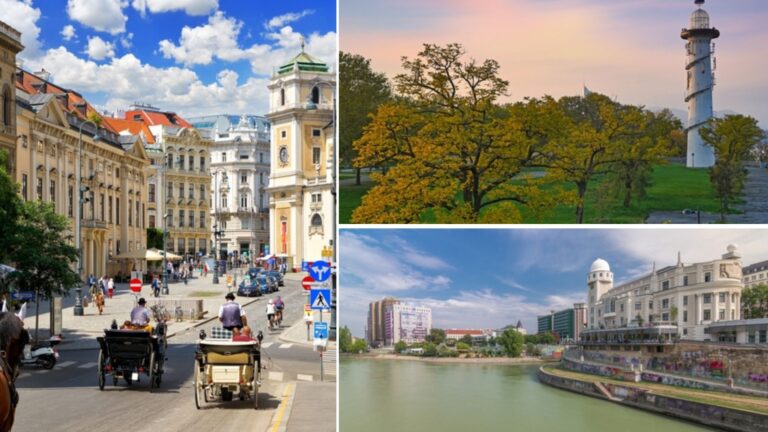
What are the best places to stay in Vienna?
The advantage of Vienna is that its best areas to stay in are relatively affordable, especially when compared with other European capitals of a similar level. These are the ones that work best for different types of travellers.
1- District 1 (Innere Stadt): The historic heart of the city
The first district is Vienna’s historic centre. St. Stephen’s Cathedral, the Hofburg Palace, the State Opera, and the Ringstrasse are all located here or just on its edge. Staying in District 1 means having almost all of Vienna’s main sights right on your doorstep.
It’s the most expensive area to stay in, with hotels ranging from more affordable options to five-star luxury palaces. For short stays of two or three days focused on exploring Vienna in depth, the extra cost compared to more distant districts is fully made up for in time and convenience.
Safety is excellent, the environment is elegant, and the concentration of restaurants, cafés, and services is the highest in the entire city.
2- District 2 (Leopoldstadt): Well-located and more affordable
Leopoldstadt is perhaps Vienna’s best-kept secret for travelers. It sits just across the Danube Canal from District 1. It’s home to the historic Ferris wheel and the Wurstelprater (the world’s oldest amusement park). On top of that, the metro connection gets you to the historic centre in just a few minutes.
Accommodation is much cheaper than in District 1. There’s a wide range of options, from hostels to good mid-range hotels. The area is more diverse and multicultural than the centre. It also has lively markets and food spots that many travelers find more authentic than the tourist areas.
The only thing to keep in mind is to check the exact street address of your accommodation to avoid staying right next to the Praterstern station.
3- Districts 4 and 5 (Wieden and Margareten): Elegant and quiet
Districts 4 and 5 are close to the centre, within walking distance of places like Naschmarkt and the Belvedere, but quieter than District 1 and a bit cheaper. District 4 (Wieden) is next to Naschmarkt, Vienna’s most famous market, which makes it a great base for combining sightseeing with local food.
They’re ideal districts if you plan to stay in Vienna for a while and want a comfortable base without the strict pace of the city centre. Safety is very good, and everyday services are well covered.
4- Districts 6, 7, and 8 (Mariahilf, Neubau, and Josefstadt): Youth, culture, and life
These three districts west of Vienna’s historic centre are popular with young travelers, design lovers, and fans of alternative culture. Mariahilfer Strasse (Vienna’s longest shopping street) runs through District 6, the Natural History Museum and the Kunsthistorisches Museum sit on the edge of District 7, and the MuseumsQuartier is located in this same area.
Accommodation prices are in between those of District 1 and the outer areas, with a very good selection of hostels, apartments, and design hotels. Metro connections are excellent, with several U-Bahn lines.
The atmosphere is lively, but without the excessive nightlife noise you find in other European cities. For a five-day (or longer) trip that includes museums, food, and sightseeing, these three districts are probably the best overall balance of price, location, and atmosphere.
5- District 3 (Landstrasse): The Belvedere and excellent transportation links
District 3 has two main advantages. First, it is home to the Belvedere Palace and gardens (one of the most impressive Baroque complexes in Europe). Second, it also includes Wien Hauptbahnhof, Vienna’s main train station, which connects to all international rail lines as well as several U-Bahn lines.
It’s an elegant area with well-preserved historic buildings and a quiet residential atmosphere. Prices are reasonable for its location. Its proximity to the Belvedere also makes it an ideal base for anyone who wants to spend time exploring the palace complex without having to travel.
How can you get internet access during your stay in Vienna?
Having mobile data from the very start is essential. You’ll need it to navigate Vienna’s 23 districts and check U-Bahn schedules in real time.
For a trip to Vienna with fixed dates, the Holafly eSIM for Austria is the most straightforward option. It gives you unlimited data that’s ready to use before you even leave home, with no need to swap SIM cards or deal with anything when you arrive at Vienna’s Schwechat airport.
For longer stays, or if Vienna is part of an itinerary through Austria, Germany, the Czech Republic, or any other European destination, Holafly’s monthly plans are an even better option. You subscribe once, pay a flat fee, and get global coverage (in over 160 countries). If you’re a digital nomad moving from one country to another, this kind of service is perfect for you.
The plans come in two options: 25 GB and unlimited data, and both include the Always On benefit. This is a 1 GB backup available in over 70 countries, which activates when you run out of mobile data or if you choose to pause your plan.

Frequently asked questions about where not to stay in Vienna
Unlike other European capitals, in Vienna the issue is not safety but distance. The only areas to avoid as a tourist are those far from the centre, far from attractions, or with poor transport links. Districts 10 to 23 are the least recommended for this reason, not because they are unsafe.
The outer districts (10–23) are far from the city centre. Around Praterstern station in District 2, it can feel a bit uncomfortable at night. Some parts of the Gürtel in Districts 15 and 16 may not match what travelers expect from imperial Vienna.
District 1 is the most convenient option for a first visit, with everything right on your doorstep, although it comes at a higher price. Districts 2, 4, 5, 6, 7, and 8 offer an excellent balance of price, location, and atmosphere. For stays of more than three days, they are the best choice.
Vienna is one of the safest cities in Europe, with very low crime rates. The most common issues are pickpocketing in busy tourist areas and on public transport. There are no neighborhoods in the city that pose a real risk of violence to travelers anywhere in Vienna.
Districts 1 to 9 have the most U-Bahn stations and the best connections. Stephansplatz in the centre and Karlsplatz between Districts 1 and 4 are the main transport hubs. The airport is directly linked to the city centre by the City Airport Train (CAT), which takes 16 minutes.
District 2 (Leopoldstadt) probably offers the best balance of price and location in all of Vienna. It has direct connections to the historic centre and significantly lower prices than District 1. Districts 4 and 5 are the more elegant alternative, but prices are a bit higher.
Plans that may interest you


Hi! I'm a Spanish-English copywriter working with Holafly, helping bring travel content to life for curious travelers. As a digital nomad with a passion for exploring, I'm always adding new spots to my bucket list. If you love to travel like me, stick around because you're in the right place to find inspiration for your next trip! ✈️🌍
