Language
Requirements for travelling to Vietnam from the U.S. in 2026
If you are thinking of travelling to Vietnam from the U.S., here we’re going to tell you what are the requirements to do so.

To travel to Vietnam, you’ll need to meet some essential requirements when travelling from the United States. We’ll guide you through all the documents and requirements throughout this article, so you won’t miss anything on your flight day.
Grab a pen and paper, because you’re about to learn what validity period your passport should ideally have for travel, which visas you may need depending on your plans in Vietnam, why your return flight ticket matters, and how to pass immigration control without problems.
Do you want to drive in Vietnam and don’t know which document you need? We explain it here, alongside other useful tips. So, stay until the end, so you can make the most of your trip to this Asian country.
Tip for travelling to Vietnam
Before we start with the mandatory requirements for travelling to Vietnam from the United States, here’s one tip: Don’t go without your own internet connection! You’ll need it throughout your trip, because it’ll help you contact accommodation and even find your way around the city.
For that, we recommend Holafly’s monthly subscription plans, which include 25 GB or unlimited data and let you share it with other devices. In addition, they’re global, so if you travel to more destinations, you won’t need extra steps, because they cover more than 170 countries.
If your stay is short, you can enjoy the Holafly eSIM for Vietnam, so you can get unlimited data for only the days you need. You won’t face roaming charges, and you won’t need to swap physical SIM cards either.
Important: If you are a frequent traveler and want to stay connected without worrying about expensive roaming or looking for a new SIM at every destination, Holafly’s subscription plans are for you. With a single eSIM, enjoy internet in more than 170 countries for a fixed price and no surprises on your bill. Travel without limits and connect easily and securely! 🚀🌍

1. Outbound flight ticket to Vietnam and return ticket to the United States
Your flight ticket will be requested when you land by immigration officers in Vietnam. Ideally, you should keep it printed and in good condition so they can check it easily.
They do this to verify how long you’ll stay in Vietnam and whether your departure date fits the legal stay period. In addition, airlines may also request it, because they want to avoid returning you if you don’t hold a flight back to the United States or to a third country.
2. Tourist, residence, or work visas for Vietnam
To enter Vietnam for any reason as a US citizen, you must apply for a visa based on the activity you plan to carry out in the country. We’re going to tell you in general terms how the tourist, residence and work visas work, in particular.
Tourist visa
As a US citizen, you must apply for an e-visa, also known as an electronic visa. You can apply online through the official Vietnam National e-Visa System portal, and it stays valid for up to 90 days.
Keep this in mind: If you need a single-entry e-visa, it becomes invalid once you leave, even within 90 days. If you plan to enter and leave several times, request the multiple-entry e-visa for the same 90 days.
When you apply, you’ll need your valid US passport and a copy. In addition, you’ll need a 4×6 cm photo with a white background, and they may also ask for your travel itinerary.
Work visa
The work visa has two types: LD1, for foreign workers entering the country without a formal work permit. However, they must match a profile that proves specialist skills in technology projects. Then, LD2 applies to workers who already hold a work permit in the country.
The requirements for these visas may vary, but in general, you need a job offer from a Vietnamese employer. That employer requests your work permit, and then you can begin your visa application.
In addition, they’ll ask for your US passport with at least 6 months’ validity when you leave the country, passport-sized photos, employment and academic certificates, and a medical certificate.

Temporary residence visa
This visa suits family members of foreign workers who already hold a work or business visa in the country. It mainly applies to children and spouses. This document remains valid for 3 years and allows the holder to work.
The requirements depend mainly on the documents provided by the work visa holder supporting family reunification. You must prove your family relationship, financial means, passport, and photos.
3. US Passport
Your US passport must have at least 6 months’ validity when you leave Vietnam. In addition, it must contain at least 2 blank pages for stamping during immigration checks in the Asian country.
It’s important to keep this document with you throughout your stay in Vietnam, because it’s your only identification abroad. Also, authorities may request it at any time, as well as your accommodation reception, or hospital staff during an emergency.
4. Address of your accommodation in Vietnam
When you arrive in Vietnam, they’ll ask you to show your accommodation address. You can prove it with a hotel booking, an Airbnb booking, or a rental agreement for a flat or house. Keep all this information somewhere practical, so you can check it easily.
If you’re staying at a friend’s or relative’s home, you must present an invitation letter to their accommodation, together with the personal details of both the host and the visitor.
In every case, you must register the temporary visit in the country with the authorities. Hotels and accommodation providers sometimes handle this, but you must make sure they complete it.
5. Pass Vietnamese immigration control
Passing immigration control means presenting all the documents and proof mentioned above. In addition, they’ll ask a series of questions about your trip, your accommodation, and the budget you carry, depending on your plans.
It’s important that your travel itinerary matches all the information you provide about your stay, because even brief suspicion may delay your immigration process and could even cause deportation.
Finally, stay patient, because they’ll carry out a baggage check before allowing entry. We recommend you to be calm, answer the questions you’re asked briefly and don’t give lengthy answers.
6. Other tips for travelling to Vietnam
Next, we’d like to share a few tips that, although not mandatory, may help you enjoy a better stay in Vietnam:
Vaccines
Vietnamese health authorities don’t require a specific vaccine list, but you should protect yourself against any medical issue by keeping routine doses up to date. For example, chickenpox, whooping cough, diphtheria, tetanus, plus measles, rubella, mumps, polio, and shingles.
Travel Insurance
Travel insurance makes an important travel companion, because it protects your health through medical cover and protects your wallet from large bills in an emergency.
It also protects your personal belongings in case of loss or theft, and even your trip, if you miss a flight or it gets cancelled. It offers many benefits, so it’s the most advisable option for your trip to Vietnam.
Permit to drive in Vietnam
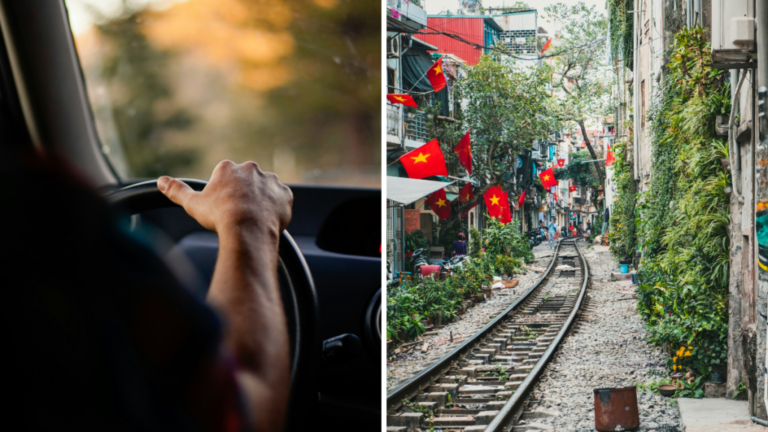
If you travel as a tourist, you can’t drive in Vietnam, because your US driving licence isn’t valid, even with an International Driving Permit added. This happens because Vietnam doesn’t recognise those US documents in the country. The best option is to use public or private transport services to move around.
However, if you hold a long-stay work visa, a temporary residence visa, or similar, the best option is to apply for a Vietnamese driving licence. That way, you can drive your own vehicle around the country without issues.
Frequently asked questions about the requirements to travel to Vietnam from the U.S.
Flight time between the United States and Vietnam depends on the airline and the itinerary. For example: It can reach up to 30 hours with stopovers, while a direct flight may take between 14 and 16 hours.
No, you can’t work with Vietnam’s electronic visa, because you’d face problems with immigration authorities. They could deport you, fine you, and even ban you from entering the country again.
Travel insurance isn’t mandatory for going to Vietnam, but experts recommend it so you can handle medical issues, personal belongings, and even flight problems.
Yes, but you must extend your stay or apply for a different visa that allows long-term legal residence. Otherwise, you’ll fall into irregular immigration status.
It depends on the visa you apply for. For example: Some e-visas allow a single entry, while others allow multiple entries and exits during their validity period.