







 Language
Palio di Siena 2026: Dates, tickets, traditions and travel tips
The Palio di Siena 2026 guide: race dates, how tickets work, free vs paid viewing, getting there, and where to stay for Italy's most iconic Palio horse race.
There are horse races, and then there is the Palio di Siena: 75 to 90 seconds of beautiful, chaotic, bareback madness that should be on the bucket-list of both travel lovers and sports fanatics.
It is Italy’s most iconic Palio horse race — a living civic tradition that combines medieval pageantry, fierce neighbourhood rivalry, and raw athletic drama. Here is everything a first-timer needs to know.
On race day, Piazza del Campo does not so much fill up as detonate. Drums roll through medieval streets, flags hang from windows, and the crowd roars, while ten horses burst around the shell-shaped square.
The Palio is not a quaint Tuscan festival laid on for visitors. It is Siena’s civic religion, neighbourhood war, summer theatre and ancestral memory rolled into one.
This guide covers the 2026 dates, the traditions, how tickets work, and how you can even watch for free. We’ll also touch on getting there, where to stay, and virtually everything else a first-timer should know. For a budget overview, our Italy trip cost guide is a useful starting point.

An eSIM you can rely on
Join over 10 million Holafly customers and get connected with our trusted, global services.
Palio di Siena at a glance
| Key detail | What to know |
|---|---|
| Event | Palio di Siena |
| Location | Piazza del Campo, Siena, Tuscany |
| 2026 dates | Thursday, 2 July 2026 and Sunday, 16 August 2026 |
| July race | Palio della Madonna di Provenzano |
| August race | Palio dell’Assunta |
| Duration of race | Around 75–90 seconds |
| Format | 10 horses and jockeys representing 10 of Siena’s 17 contrade |
| Course | Three laps of Piazza del Campo |
| Cost to attend | Free standing space in the centre of the piazza; paid seats in grandstands or private balconies |
| Best for atmosphere | Stay in Siena for the full four-day build-up |
| Book accommodation | As early as possible, ideally many months ahead |
The Palio is held twice each year, on 2 July and 16 August, with each edition forming part of a four-day programme of trials, rituals and procession in Siena.
What is the Palio di Siena?
The Palio di Siena is a historic bareback palio horse race held in Siena’s Piazza del Campo. Ten horses, each representing one of the city’s contrade (historic districts), race three laps around the square.
The winning contrada receives the drappellone, a painted silk banner, and bragging rights over every rival district.
Dating back to the 17th century, the race has roots in Siena’s medieval games. The event is officially a race, but that doesn’t quite cover it. For Sienese people, the contrada is identity. You are not simply from Siena. You are Oca, Istrice, Nicchio, Torre.
You are born into a district, baptised into its traditions, raised with its colours, songs, saints, enemies and victories. The Palio is where all of that comes to the surface.
It is a living civic tradition and the crowd around you may consider it the most important 90 seconds of their year.
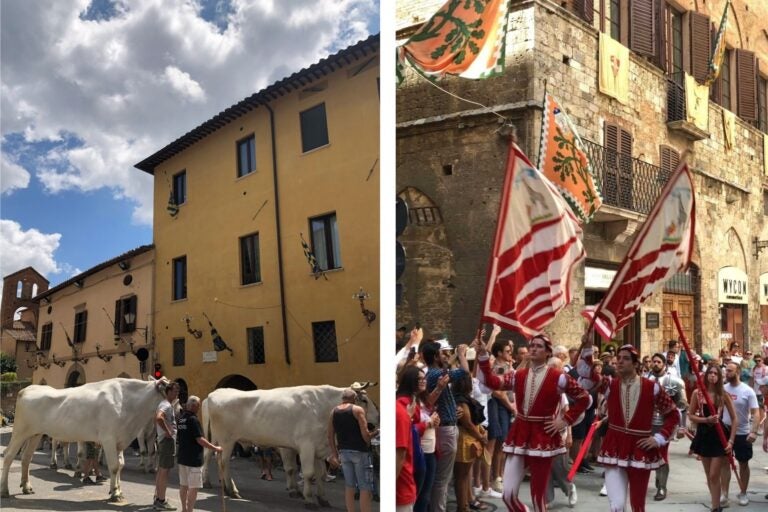
Palio di Provenzano vs Palio dell’Assunta: which should you attend?
Siena runs two Palii each summer. The first, on 2 July, is the Palio della Madonna di Provenzano. The second, on 16 August, is the Palio dell’Assunta, dedicated to the Assumption of Mary.
| Race | Date in 2026 | Best for | Things to consider |
|---|---|---|---|
| Palio di Provenzano | Thursday, 2 July 2026 | Travellers already in Tuscany in early summer; slightly earlier-season energy | Still extremely busy and hot, but usually before Italy’s peak Ferragosto holiday period |
| Palio dell’Assunta | Sunday, 16 August 2026 | Maximum summer atmosphere; mid-August visitors to Italy | Hotter, busier, and accommodation can be harder to find because August is peak holiday season |
The July Palio is a better option for those who want to avoid the mid-August rush. It is still busy, but the August Palio is a different animal; it has that blazing high-summer feel where Siena is baked golden and the streets are heavy with heat.
Neither is “better”. If your Tuscany trip naturally falls around one date, go to that one. If you have a choice, July may be easier logistically, but a good deal in August is unlikely to disappoint. Our Italy travel guide can help you plan the rest of your trip around whichever date you choose.
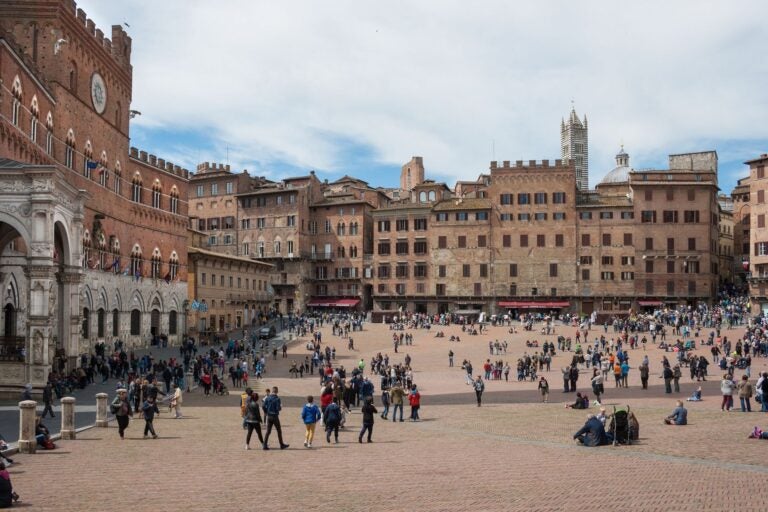
The 17 contrade
Siena is divided into 17 historic districts called contrade. Each has its own identity, reflected in its emblem, colours, songs and saints.
You belong to your contrada from birth and during Palio season, loyalties become impossible to miss. There are flags in windows, scarves around necks, and children are singing songs that sound lovely until you realise they are insulting a rival.
Only 10 of the 17 contrade race in each Palio: the seven that did not run in the corresponding race the previous year, plus three drawn by lot.
| Italian name | English meaning |
|---|---|
| Aquila | Eagle |
| Bruco | Caterpillar |
| Chiocciola | Snail |
| Civetta | Little Owl |
| Drago | Dragon |
| Giraffa | Giraffe |
| Istrice | Crested Porcupine |
| Leocorno | Unicorn |
| Lupa | She-Wolf |
| Nicchio | Seashell |
| Oca | Goose |
| Onda | Wave |
| Pantera | Panther |
| Selva | Forest |
| Tartuca | Tortoise |
| Torre | Tower |
| Valdimontone | Valley of the Ram / Ram |
How does the Palio di Siena work?
The build-up to The Palio is where excitement builds. First is the tratta, which is the assignment of horses, then there are trial races where jockeys get to know their steeds and the track.
All this takes place around a rumour mill like you’ve never seen before, where anticipation and tension are thick in the air.
By the time race day arrives, the Campo has already been transformed with a layer of earth laid around its perimeter, the city is dressed in flags, and every conversation seems to contain either a prophecy or a conspiracy.
A typical Palio build-up includes:
| Stage | What happens |
|---|---|
| Horse selection and assignment | Horses are assessed and assigned to the participating contrade |
| Trial races | Practice runs take place in the days before the race |
| Contrada dinners | Neighbourhoods gather for huge communal meals |
| Blessing of the horse | Each horse is blessed in its contrada church |
| Corteo Storico | A grand historical procession enters Piazza del Campo |
| The race | Ten horses complete three laps of the square |
You don’t want to take a phone call during the race, and a bathroom break would not be possible. That is because it’s phenomenally short, with horses racing three laps of Piazza del Campo, which is about 1,000 metres in total. That usually takes no more than 90 seconds for the victor.
Jockeys ride bareback. The corners are tight. The start can be delayed by tactics and tension. And yes, a riderless horse (known as a cavallo scosso) can still become a hero for its contrada if it crosses the line first.
There are politics involved too, with many of the jockeys watched by everyone and trusted by almost no one.
The point is not simply to win. It is to win while your enemy loses.
How to watch the Palio di Siena
You have two options: stand for free in the centre of Piazza del Campo, or pay for a seat in the grandstands or on a private balcony around the square.
Neither option is perfect. The free option is atmospheric but crowded and uncomfortable. The paid option is more civilised but expensive and limited.
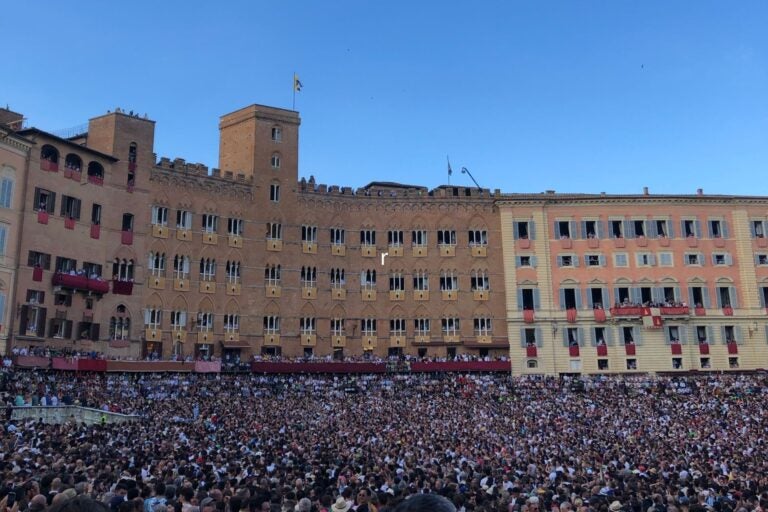
Free viewing in Piazza del Campo
The centre of Piazza del Campo is free to enter for the Palio. That freeness comes at a price: it will be hot, toilets are not accessible once you are in, shade is scarce, and exits are essentially impossible once the square fills up.
Of course, you will also be in the middle of one of Europe’s great civic spectacles, surrounded by singing, shouting, sweating humanity.
If you are fit, patient and heat-tolerant, this can be the ideal option. Arrive early, bring a hat, and go in with realistic expectations.
Paid grandstand and balcony seats
Paid seats are available in temporary grandstands, known as palchi, and on private balconies overlooking the Campo. Both offer better views, more comfort and a far less punishing wait.
Grandstand seats are usually arranged around the edge of the piazza, while balcony places are sold by private buildings, restaurants, agencies or local contacts. There is no universal ticketing system for every seat, but recent travel guidance puts grandstand seats at approximately €160–€350, with balcony views often starting around €350 and rising sharply.
Getting to Siena for the Palio di Siena
Siena is well connected, but Palio days are not the time to wing it. Roads are busy, accommodation is tight, and the historic centre is not built for indecisive drivers in rental cars.
By train
Siena is a straightforward day trip from Florence by train — direct regional services usually take around 90 minutes, with some routes requiring a change at Empoli. The station sits below the historic centre, but escalators and buses connect it to the upper town.
A good option if you value predictability. Just remember that after the race, thousands of other people will have the same plan.
By bus
The bus from Florence is often the more convenient option because it drops you closer to Siena’s historic centre than the train station. Services from Florence to Siena are frequent, and journey times are commonly around 1 hour to 1 hour 15 minutes depending on route and traffic.
Book ahead on race day!
By car
Driving into Siena during the Palio is not recommended. The historic centre is covered by a ZTL (restricted traffic zone), and unauthorised vehicles risk fines. Park outside the walls and walk in.
Decent parking options include areas near the stadium, Santa Caterina, Il Campo and the train station, though spaces fill quickly.
Where to stay for the Palio di Siena
Accommodation in Siena books out months in advance for both Palio dates. Do not leave this until the last minute.
| Where to stay | Best for | Pros | Cons | Approximate price feel |
|---|---|---|---|---|
| Central Siena | Full immersion | Walk to the Campo, experience the build-up, easy access to trial races and processions | Expensive, limited availability, noisy | High to very high |
| Outside the walls | Practical Siena stay | Still close, often better value, easier for parking | May involve uphill walks or taxis | Medium to high |
| Nearby Tuscan towns or villages | Travellers with a car | More peaceful, scenic, sometimes better value; easy to combine with day trips from Siena | Race-day logistics need planning | Medium |
| Florence | Day-trippers | More accommodation choices, easy to combine with a city break | Long day, crowded transport after the race | Broad range |
If possible, you should stay in Siena for at least one night. The trial races, dinners, processions and neighbourhood rituals are what turn the Palio from “I saw a famous race” into “I briefly understood why this city loses its mind twice a year”.
Towns such as Monteriggioni, Colle di Val d’Elsa, San Gimignano, Asciano or in the Chianti area can offer cheaper options, but check transport carefully.
The Palio is just one of the things that makes Italy unlike anywhere else. For more on the country’s culture, history and landmarks, take a look at our guide to what Italy is known for.
Essential tips for attending the Palio di Siena
The first thing you should do is read up on the race (you’re on this blog, so that’s a good start!)
Even knowing the names, colours and rivalries of a few districts will make the event far richer. Pick a contrada to loosely follow if you like, but do not wade into local rivalries like you are doing Serie A punditry after two Aperols.
Be respectful. For locals, this is not just a spectacle. People cry over this. People plan their year around this. People inherit joy and grievance through it.
Outside of learning the basics of the contrade, there are a few other simple tips that will help make your visit more enjoyable.
- Dress for heat: lightweight, breathable clothing is essential in July and August
- Wear comfortable footwear: you will be on cobblestones for hours
- Arrive early: especially for free viewing in the Campo
- Bring water and keep your kit light: you do not want to be carrying a heavy bag through a packed medieval square
- Expect crowds: plan for no easy exit once you are inside the piazza
One final note: The Palio is controversial because horses can and do face risk on the tight, fast course. Siena has veterinary checks and horse protocols, but animal welfare concerns remain part of the wider conversation around the event.
Stay connected at the Palio di Siena with Holafly
Navigating Siena during the Palio is much easier with a reliable data connection. A Holafly eSIM for Italy connects you to local networks from the moment you land, with no SIM swapping and no roaming surprises on your home bill. Holafly covers over 200 destinations with unlimited data, and setup takes a few minutes before you leave home.
Every Holafly eSIM also includes Always On — 1 GB of monthly backup data at no extra cost. Keep the eSIM on your phone after your plan ends, and if you forget to renew while you’re caught up in the build-up to race day, Always On activates automatically so you’re not left without a connection when you need it.
Get an unlimited data eSIM
Use code MYESIMNOW5 for 5% off at checkout
Plans that may interest you

哈囉我是來自台灣的 Wen,平常最喜歡旅遊,也喜歡將旅遊的種種化成文字跟大家分享,希望大家能在我的文章中找到有用的資訊,加上 Holafly 的 eSIM,讓你的旅程更美好!✈️✈️✈️ Hi! I'm Wen, a passionate content writer and travel enthusiast from Taiwan. I transform my wanderlust adventures into engaging stories and practical guides, helping fellow travelers make the most of their journeys.Through my articles, I strive to provide travel tips while introducing how our eSIM technology can enhance your travel experience - keeping you connected wherever your adventures take you!

