Language

Transportation in Dubai: How to get around in 2026
From the Dubai Metro and tram to buses, taxis, and abras, here’s how transportation in Dubai works, what it costs with a Nol Card, and how to pay.

The Dubai Metro is the backbone of public transportation in Dubai, with trams, buses, and boats filling in the gaps, and taxis and ride-hailing apps covering door-to-door trips. One rechargeable Nol Card pays for almost all of it.
Understanding the ins and outs of transportation in Dubai is key to unlocking the city’s sites, whether you’re a first-time visitor or return traveler.
This guide will help you discover how to get around Dubai efficiently, covering all the important modes of transport, from its Metro system to taxis and ride-sharing services, with tips from a local. We also show you how to stay connected as you navigate Dubai, and where to buy eSIM data with unlimited internet before you land.

An eSIM you can rely on
Join over 15 million Holafly customers and get connected with our trusted, global services.
What is the best way to get around Dubai?
The Dubai Metro is the best way to get around Dubai for most trips. It’s fast, affordable, air-conditioned, and links the airport with Downtown Dubai, Business Bay, and Dubai Marina. For anything the Metro doesn’t reach, combine it with a short taxi ride rather than walking in the heat.
The other modes of transportation in Dubai each fill a specific gap. Trams cover the Marina area, buses reach residential neighborhoods, boats cross the Creek and cruise the coast, and taxis handle door-to-door trips. This quick comparison shows where each of the transportation options in Dubai fits:
| Mode | Best for | Typical cost | How to pay |
|---|---|---|---|
| Dubai Metro | Getting across the city fast | $0.82 to $2.04 a trip | Nol Card or Red ticket |
| Dubai Tram | Dubai Marina, JBR, and Al Sufouh | From $0.82 a trip | Nol Card or Red ticket |
| Bus | Areas the Metro doesn’t reach | $0.82 to $2.04 a trip | Nol Card only |
| Palm Monorail | Getting to Atlantis, The Palm | From $1.36 one way | Ticket online or at the station |
| Abra | Crossing Dubai Creek | $0.27 a crossing | Cash |
| Dubai Ferry and water taxi | Sightseeing along the coast | $1.91 to $9.53 a trip | Cash, Nol Card, or card |
| Taxi | Door-to-door trips | Minimum fare of $3.27 | Cash, card, Apple Pay, or Nol Card |
| Rental car | Day trips and exploring at your own pace | Varies by car and agency | Online or at the rental desk |
Disclaimer: The data in this article is accurate as of November 18, 2026, and is subject to change.
How much is public transportation in Dubai?
A Metro, tram, or bus trip costs $0.82 to $2.04 with a Silver Nol Card, depending on how many of Dubai’s seven fare zones you cross. Cash isn’t accepted on RTA (Roads and Transport Authority) public transport, so you’ll need a Nol Card or a paper Red ticket before you ride.
Nol Card options
The Nol Card is the rechargeable smartcard for the Metro, tram, buses, and most boats, and you can buy one at any Metro station. These are the cards that matter most for visitors:
- Silver Card: $6.81, including $5.17 of credit. This is the regular card most travelers buy.
- Gold Card: $6.81, including $5.17 of credit. It gives you access to the Gold class cabins on the Metro and tram at double the regular fare.
- Red ticket: $0.54 for a paper ticket you can top up for up to 10 journeys within 90 days. It works on one mode of transport at a time.
- nol Travel card: $27.23, including $5.17 of credit, with offers and discounts for visitors.
Fares by zone
So, how much does public transportation cost in Dubai? Fares for the Metro, tram, and buses are based on the number of zones you cross:
| Ticket | 1 zone | 2 zones | 3+ zones |
|---|---|---|---|
| Silver Card | $0.82 | $1.36 | $2.04 |
| Red ticket | $1.09 | $1.63 | $2.31 |
| Gold Card | $1.63 | $2.72 | $4.08 |
Children aged 5 and under ride for free. If you switch between the Metro, tram, and bus within 30 minutes, it counts as one journey.
✅ Top tip: If you’ll ride a lot, load a 7-day travel pass onto your Silver Card for unlimited Metro, tram, and bus trips. It costs $13.61 for 1 zone, $21.78 for 2 zones, or $29.95 for all zones.
Public transportation in Dubai
So, how is public transportation in Dubai? Modern, clean, and air-conditioned, with the Metro, tram, buses, a monorail, and boats all run on clear schedules. Here’s how each part of Dubai public transportation works.
Dubai Metro
Best for: Getting across the city fast. The Dubai Metro offers a fast, affordable, and air-conditioned way to explore the city, so you can hop on and off as you please, enjoying the sights and tasting some delicious Dubai street food.
How it works: It’s the world’s largest driverless train system, with two lines. The Red Line runs between Centrepoint and Expo 2020 or Life Pharmacy, passing Dubai International Airport (DXB), Downtown Dubai, Business Bay, and Dubai Marina. The Green Line runs between e& and Creek. You can change lines at Union and BurJuman, and switch to the tram at Sobha Realty and DMCC.
Hours: 5 AM to midnight from Monday to Thursday, 5 AM to 1 AM on Friday, 5 AM to midnight on Saturday, and 8 AM to midnight on Sunday.
Cost: $0.82 to $2.04 a trip with a Silver Card, depending on zones.
How to pay: Tap your Nol Card or Red ticket at the gates when you enter and exit.

Dubai Tram
Best for: Short distances around Dubai Marina, Jumeirah Beach Residence (JBR), and Al Sufouh.
How it works: The Dubai Tram complements the Metro, with 11 stations along Al Sufouh Road. It connects with the Metro Red Line at Sobha Realty and DMCC, and with the Palm Monorail, expanding your options for getting around Dubai. Like the Metro, it has dedicated cabins for Gold Card holders and for women and children.
Hours: 6 AM to 1 AM from Monday to Saturday, and 9 AM to 1 AM on Sunday.
Cost: The same zone-based fares as the Metro, from $0.82 a trip with a Silver Card. If you’re on a budget and wondering how much does it cost to go to Dubai, the tram will help to lessen the financial load.
How to pay: Nol Card or Red ticket.
✅ Top tip: Just remember your Nol Card and research how to dress in Dubai to ensure a smooth journey.
Buses
Best for: Areas of the city not covered by the Metro or tram. Buses offer cheap transportation in Dubai, linking residential areas with business districts and tourist attractions. With the right travel guide for Dubai, you can discover some local gems along the bus routes.
How it works: The RTA operates a modern fleet of air-conditioned buses, and stops are clearly marked and often equipped with air-conditioned shelters. Bus travel is slower than the Metro due to traffic. RTA intercity buses also connect Dubai with other emirates, and the Hatta Express (H02) runs from the Dubai Mall Bus Station to Hatta for $6.81.
Hours: 4 AM to 1 AM daily, and route C01 runs 24 hours.
Cost: $0.82 to $2.04 per journey with a Silver Card, depending on the zones crossed.
How to pay: Buses only accept Nol Cards, so make sure yours has credit before you board.

Palm Monorail
Best for: Getting to Atlantis, The Palm, and the attractions along Palm Jumeirah.
How it works: The monorail runs from Gateway station, near the tram on Al Sufouh Road, to Atlantis, with trains every 15 minutes.
Hours: Every day, from 9 AM to 9:45 PM from Gateway, and from 9:15 AM to 10 PM from Atlantis.
Cost: Single tickets start at $1.36, and round trips start at $2.72.
How to book: Buy tickets online or at the station. It’s the only public transport in Dubai that doesn’t use Nol Cards.
Abras, ferries, and water taxis
Best for: Crossing Dubai Creek and seeing the city from the water. These aren’t just modes of Dubai transportation, but also fantastic sightseeing opportunities.
How it works: Embrace Dubai’s maritime heritage by boarding one of its three types of RTA boats:
- Abra: These traditional wooden boats have ferried passengers across Dubai Creek for centuries, connecting Bur Dubai and Deira. A crossing costs just $0.27, making it the cheapest mode of transport in Dubai. Air-conditioned and petrol abras on other Creek routes cost $0.54, and you can charter a traditional abra for $16.34 for 30 minutes or $32.68 for an hour.
- Dubai Ferry: Air-conditioned ferries link Al Ghubaiba, the Dubai Canal, Bluewaters, and Dubai Marina, plus an intercity route to the Sharjah Aquarium. Fares range from $4.08 to $9.53 per stop, and a round trip from Dubai Marina costs $13.61 in Silver class.
- Dubai Water Taxi: Hop on and off at stops around Dubai Marina for $1.91 per stop.
Children under 12 can’t ride RTA boats alone and must wear a life jacket on board, so keep their ID handy if you’re traveling as a family.
How to pay: The traditional abras on Dubai Creek take cash only. The ferry and water taxi accept cash, Nol Cards, and bank cards, and you can book single ferry tickets online or buy them at the station.

Taxis, ride-hailing apps, and car rentals in Dubai
For door-to-door trips, you can hail an RTA taxi, book a ride through an app, or rent a car. Each suits a different kind of journey.
Taxis
Best for: Door-to-door, air-conditioned convenience, especially with luggage or in the summer heat.
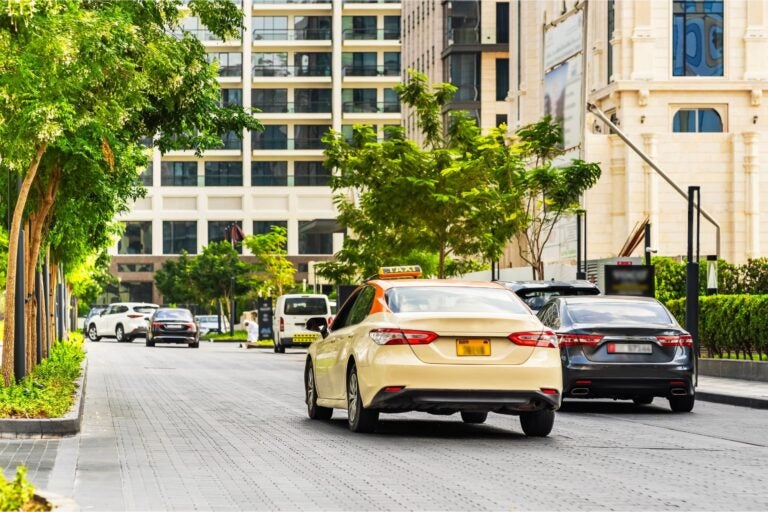
How it works: The network of Dubai taxis, regulated by the RTA, is available city-wide, recognizable by colorful roof trims. Taxis can be found outside malls and hotels, easily hailed on the street, and right outside the airport.
Cost: Hailing a taxi on the street starts at $1.36 during the day and $1.50 at night, plus $0.67 per kilometer and $0.14 for every minute of waiting. The minimum fare is $3.27, or $3.54 if you book through an app.
How to pay: Cash, bank card, Apple Pay, or Nol Card.
✅ Top tip: Always check that the meter is running. If it isn’t, the ride is free.
Ride-hailing apps
Best for: Booking a car with a set price, without waiting on the street.
How it works: Careem and Uber are the most popular ride-hailing apps, and Careem is the local competitor that often has lower prices. You can also book RTA taxis through S’hail, Careem, or Bolt. Fares on ride-hailing apps are slightly higher than street taxis, and you’ll need an internet connection to book the ride, which is where a local Dubai SIM card can come in handy.
Cost: Booking a taxi through an app starts at $2.45 to $3.54.
How to pay: In the app, with a card or cash.
Car rentals and Salik tolls
Driving in Dubai gives freedom and flexibility, especially if you plan to explore beyond the main tourist hubs or want to travel at your own pace. Before you set off, these are the key things to know:
- Where to rent: Rental agencies are abundant at Dubai International Airport, malls, and hotels across the city, or you can book online. Car-sharing apps like Udrive and eKar are handy for shorter trips.
- Roads: The city has well-maintained roads and clear signage, though traffic can be heavy during peak hours.
- License: Visitors can typically drive with a valid international driving permit alongside their national driving license.
- Salik tolls: Toll gates on major highways automatically deduct a fee from a prepaid tag linked to the rental car. Crossings cost $1.72 at peak times (6 to 10 AM and 4 to 8 PM, Monday to Saturday), $1.14 at other times and all day Sunday, and nothing from 1 to 6 AM. Ramadan has different peak hours.

Getting from Dubai Airport
Airport transportation in Dubai is straightforward, as the Metro, buses, and taxis all serve Dubai International Airport (DXB).
Best for: The first and last legs of your trip.
How it works: The Metro Red Line runs from DXB to Downtown Dubai, Business Bay, and Dubai Marina, making it the cheapest way into the city if you’re traveling light. Buses stop at all airport terminals, and official airport taxis wait outside arrivals, with signs guiding you to the pick-up areas.
Cost: A Metro trip costs $0.82 to $2.04 with a Silver Card. Airport taxis start at $5.45 to $6.81, plus the distance fare.
How to pay: Buy a Nol Card at the airport Metro station before you ride, or pay for your taxi in cash, by card, or with Apple Pay. With an eSIM already active, you can check your route the moment you land, without hunting for the Dubai Airport WiFi login.
Tips for using public transportation in Dubai from a local
Get a Nol Card on day one, ride outside rush hour, and let the Metro do the long stretches in the heat, and transportation in Dubai for tourists becomes affordable and stress-free. These habits will help you ride like a local.
💡 Local tip: Manuela Oswald, a local expert on Dubai, sums up the most common slip-up: “Not getting a NOL card on the first day (available at all metro stations).”
Download the right transportation apps in Dubai
The RTA’s S’hail app shows all connections, schedules, and real-time information, and even how full the next Metro will be. For ride-hailing, Careem and Uber are the most popular. Keep in mind you still need your physical Nol Card to pay at stations and on buses.
Avoid rush hour when you can
The Metro gets very crowded from 7 to 9 AM and from 5:30 to 7:30 PM. If your plans are flexible, travel outside these hours for a more comfortable ride.
Don’t walk long distances in the summer heat
With summer temperatures reaching 40 to 45°C, walking between attractions can be exhausting. Combine the Metro with short taxi rides instead. The air-conditioned bus shelters help too, and Manuela warns they keep a constant 24°C, which can feel cold if you’re lightly dressed.
Use the women and children cabins
The Metro and tram have special cabins only for women and children. They’re clearly marked, so check the signs before you board.
Get a separate ticket for the Palm Monorail
Travelers often assume the Nol Card works on the Palm Monorail, but you need a separate ticket, which you can buy online or at the station.
Save with the Careem Tourist Pass
The Careem Tourist Pass, created for visitors, gives you reduced prices on transport, dining, food delivery, and attractions for seven days, at no cost to sign up.
Use transport like a local in Dubai with a Holafly eSIM
Whether hopping on a bus, riding the Dubai Metro, or hailing a Dubai taxi, staying connected in the city is a must. Reliable internet access helps you check S’hail for the next train, book a Careem ride, or see which stop is yours.
A Holafly eSIM for Dubai gives you unlimited data across the city, so you can skip the hunt for Wi-Fi hotspots or the hassle of renting pocket WiFi for Dubai. Install it before you fly, and it connects the moment you land at DXB. Planning to explore more of the country, from Abu Dhabi to Hatta? Take a look at the eSIM for the UAE too. Wherever you go, 24/7 support is there in the app if anything comes up.
If you travel often, Holafly Plans is a monthly subscription that works in 160+ destinations, so you don’t have to buy a new eSIM for every trip. And with Always On, you keep 1 GB of monthly backup data in your pocket in 150+ destinations, at no extra cost.

Book your transport as you land
Get your eSIM for Dubai, activate on arrival, and enjoy instant internet access.
FAQs about transportation in Dubai
Not the cheapest option. Uber fares are usually slightly higher than RTA street taxis, which have a minimum fare of $3.27. Careem, the local ride-hailing app, often has lower prices than Uber, and the Metro is far cheaper for longer trips across the city.
The traditional abra across Dubai Creek is the cheapest transportation in Dubai, at $0.27 a crossing. For getting around the city, the Metro, tram, and buses start at $0.82 a trip with a Silver Nol Card, and a 7-day travel pass gives you unlimited rides from $13.61.
Yes. Dubai is generally extremely safe, and its public transport is modern, clean, and well-maintained, including at night. The Metro and tram have dedicated cabins for women and children, and children under 12 must be accompanied and wear a life jacket on RTA boats.
Rarely. The Metro, tram, and buses don’t accept cash, so you’ll pay with a Nol Card, or a Red ticket on the Metro and tram. Taxis take cash, cards, Apple Pay, and Nol Cards. The main exception is the traditional abra on Dubai Creek, which is cash only, so keep a few dirhams on hand.
Download S’hail, the RTA’s journey planner with real-time schedules and taxi booking, plus Careem and Uber for ride-hailing. Bolt is another way to book a taxi. A Holafly eSIM for Dubai keeps these apps online from the moment you land.
Plans that may interest you


With a background in English literature and a focus on storytelling, I’ve turned my interests in travel and technology into a career helping others stay connected abroad. Originally from Serbia, I work remotely with my husband, experiencing local cultures firsthand and bringing that perspective to my writing for Holafly. Fun fact: before focusing on content creation, I was a professional volleyball player.