Language
You can leave Beijing airport on a layover. Here is what actually happens when you do
Got a long layover in Beijing? Discover how to use China's visa-free transit policy to leave the airport and explore the city before your next flight.

Maciej, a Holafly team member, recently had a very unexpected travel experience in Beijing.
He had just started a 9.5-hour layover in Beijing Capital International Airport with his partner when a quick Google search led him down an unexpected rabbit hole: he discovered he could leave the airport and explore Beijing without a visa.
Most airports require you to remain in the terminal during your layover. But China has a little-known transit policy that allows certain nationalities to leave and come back, no questions asked.
So Maciej and his partner did exactly that.
Whether you’ve got an upcoming layover in Beijing or you’ve heard rumors about China’s visa-free transit rules, read on. This is how Maciej was able to spontaneously leave Beijing airport to explore the city, and how you could too.
First things first: can you actually leave Beijing airport?
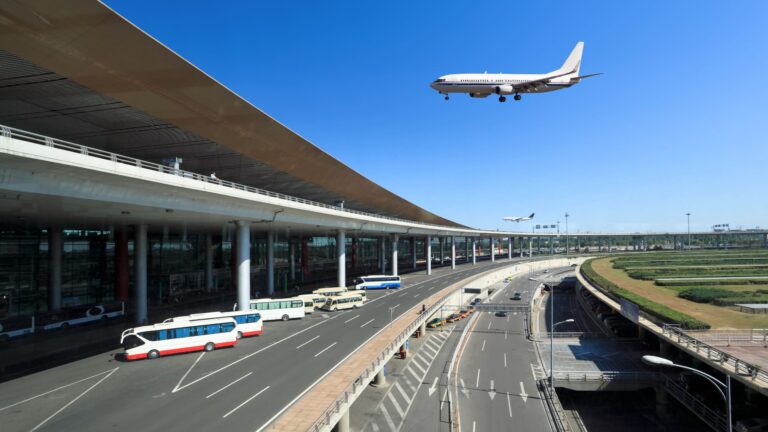
What Maciej and his partner did was totally legal, yet most transit passengers in China have no idea it’s possible.
That being said, it’s not possible for everyone. It all comes down to your nationality.
Firstly, all nationalities qualify for China’s 24-hour visa-free transit. This means anyone can travel through a Chinese airport as part of a continued journey, provided their layover flight is within 24 hours of landing. However, travelers must remain inside the airport’s restricted area and cannot leave the terminal.
But Maciej discovered the 240-hour visa-free transit policy, which allows nationals of 55 countries to leave the airport during their layover for up to 240 hours (10 days). This duration starts from 0:00 on the day after entry, not from the moment of arrival. These nationalities don’t need to obtain a visa to leave the airport, but they do need proof of onward travel.
As Maciej was one of the 55 nationalities and had proof of onward travel, he was allowed to freely explore the city while waiting for his flight. You could be eligible to do the same if you hold a passport issued by:
- 40 countries in Europe including Albania, Austria, Belarus, Belgium, Bosnia and Herzegovina, Bulgaria, Croatia, Cyprus, Czech Republic, Denmark, Estonia, Finland, France, Germany, Greece, Hungary, Iceland, Ireland, Italy, Latvia, Lithuania, Luxembourg, Malta, Monaco, Montenegro, the Netherlands, North Macedonia, Norway, Poland, Portugal, Romania, Russia, Serbia, Slovakia, Slovenia, Spain, Sweden, Switzerland, Ukraine, United Kingdom.
- Canada or the United States
- Argentina, Brazil, Chile, Mexico
- Australia or New Zealand
- 7 countries in Asia: Brunei, Indonesia, Japan, Qatar, Singapore, South Korea, United Arab Emirates
Now you know whether you can leave the airport; in the next section, we’ll discuss whether it’s worth it.
What Beijing actually has to offer in a few hours

Whether you arrive in Beijing Capital or Beijing Daxing, you can reach the city center in 20- 30 minutes thanks to the city’s high-speed trains. However, when you also consider the time it takes to disembark the plane and clear transit immigration, you’re looking at about 90 minutes from landing.
You should allow the same buffer time for your return journey to the airport, so you need a total of 3 hours to travel and handle airport logistics.
Considering this, if your layover is 4-6 hours, it’s probably not worth the hassle. However, if your layover is 8+ hours like Maciej’s was, it is definitely worth it.
Why?
Beijing is one of the most iconic and historically rich cities on earth. It is home to one of China’s most famous places, the Forbidden City, which you can reach in just 20 minutes by taxi.
Rather than trying to squeeze multiple sights into such a tight timeframe, choose one landmark and pair it with one meal and a walk around one neighborhood.
For instance, this example half-day itinerary gives a meaningful and authentic travel experience while keeping things simple and stress-free:
- A walk through a hutong neighborhood.
- A view of the Forbidden City from Tiananmen Square.
- A bowl of hand-pulled noodles at a street stall.
The moment you leave the terminal, everything you rely on stops working
While leaving Beijing airport on a layover may seem simple, there are some important things you should know before you try it.
Many apps you use every day don’t work in China. WhatsApp is blocked in China, as are Google Maps and Uber.
So, the moment you leave the airport and pull up Uber to order a ride or check Google Maps to plan your route? Nothing happens.
The apps don’t work, as Maciej and his partner found out when they were standing outside the terminal, trying to figure out how to get to the city.
And that wasn’t the only problem they encountered. Just trying to buy a bottle of water from a vending machine outside the terminal also proved more complex than it should be. There was no option to pay by card; instead, the only way they could pay was via mobile payment with a QR code.
That’s because China is a cashless nation, and cards (especially foreign bank cards) are not accepted at most street-level vendors, restaurants, and transit gates.
You downloaded Alipay but it doesn’t work the way they told you it would
Being a savvy traveler, Maciej had downloaded alternative China travel apps before leaving the airport. He set up the Alipay app, linked his foreign bank card, and got a personal QR code to make payments while in Beijing.
But he still encountered several problems using Alipay as a foreigner:
| Situation | What you expect | What actually happens |
|---|---|---|
| Translating the app | Auto-translates | Only works with a live internet connection |
| Paying at a food stall | Scan QR, done | Only works if app is connected to data |
| Taking the metro | Use standard payment QR | Needs a separate Metro Card QR found in a specific tab |
| Vending machine | Standard scan | May need account settings adjusted first |
- App translation: When Maciej left the airport and opened the app, he noticed the interface had defaulted to Chinese. This is because the international interface requires in-app translation to load, and this only works with a live internet connection. If you leave the airport without data, the interface stays fully in Chinese.
- Making payments: Although Alipay can technically process payments offline without an internet connection, the translation layer does not load. As a result, foreigners cannot navigate the app offline.
- The Metro: Maciej discovered that you cannot use the standard Alipay payment QR to get through Beijing’s metro gates. Instead, you need to generate a dedicated Metro Card QR code from the “Transport” tab in the app. To set it up, tap “Enable service” and enter your personal information.
- Vending machines: Some machines require account settings to be adjusted before a scan will register, and those settings are untranslated without internet access.
What to sort before you leave the airport
- Install and set up Alipay: Setup involves phone verification and linking a foreign Visa or Mastercard. Verification can take up to 24 hours and may require receiving an OTP code from your bank. Therefore, it’s best to do this step before leaving home, as your phone might not work in China.
- Familiarize yourself with the app: While connected to the airport Wi-Fi, open the app and locate your personal QR code and metro transit QR code.
- Download Amap (AutoNavi): On the app, download an offline map covering Beijing so you can navigate the city without data.
- Install the DiDi ride-hailing app: Set up the international version, add a payment method, and perform a test search.
- Sort out mobile data: Payments, translation tools, maps, and ride-hailing all require a stable internet connection, and once you leave the airport, you won’t be able to rely on Wi-Fi.
Get connected before you land on Beijing
The simplest fix for all of the above is sorting a data plan before the flight.
A Holafly China eSIM activates before boarding, so you arrive with a working connection from the first step outside the terminal. The Alipay translation layer loads correctly, the Metro Card QR tab can be found and set up in real time, and DiDi and Amap work from the moment you need them.
No SIM swap, no airport counter, no delays. Just unlimited data across China’s major networks, with 5G speeds where available and 24/7 customer support if anything needs troubleshooting.
Every Holafly eSIM also includes Always On: 1 GB of monthly backup data at no additional cost, automatically active as long as the eSIM stays installed on your device. It renews every month and works across 70+ destinations, so even when your main data plan runs low mid-layover, your connection stays live and Alipay keeps working.
Get the eSIM for China sorted before your next Beijing stopover.

Unlimited data. Peace of mind.
Make sure you have travel data that's there when you need it most.
So is a Beijing layover actually worth it?
Yes, but only if:
- You have a layover of at least 8 hours.
- You set up your phone before landing (following the steps above).
Without installing the necessary apps beforehand, you’ll lose a lot of time trying to sort things out on the ground.
Also remember that you can only leave the airport during your layover if you’re from one of the 55 eligible nationalities. Check the official government website first.
Lastly, as the 240-hour policy gives you up to 10 full days across Beijing, Tianjin, and Hebei Province, most travelers use it as an opportunity to do one of two things:
- Take a deliberately long stopover to create a multi-stop trip.
- Take the opportunity to sample Beijing and see whether it’s worth planning a trip to China at a later date.
Plans that may interest you

Hi, I'm Mika, a South Korean writer living in the US. I cover travel and live events, focusing on the practical stuff that makes your trip smoother, whether you're navigating a new city or heading to a major international event.I'm also the founder of Search SEOul, South Korea's leading SEO conference, bringing together search marketing experts and speakers from around the world.