Language
Cost of living in the Netherlands 2026: Honest monthly budget guide
Discover what it really costs to live in the Netherlands with honest median figures for rent, food, transport, and healthcare, plus real expat insights.

The cost of living in the Netherlands is high by European standards, and housing is where you’re most likely to feel it. A realistic average-spender budget is about €2,480 a month for one person, including rent, groceries, transport, utilities, healthcare, and everyday lifestyle spending.
This figure can be much lower outside the biggest cities, or considerably higher in Amsterdam. Here’s what the cost of living in the Netherlands actually looks like, with the amounts and context to help you build a realistic budget.
Average cost of living in the Netherlands at a glance
A single person renting a one-bedroom home in the Netherlands may need around €2,480 per month for a moderate lifestyle. A more budget-conscious lifestyle could cost around €1,660 per month, while higher spending can reach €3,760 or more.
The table compares three lifestyle scenarios, low-spender, average-spender, and big-spender, to help you estimate a monthly budget based on your housing and spending habits. Location matters too, particularly for rent, with Amsterdam generally requiring a higher budget than smaller Dutch cities.
| Category | Low-spender | Average-spender | Big-spender |
|---|---|---|---|
| Rent: 1-bedroom | €900 | €1,500 | €2,300 |
| Groceries | €250 | €350 | €550 |
| Public transport | €70 | €100 | €200 |
| Utilities | €180 | €220 | €300 |
| Eating out / lifestyle | €100 | €150 | €250 |
| Basic health insurance | €159 | €159 | €159 |
| Estimated total | €1,659 | €2,479 | €3,759 |
For simplicity, we use the rounded monthly budgets of €1,660, €2,480, and €3,760 throughout the rest of this guide.
Dutch official data shows that rents rose 4.9% nationally in the Netherlands in 2025, while the Amsterdam metropolitan region continues to have a mismatch between household incomes and the supply of affordable homes. The utilities estimate is also grounded in current Dutch energy data. CBS estimates the average household energy bill at €1,993 a year in 2026, although the actual amount varies considerably by property size, insulation, heating system, and occupancy.
Housing costs in the Netherlands
Housing’s likely to be your biggest monthly expense with about €1,500 a month.
Renting in Amsterdam: Amsterdam is the hardest place to make a low-cost budget work. A 1-bedroom apartment can easily consume most of a modest salary, particularly if you want a central or recently renovated home. Neighborhood choice also matters. Areas outside the historic center, as well as districts with good tram, metro or train connections, can make more financial sense than paying a premium for a central address. For many expats, living farther out, or commuting from another municipality is the practical compromise.
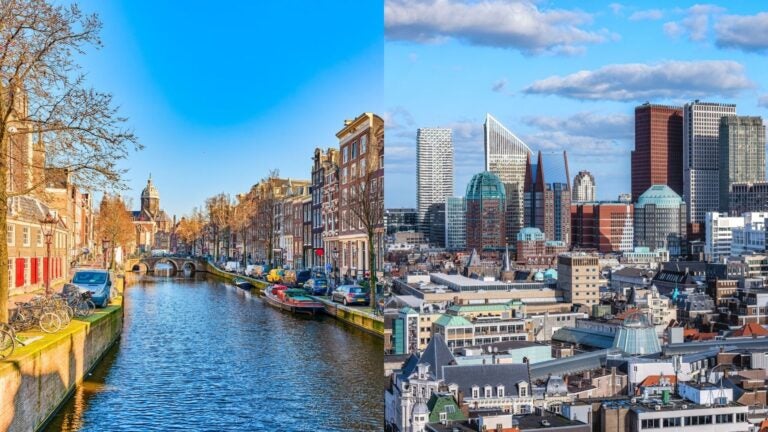
Renting in a secondary city: Rotterdam, The Hague, and Utrecht offer more choice for your buck, but they’re not cheap alternatives.
Buying property: Foreigners can buy Dutch property, but getting a mortgage, meeting income requirements, and navigating taxes and legal paperwork are separate questions. Get advice from a Dutch mortgage adviser and property lawyer before making an offer.
The affordability gap: This one’s important for Americans. CBS data puts the median housing-cost ratio for Dutch households at 20.1% of disposable income. In the Amsterdam metropolitan region, renters were spending an average 27% of net income on rent. A US remote worker earning dollars can therefore experience the Netherlands very differently from someone earning a Dutch salary.
A €1,500 rent may be uncomfortable on a local income but manageable on a strong US salary. Anecdotally, this is what comes through in Reddit discussions as well. A 2025 discussion in r/Amsterdam described studios around €1,500-1,600 as common in the listings users were seeing, with better apartments costing substantially more.
Food and grocery costs in the Netherlands
Budget about €350 a month for groceries for 1 person if you cook regularly and shop sensibly. Food is not necessarily a huge saving compared with the US.
The Netherlands has relatively high consumer prices overall, and Eurostat places Dutch household consumption prices above the EU average. Cooking at home can still keep your food budget under control. A low-spender can manage around €250 a month, while someone buying premium products, imported US brands, alcohol, and convenience foods can easily reach €500 or more.
Eating out is where your budget starts increasing quickly. Local cafés and casual restaurants are much easier to fit into an average budget than frequent sit-down meals, delivery, or international restaurants.
Transport costs in the Netherlands
Set aside about €100 a month for transport if you rely mainly on public transport and cycling.
You do not need a car for everyday life in most Dutch cities. Trains, trams, buses, and cycling make car-free living genuinely practical. Amsterdam’s GVB, for example, charges €129 for unlimited monthly travel on its own network, while pay-as-you-go fares start at €1.16 plus €0.217 per kilometre.
Cycling can reduce your transport budget considerably. Bike ownership is common, and cycling is often the fastest way to make short urban trips.
Outside major cities, a car’s more useful, especially if your home and workplace are poorly connected by rail or bus. But this is also when fuel, insurance, parking, and maintenance costs can push transport well above €200 a month.

Healthcare costs in the Netherlands
Keep aside €159 a month for basic health insurance. The Dutch system is different from the US. If you live or work in the Netherlands and fall under the Dutch system, you need to take out basic health insurance from a Dutch insurer. The government regulates the basic package, which covers care such as GP visits, hospital treatment, and prescribed medicines. The average basic premium for this is €159 a month. Adults also have a mandatory €385 annual deductible for most care covered by the basic package, although GP care is not subject to that deductible.
Additional insurance, such as dental coverage, costs extra and is not mandatory. If you have a complicated medical situation, check your coverage carefully with a licensed Dutch insurance broker before moving.
Monthly budget breakdown: What does life in the Netherlands actually cost?
Your monthly cost of living in the Netherlands will depend largely on where you live, your housing choices, and your day-to-day spending. Based on the estimates in this guide, a single person could budget around €1,660 to €3,760 per month, with €2,480 representing a more moderate spending level.
Here’s what each of those budgets could look like in everyday life.
- Low-spender: €1,660/month. This is a careful budget. You live outside the most expensive neighborhoods, choose a modest accommodation, cook most meals, cycle and use public transport, and keep entertainment fairly simple. The €159 basic insurance premium is included, but you’d still want to save for the €385 deductible if you need covered care. This budget can work for someone with a modest pension or Social Security, but it leaves little room for frequent travel, major purchases, or unexpected expenses.
- Average-spender: €2,480/month. This is if you want a reasonably comfortable lifestyle without living extravagantly. You’ll be living in a decent one-bedroom in a well-connected area, go grocery shopping regularly, eat some meals out, use public transport, cycling, and the occasional taxis, and have a normal social life. For an American earning a steady remote income, this is much more achievable than it would be on a modest Dutch salary in Amsterdam. If you’re considering working in the Netherlands, however, please tally your expected income with your expenses before making the move.
- Big-spender: €3,760 a month. This is where the cost of living in the Netherlands starts to resemble a comfortable Western expat lifestyle. You have a larger or more central apartment, eat out frequently, use taxis or a car more often, buy international products, and spend more freely on entertainment. A strong US salary can support this lifestyle, but you should still account for taxes, currency movements, and travel costs separately.
Is the Netherlands cheaper than the US?
Yes, in some categories, but the Netherlands is not uniformly cheaper than the US. Housing is the big variable. A US household moving from a lower-cost American city may find Dutch rent extremely high, while someone coming from New York, San Francisco, or another expensive US city may find it more familiar.
The Netherlands can be affordable for its public transport, cycling infrastructure, and regulated healthcare costs. Food is not automatically cheaper, however, and imported American products can be expensive. Eurostat data also places Dutch overall household consumption prices above the EU average.
For a broader comparison, see the cost of living in the US.
Stay connected in the Netherlands and beyond with Holafly
If you’re living in the Netherlands for months on end rather than just visiting, connectivity becomes as important as the other expenses mentioned above. You may need to manage US bank accounts, receive verification codes, and travel to other European countries without constantly changing SIMs.
That’s where Holafly Plans comes into the picture. It offers a monthly option with coverage in 160+ destinations. The Unlimited Plan includes unlimited data, hotspot use, and a local US, UK or Canada number, while the Light Plan is designed for lighter data users.
Both plans also include Always On, which provides 1GB of backup data each month and activates automatically when installed.
You can also check eSIM for the Netherlands before you move.

FAQ: Cost of living in the Netherlands
Is €3,000 a good salary in the Netherlands?
Yes and no. It depends on whether you mean gross or take-home pay and where you live. A €3,000 gross salary can feel tight for a single person renting alone in Amsterdam, while €3,000 net gives you considerably more breathing room.
Is healthcare free in the Netherlands?
No. Residents pay a monthly basic health insurance premium, which averages about €159. The government regulates the basic package, and adults also have a €385 mandatory deductible for most covered care.
Is it cheaper to live in the UK or the Netherlands?
There is no universal winner because housing and lifestyle make a major difference. London is particularly expensive, while comparing smaller Dutch cities with smaller UK cities can produce a very different result.
Is it cheaper to live in the Netherlands or the US?
For many Americans, it depends more on where they live in the US than on the country alone. Dutch healthcare and urban transport can make some everyday expenses easier to manage, while housing and certain consumer goods can be expensive.
Sources and methodology
This guide uses data and information from Statistics Netherlands (CBS), the Dutch national government, Zorginstituut Nederland, the Municipality of Amsterdam, GVB and Eurostat, supplemented by Reddit discussions for context. The 3 budget totals focus on the same 6 categories: Housing, groceries, transport, utilities, healthcare, and lifestyle spending.
Sources
- Statistics Netherlands: rent increases
- Statistics Netherlands: 2026 energy bills
- Dutch government: 2026 health insurance changes
- Dutch government: mandatory health insurance and deductible
- Dutch government: 2026 average health premium
- Municipality of Amsterdam: housing market and affordability
- GVB: 2026 public transport fares
- Eurostat: household consumption price levels
- US Bureau of Labor Statistics: Consumer Expenditures
- Reddit: Netherlands cost-of-living
- Reddit: Amsterdam housing
Plans that may interest you


With an MBA degree I used to put to good use in another life, I now write for both passion and profession! When not writing, I'm exploring the world, collecting stories and souvenirs along the way.