




 Language
The ultimate corporate event planning checklist (73 steps)
A step-by-step corporate event planning checklist, from budget to post-event ROI.

Corporate events have many moving parts, and one missed detail can put a dent in the day.
This corporate event planning checklist contains:
- Pre-event planning
- Running the event
- Post-event wrap-up
- A downloadable version of this checklist in Google Sheets at the end for your convenience.
If your event pulls employees in from abroad, keeping them online is one more item worth solving, which is where Holafly for Business can help.

Business travel made easy
Want to learn more? Check out these guides:
- Corporate event management: What it is and how to do it
- Corporate event planning: How to do it in 8 steps
- Corporate incentive travel: What it is and how to plan it
Phase 1: Pre-event planning
Phase one covers every decision made before doors open.
Setting the event’s purpose, building the budget, timeline, venue, vendor, travel, registration, speaker, food, sponsorship, marketing, and risk plans.
Get these twelve pieces right, and phases two and three are largely a matter of execution.
1. Define your goals and audience
Every event should trace back to a business goal, be it team bonding, client retention, or a product launch.
- Decide whether the event is internal, client-facing, or hybrid, and what its outcome is.
- Bring in sales, marketing, and leadership early to align on the audience.
- Draw on CRM records and past registration data to predict turnout and segment your invitation list.
- Look back at what worked well and what didn’t last time, and carry those lessons into this one.
- Settle on how you’ll measure the event’s success (e.g., lead quality, engagement, renewal rate, attendee satisfaction), so you have something to report against.
- Confirm the event’s tone and format match your company’s values.
2. Build the budget
A realistic budget prevents most of the costly surprises that might arise later.
- Cover venue, A/V, catering, marketing, insurance, signage, staffing, and travel before requesting a quote.
- Remember that permits, graphic design and printing, temporary labor, and speaker honoraria add up and are easy to forget about.
- Set aside ~10% of the total budget for unplanned costs.
- Update your estimated budget into a projected one as vendor bids come in, using a weighted scoring grid to compare offers.
- Check actual costs against your projections during planning.
3. Set the timeline and core team
Your timeline is the one document that keeps other tasks on schedule.
- Note that strategy and budget usually take shape three to six months out, with logistics and vendor contracts following two to three months before the event.
- Give each team member ownership of one piece, from vendors to registration to day-of logistics.
- Weigh whether the event’s scale and complexity justify hiring a professional planner.
- Hold regular committee meetings and share timeline updates.
4. Source and contract the venue
The venue shapes almost every other decision, so vet carefully before signing anything.
- Narrow venue options based on where attendees are traveling from, capacity, the time of year, and the atmosphere you want.
- Check A/V capability, parking, accessibility, load-in access, local amenities, and how the layout flows between spaces.
- Confirm hotels are within easy reach for out-of-town guests.
- Push for attrition, cancellation, indemnification, force majeure, and no-walk clauses before signing, since these limit your liability if plans change.
- Decide who makes the backup-venue call and how you’ll communicate it to attendees.
5. Vet vendors and align your tech stack
Vendor selection covers software as much as it covers catering and decor.
- Cover catering, A/V, decor, and photography early so you have room to negotiate.
- Ask about CRM sync, badge printing, data security, and reporting.
- Confirm registration-to-badge and multi-venue check-in hold up.
- Collect certificates of insurance and any required permits from vendors.
- Coordinate police or security forms and schedule a fire marshal walkthrough for tents, staging, or outdoor structures, as these often require separate layout approval.
6. Plan travel and accommodations
Anyone traveling in for the event needs a plan that covers more than just a plane ticket.
- Decide on your budget ceiling, location type, and amenities.
- Track arrivals, departures, hotel bookings, and any special needs for each traveling person.
- Book shuttles or transportation for attendees and speakers coming from the airport.
It’s also where your company’s business travel duty-of-care obligations come into play for staff traveling to the event. If the guest list is large enough to strain your usual booking process, it’s worth learning about what a travel management company is and comparing the best corporate travel agencies before you do it in-house.
7. Set up registration and RSVP tracking
The registration setup depends on how formal the event is.
- Use a simple RSVP for casual events and a full registration site for larger ones.
- Collect dietary restrictions, accessibility accommodations, and pronouns as part of registration.
- Log RSVPs and status updates in your CRM or a spreadsheet.
- Lean on past event data to anticipate how many confirmed guests won’t show.
8. Recruit and prep speakers
Speakers need almost as much logistical planning as the venue.
- Document their A/V, greenroom, and travel needs.
- Gather headshots and phonetic name spellings ahead of the event.
- Build a talking-points book with markers for each speaker change.
- Hold a rehearsal with speakers the day before the event.
9. Plan food, beverage, and accessibility
Food and drink choices come down to price and accessibility.
- Decide on meal types, headcounts, dietary options, and whether any meals will be served offsite.
- Confirm with your caterer when final numbers are due and whether late additions have a surcharge.
- Map out the room layout.
- Book translation, simultaneous interpretation, or CART captioning for attendees who need it, and budget for two interpreters if the event runs long enough, so they can switch off.
- Arrange for a stenographer or a verbatim transcription for a formal record of the proceedings.
10. Design sponsorship tiers (if applicable)
Sponsorships work best when built into the agenda.
A tiered structure gives sponsors a good reason to sign: Platinum might include a keynote slot and lead-scanning access; gold, a breakout session and signage; silver, a tabletop with attendee list access.
Draft each proposal with an ROI case specific to that tier.
11. Market and promote the event
An event that isn’t marketed can struggle to fill the room, no matter how well it’s planned.
- Combine email, social, press, and blog content to reach your audience.
- Write different copy for sponsors and exhibitors than for attendees.
- Produce invitations, signage, and program books.
- Track your site launch date, press, and list growth against a schedule.
12. Build a risk mitigation plan
Every event needs a plan for what happens if something goes wrong.
- Map a response for each scenario you identify.
- Verify requirements with local authorities.
- Review contracts, as some liability for a vendor’s shortcomings can fall back on you as the organizer.
- Document response routes and evacuation procedures.
- Draft messaging for each risk scenario, including how you’ll communicate internally during the incident, brief the venue and vendors on their part in the response, and manage post-event public reporting.
Phase 2: During the event
Phase two covers the event itself: staffing the room, tracking what’s happening, and managing the logistics, such as badges and signage.
13. Run the show and staff the room
Your pre-event planning becomes a live operation when the doors open.
- Convert your timeline into a daily schedule.
- Pair a project manager with role-specific team members for each event component.
- Pack pens, tape, safety pins, and spare nametags for last-minute fixes.
- Give staff and volunteers a briefing document and walk them through.
14. Monitor live and adapt
Conditions can change, so don’t assume the schedule will hold as written.
- Track check-ins, app engagement, and sponsor lead scans.
- Line up backup speakers, overflow plans, and a secondary audio feed.
- Keep the backup-venue decision-maker reachable and the communication line open.
15. Manage badges, signage, and flow
Small operational details are what attendees notice most.
- Keep blank nametag templates on hand for surprise guests, and consider an on-site badge-printing machine for large events with many walk-ins.
- Station volunteers at key decision points to keep traffic moving.
- Tie the photo and video coverage to VIPs and program highlights.
Phase 3: Post-event
Phase three covers everything after the doors close: reconciling the budget, collecting feedback, and turning what you learned into a better starting point for the next event.
16. Close out logistics and finances
The event isn’t finished until the accounts are settled.
- Return unused materials, and settle accounts and invoices with vendors.
- Check spend against your projected numbers, and note categories that ran over for next time’s budget.
- Close outstanding payments and send thank-yous to speakers, sponsors, and vendors.
17. Collect feedback and measure ROI
Feedback only pays off if it’s tied to the goals you set at the start.
- Send questions to attendees, sponsors, speakers, and internal stakeholders.
- Match survey questions to the goals you set in phase one.
- Document what worked and what didn’t, and report results to stakeholders.
- Combine your metrics with a post-event dashboard for a complete ROI picture.
18. Turn results into your next event cycle
A finished event is also the starting point for the next one.
- Cover venue, content, and budget takeaways in one document.
- Save your budget sheets, vendor comparison grids, and logistics trackers.
- Turn recordings and engagement data into sales enablement or marketing material.
- Lock in next year’s venue while momentum is high, if the event is recurring.
Downloadable checklist in Google Sheets
For your convenience, we’ve put together this corporate event planning checklist as a ready-to-use Google Sheet.
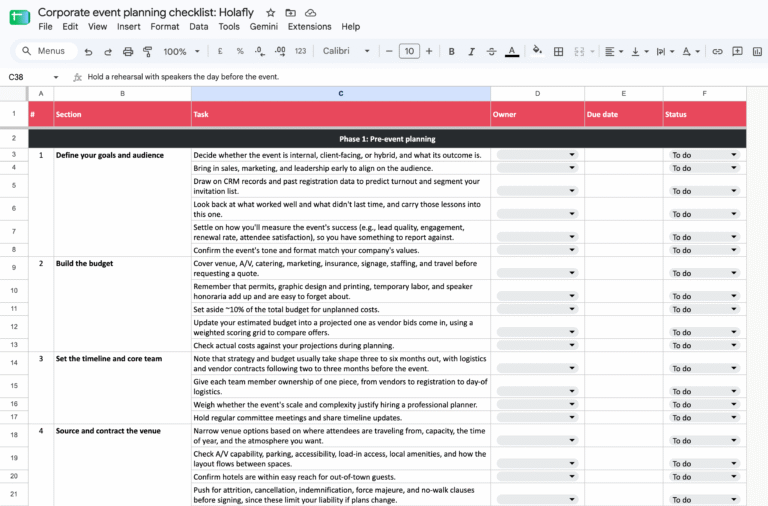
(Screenshot: Google Sheets version of the corporate event planning checklist)
Treat it as a starting point and feel free to modify it to fit your event.
Give traveling event staff secure data with Holafly for Business
When your event brings staff across the globe, secure mobile data is part of the plan.
Holafly for Business is an eSIM provider available in 160+ destinations that activates on your team’s devices, so they don’t have to worry about sourcing local SIM cards or unexpected roaming charges. You also get access to our centralized management platform, the Holafly Business Center, where you can manage individual eSIMs, invoices, and data usage.
Holafly Plans for Business come in four tiers, all featuring hotspot, 4G/5G, and 24/7 multilingual support:
- Daily: unlimited data with pay-per-day flexibility, built for short business trips under 16 days a month.
- Monthly: unlimited data for teams traveling more than 16 days a month, a fit for frequent travelers and long-term remote staff.
- Annual: unlimited data for ultra-frequent travelers, suited to long-term global operations and predictable annual budgets.
- Enterprise: custom-built plans for companies managing travel for 20+ employees a year, with volume discounts, a dedicated account manager, priority support, and custom integrations, built to optimize costs, streamline operations, and ensure seamless global connectivity across teams.
Not sure which plan is right for your team? Book a demo.
Business travel made easy
FAQ
The legal clauses worth negotiating into a venue or hotel contract include attrition, cancellation, indemnification, force majeure, and no-walk clauses, all of which limit your liability if attendance or plans change.
A good RFP for event technology vendors centers on integration needs, such as CRM sync, badge printing, data security, and reporting. Confirm those workflows hold up by testing them in a vendor demo.
Corporate event planning generally starts three to six months out for strategy and budgeting, narrows into vendor contracts and logistics two to three months before the event, and covers final preparations in the last two to four weeks.
Measuring ROI on a corporate event requires tying the KPIs you set in phase one (e.g., lead quality, engagement, renewal rate, satisfaction) to a post-event analytics dashboard so you can compare results against your original goals.
The accessibility accommodations a corporate event should plan for include ADA-compliant venue access, CART captioning or ASL interpretation, and a registration process that captures dietary and accessibility needs.
It’s best to segment post-event feedback surveys by audience (e.g., attendees, sponsors, speakers, internal stakeholders), as each group can speak to a different aspect of the event.
The best way to handle a rain plan or event backup is to decide who makes the final call and how you’ll communicate it before the event, then keep that decision-maker reachable during the day.

I’m a writer with over eight years of experience in digital content. My work has appeared in publications such as The New York Times, Forbes, Business Insider, and the BBC. At Holafly, I write clear, practical guides to help travelers stay connected with eSIM technology. In my spare time, I enjoy car detailing, biking around Warsaw, and capturing portraits.