Language
Company travel expense policy (Template and guide)
Get a free company travel expense policy template in Google Docs, plus how to write one in 7 steps.

A company travel expense policy is the set of rules for how employees book, spend, document, and get reimbursed for business travel. A travel and expense (T&E) policy is part of the broader travel and expense management, but it’s narrower than a corporate travel policy, which also covers booking mandates and risk management.
This guide contains:
- How to write a travel and expense policy
- How to enforce policy compliance
- A free company travel expense policy template
If your employees travel abroad, Holafly for Business can keep them online with secure mobile data.

Business travel made easy
Want to learn more? Check out these guides:
- Corporate travel budget: How to build and manage one
- Corporate travel planning: How to do it in 10 steps
- Travel policy best practices for your company
- Travel expense analytics: What it is and how to set it up
- Travel and expense reporting: What it is and how to do it
Company travel expense policy template
For your convenience, we’ve put together a ready-to-use company travel expense policy template as an editable Google Doc.
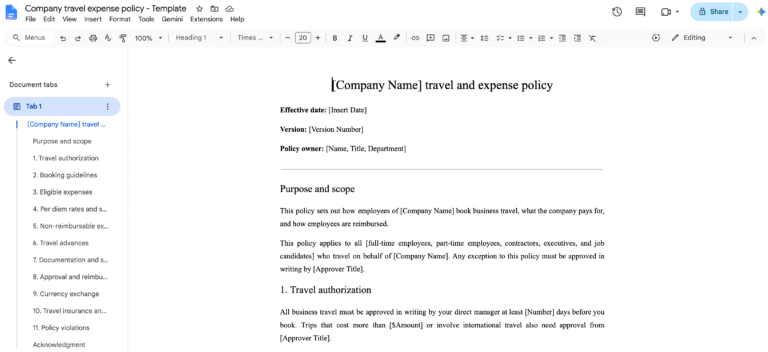
(Screenshot: Google Docs version of the company travel expense policy template)
Treat it as a starting point, and edit it to fit your company’s size, travel patterns, and local laws.
Why your business needs a travel expense policy
According to the Association of Certified Fraud Examiners, companies lose an estimated 5% of revenue to fraud per year. SAP Concur reports that nearly 20% of T&E expenses fall outside travel policies.
Here’s what a good policy gives you:
- Spending limits are set before the trip, so there are fewer surprises on the card statement.
- Written rules lower expense report mistakes.
- Reports move through approval more quickly, and employees get paid back on time.
- Employees know what is and isn’t reimbursable.
Who should know the company travel expense policy
Everyone who books, approves, or processes travel needs to know the policy.
Here’s how each group uses it:
| Group | Role in the policy |
|---|---|
| Employees | Travelers check the spending limits, preferred vendors, and receipt rules before they book a trip |
| Managers | Managers act as the first line of approval, signing off on trips and handling exception requests |
| Finance team | Finance reviews expense reports, processes reimbursements, and keeps the audit trail clean |
| HR and operations | HR shares the policy during onboarding and updates everyone when rules change |
What to include in a travel and expense policy
A complete policy covers every stage of a trip, from booking to reimbursement.
Below are the nine sections to build in:
1. Eligible expenses
Eligible expenses are the costs the company pays for, and you’ll need to spell out the rules for each category:
- Air travel: Economy class as the default, when business class is allowed, whether fares must be refundable, and which extras (e.g., checked bags, in-flight meals) are covered.
- Lodging: Standard rooms at preferred hotels, and which incidentals are reimbursable (e.g., WiFi, parking, late checkout fees).
- Transportation: Rail class, taxis, and rideshare between locations, the rental car class, and mileage for personal vehicles at your rate or the IRS standard mileage rate.
- Meals: Costs with a cap, or a fixed daily per diem.
- Incidentals: Business-related costs (e.g., tolls, tips, dry cleaning).
2. Non-reimbursable expenses
It’s important to be clear about what the company won’t cover, so employees avoid unwanted surprises:
Common exclusions include:
- Personal entertainment
- Unauthorized upgrades
- Mini-bar charges
- Traffic tickets and parking fines
- Personal items
- Travel costs for family members
3. Per diem rates and spending limits
A per diem is a fixed daily allowance for meals and incidental expenses.
Companies usually base their per diem rates on the GSA per diem rates for US locations and the US Department of State rates for foreign countries.
For fiscal year 2027 (starting October 1, 2026), the GSA standard rate is $113 per night for lodging and $68 per day for meals and incidentals.
4. Booking guidelines
Booking rules tell employees where and how to reserve travel.
Here’s what your policy should cover:
- Preferred vendors: Airlines, hotels, and rental car companies where you have negotiated rates.
- Class of travel: Economy as the default, and when (if ever) premium economy or business class is allowed.
- Advance booking: A minimum window (e.g., 14 days before departure for flights).
- Booking channel: The approved booking tool or travel management company (TMC) employees must use.
5. Approval workflow
Approvals happen before and after the trip.
For pre-trip approval, employees submit a travel request to their manager listing the destination, travel dates, business purpose, and estimated costs.
After the trip, the reimbursement process is as follows:
- The employee pays for a business expense.
- They submit an expense report with receipts.
- Their manager reviews and approves the report.
- The finance team approves and processes the payment.
6. Documentation and submission deadline
Itemized receipts and a business purpose back every expense claim. Each receipt should show the vendor, date, and total amount, and you can require them for any expense over a set amount (e.g., $25).
You may also want to set a submission deadline, such as within 30 days of the trip’s end.
7. Travel advances
A travel advance is money paid to an employee before a trip to cover out-of-pocket costs.
Your policy should explain how to request one (e.g., by submitting a form a set number of days before the trip), any cap on the amount, and how the advance is reconciled with the expense report.
8. Currency exchange
For international trips, set a rule for converting foreign-currency expenses, such as your company’s rates or rates from a bank or currency exchange service.
Ask employees to document the rate, its source, and the date.
9. Travel insurance and duty of care
Business travel duty of care is your legal and ethical obligation to keep traveling employees safe.
Company-provided travel insurance should cover:
- Trip cancellation
- Medical emergencies
- Lost luggage
- Emergency evacuation
High-risk activities (e.g., extreme sports) are typically excluded, so employees need their own coverage for them.
It’s also a good idea to list 24/7 emergency contacts, how you’ll communicate during a crisis, rules for booking well-known hotels, and where to find the latest travel advisories.
How to write a travel and expense policy in 7 steps
Writing a company travel expense policy comes down to a few steps:
- Review your travel spending. Pull recent expense reports to see where people overspend and where confusion comes up.
- Define the policy’s goals and scope. Decide whether you’re after cost control, compliance, clearer expectations, or all three, and list whom it covers (e.g., full-time staff, part-timers, contractors).
- Draft rules for each expense category. Be specific, so “a nightly cap by city tier” replaces “reasonable lodging.”
- Set the approval and reimbursement steps. Name who signs off at each stage, which documents are needed, and how long reimbursement takes.
- Build in compliance and safety measures. Line your rules up with IRS guidelines and state reimbursement laws, and add a process for reporting lost or stolen company property (e.g., laptops, phones).
- Gather feedback before you finalize. Share the draft with finance, HR, legal, and a few frequent travelers to spot issues early.
- Roll out the policy and embed it in your tools. Share it by email, Slack, and during onboarding, then add the rules into your expense software.
Pro tip: If your T&E policy falls under a broader travel program, our guide to managing corporate travel covers booking, vendors, and approvals.
Best practices for a policy that employees follow
A company travel expense policy only works if people read it and follow it.
These habits should help:
- Keep the document short and plain, with headings and without jargon.
- Apply the same limits company-wide, and document exceptions for executives or specific roles.
- Make submitting expenses easy.
- Invite employee input before rollout, since people who help shape the rules are more likely to follow them.
- Update the policy at least once a year, or whenever travel patterns or costs shift.
How to enforce policy compliance
Enforcement works best when it’s built into your process and tools.
Here’s how you can keep people on track:
- Require manager sign-off before booking and after the trip, with automated routing for a clean audit trail.
- Name the common violations (e.g., missing receipts, upgrades without pre-approval, personal expenses, late reports) and what follows, from delayed reimbursement to disciplinary action for repeated or fraudulent claims.
- Use travel and expense management software to flag out-of-policy spending and missing receipts before a report reaches finance.
- Run monthly or quarterly audits to spot repeat offenders and limits that no longer fit.
Give traveling employees secure data with Holafly for Business
When your employees travel for business, secure mobile data is key.
Holafly for Business is an eSIM solution available in 160+ destinations that activates on your team’s phones, so they don’t have to worry about local SIM cards or roaming charges. You also get access to our centralized management platform, the Holafly Business Center, where you can manage individual eSIMs, invoices, and data usage.
Holafly Plans for Business come in four tiers, all featuring hotspot, 4G/5G, and 24/7 multilingual support:
- Daily: Unlimited data with pay-per-day flexibility, built for short business trips under 16 days a month.
- Monthly: Unlimited data for teams traveling more than 16 days a month, a fit for frequent travelers and long-term remote staff.
- Annual: Unlimited data for ultra-frequent travelers, suited to long-term global operations and predictable annual budgets.
- Enterprise: Bespoke plans for companies managing travel for 20+ employees a year, with volume discounts, a dedicated account manager, priority support, and custom integrations, built to optimize costs, streamline operations, and ensure seamless global connectivity across teams.
Not sure which plan is right for your team? Book a demo.
Business travel made easy
FAQ
The $2,500 expense rule is the IRS de minimis safe harbor, which lets businesses without an applicable financial statement deduct items costing up to $2,500 per invoice or item immediately rather than capitalizing them.
The IRS rules for business travel expenses cover ordinary and necessary costs when work keeps you away from your tax home substantially longer than an ordinary day, and you need sleep or rest, with business meals generally limited to 50% of the unreimbursed cost. IRS Publication 463 also requires receipts for all lodging and for any other expense of $75 or more.
The 300% rule for travel expenses comes from the Federal Travel Regulation, which allows federal agencies to reimburse lodging costs up to 300% of the per diem rate when no room is available at the standard rate.
Employers aren’t required by federal law to reimburse travel expenses, although the Fair Labor Standards Act (FLSA) requires some travel time to be paid as hours worked. Some states, such as California (Labor Code Section 2802) and Illinois (820 ILCS 115/9.5), require reimbursement of necessary business expenses, and Massachusetts courts have read the state’s wage law to cover some of them.
Reimbursements are tax-free for employees when you pay them through an IRS accountable plan, which requires a business connection, substantiation within a reasonable time, and the return of any excess amounts. Under the IRS safe harbor, employees account for expenses within 60 days and return any excess within 120 days.

I’m a writer with over eight years of experience in digital content. My work has appeared in publications such as The New York Times, Forbes, Business Insider, and the BBC. At Holafly, I write clear, practical guides to help travelers stay connected with eSIM technology. In my spare time, I enjoy car detailing, biking around Warsaw, and capturing portraits.