Language

Romania doesn’t really do Halloween. So how did Transylvania become its spookiest destination?
Transylvania wasn’t always a Halloween destination. Discover how Romanian history, vampire fiction, and tourism made it become ‘Dracula’s home.’

Every Halloween, travelers flock to Transylvania, eager to explore its haunted castles, vampire legends, and ties to Dracula. But there’s one catch: Halloween isn’t a traditional Romanian holiday.
So how did Transylvania become one of the world’s most famous spooky destinations?
The answer lies in an unlikely chain of events, from a 15th-century prince and a Victorian vampire novel to a medieval castle transformed into a tourist attraction.
Read on to discover the timeline behind Transylvania’s transformation into a Halloween hotspot.
| Year | Moment | What it added |
|---|---|---|
| 1400s | Vlad III rules Wallachia | The name “Dracula” |
| 1885 | Emily Gerard’s essay on Transylvanian superstitions | The vampire folklore |
| 1890 | Bram Stoker visits Whitby | The idea and the name |
| 1897 | Dracula is published | Transylvania as the setting |
| 1931 | Bela Lugosi’s Dracula | The cape-and-castle image |
| 1972 | In Search of Dracula | The Vlad and Dracula link |
| 2000s onward | Bran Castle leans into the legend | Halloween tourism |
Halloween was never a Romanian tradition
Halloween isn’t a holiday in Romania, but they do observe other spiritual days dedicated to the dead, such as Moșii de Toamnă (Autumn Ancestors’ Day) on November 7.
Romania also has its own supernatural folklore. Strigoi and Moroi are known locally as the real vampires of Romania, who have been feared by rural communities for centuries. Locals would protect themselves by rubbing garlic around doors and windows.
So, those Halloween celebrations you encounter in Transylvania today?
They are largely modern, tourism-focused events designed for international travelers, based on Halloween’s Celtic roots rather than long-established Romanian customs.
The real Dracula: A prince, a dragon and a name
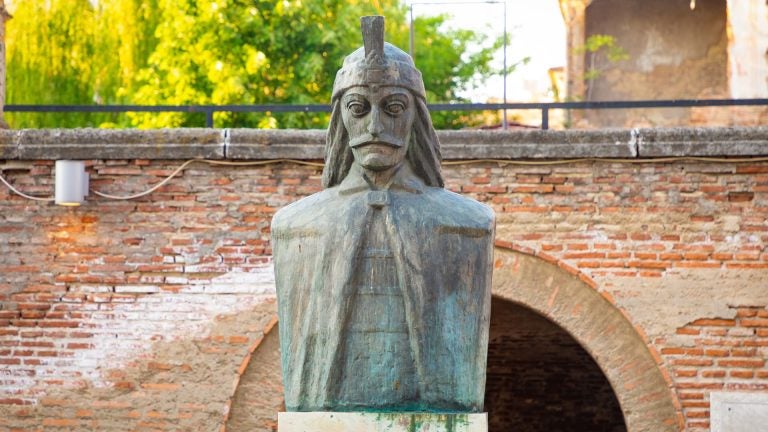
Internationally, Dracula is known as the vampire antagonist in Bram Stoker’s 1897 gothic horror novel.
This fictional character was loosely inspired by Vlad the Impaler (Vlad III), a 15th-century prince who earned a fearsome reputation for his brutal methods of execution.
But the name Dracula actually came from Vlad III’s father, Vlad II, who belonged to the Order of the Dragon. His nickname was Dracul, meaning “the Dragon”; hence, Vlad III became known as Dracula, meaning “son of Dracul.”
Despite his brutality, Vlad III was never originally linked to vampires. That connection came later, when Bram Stoker borrowed the name for his fictional Count Dracula.
The Irish writer who never set foot in Transylvania
Bram Stoker may have written the 1897 novel Dracula, but this Irish-born author never actually stepped foot in Romania.
Instead, he created the fictional Count Dracula, inspired by books, folklore, and, most surprisingly, a holiday in Whitby on England’s Yorkshire coast. It was here that Stoker pieced together the Gothic backdrop based on the seaside town’s dramatic abbey ruins and windswept churchyard.
So if you’re interested in seeing the inspiration behind the world of Dracula, book a flight to Newcastle or Leeds, buy a UK SIM card, and take a train to Whitby, changing at Middlesbrough for the scenic Esk Valley line.
Stoker settled on the name Dracula by reading an 1820 book by William Wilkinson, which noted Vlad the Impaler’s nickname, “Dracula”.
Then, for the region’s supernatural lore, Stoker drew heavily on Emily Gerard’s 1885 essay Transylvanian Superstitions, which described local beliefs about vampires and other spirits.
One fun detail?
In his early notes, Stoker called the villain ‘Count Wampyr’ and based the story in Styria, Austria, before switching to Dracula and Transylvania.
How Hollywood gave Transylvania its look
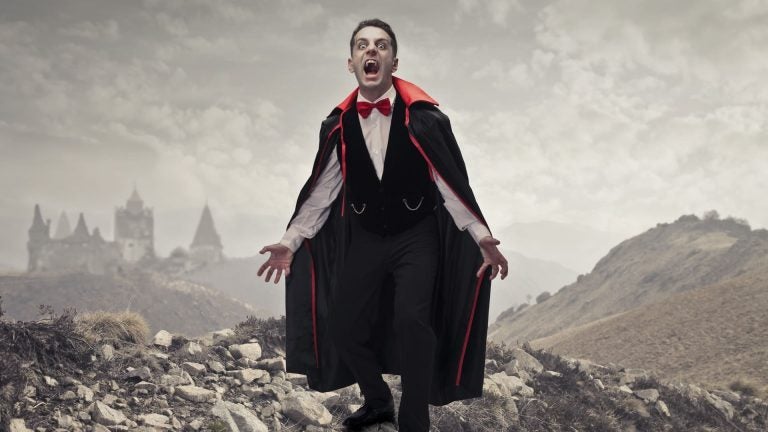
Bram Stoker’s novel set the stage for Transylvania’s spooky reputation. In 1924, Hamilton Deane adapted it into a stage play; then, in 1931, it became the first Hollywood Dracula movie, starring Bela Lugosi.
This black-and-white film cemented the Transylvanian castle image and the vampire’s signature look: a sweeping black cape, hypnotic stare, pale skin, and slicked-back dark hair.
Then came Britain’s 1958 version of Dracula, produced by Hammer Films. It was the first color vampire movie, adding fangs, vivid red blood, and a more visceral horror-style look.
These screen adaptations put the Romanian region on the map, making “Transylvania” known for haunted castles and vampires. This reputation continued to grow throughout the decades as further Dracula movies were released.
The 1972 book that sent tourists looking for Dracula
In 1972, historians Radu Florescu and Raymond T. McNally published ‘In Search of Dracula.’ The book connected Vlad the Impaler with Bram Stoker’s fictional vampire, inspiring Western readers to travel to Transylvania in search of Count Dracula.
For communist-era Romania, this created an awkward dilemma. Many regarded Vlad as a national hero, and the vampire myth clashed with the country’s carefully managed image as a modern socialist state.
Officials debated whether to discourage Dracula tourism or profit from it. Ultimately, they began promoting historical sites linked to Vlad, and tour groups started running tours of these sites.
How Bran Castle became “Dracula’s Castle”
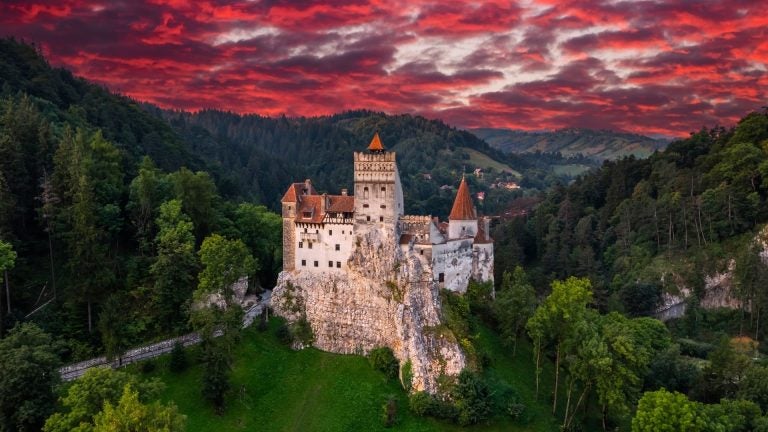
Perched dramatically on a rocky outcrop above a mountain valley, Bran Castle looks like the perfect setting for a vampire story. Yet the fortress had little or no connection to Vlad the Impaler. He likely passed through the Bran Pass a few times, but there’s no record that he ever stayed there.
Construction began after 1377, when Brașov’s townspeople were granted permission to build a defensive fortress, and it was finished in 1388. In 1920, the city gifted it to Queen Marie of Romania, who made it her beloved royal retreat until the communist government confiscated it in 1948.
In 1956, the communist government reopened it as a public museum. The castle was returned to Queen Marie’s Habsburg heirs in 2006, and today it embraces both sides of its identity: a royal residence steeped in Romanian history and its legend as one of the most haunted castles in Europe.
Dracula Land, the theme park that never happened
In the early 2000s, Romania had an ambitious plan to turn Dracula into a tourist goldmine. They wanted to build a huge vampire-themed amusement park near Sighișoara, the medieval Transylvanian town associated with Vlad the Impaler’s birthplace.
The project was announced in 2001, but it soon faced fierce opposition from environmentalists, religious groups and heritage campaigners. UNESCO also warned that the park could harm Sighișoara’s UNESCO-listed historic center. The government dropped the Sighișoara site in early 2003, and a later plan to move the park near Bucharest also fizzled out.
The story of Dracula Land is a clear example of the ongoing tension between selling an internationally famous vampire myth and protecting Romania’s real history and landscapes.
However, Romania does seem to have found a compromise.
Today, Bran Castle and local tour operators lean into that reputation with special events during Halloween in Transylvania, including at Bran Castle and in cities like Brașov and Sighișoara Citadel.
Can’t get to Transylvania this Halloween? Follow Dracula elsewhere
Halloween 2026 is just days away, so it may be too late to make it to Transylvania this year, but you can certainly start planning a Romania trip for next Halloween.
With smart planning and an eSIM for Europe, you could extend your trip beyond Romania:
- Pair this famous Halloween destination with a more unusual Halloween tradition, such as Estonia’s Nordic folk-style trick-or-treating on November 10.
- Already in the UK this week? Whitby Goth Weekend runs from October 30 to November 1 in the North Yorkshire seaside town that inspired Stoker’s Dracula story.
- Pencil in Dublin’s Bram Stoker Festival for next year. This year’s edition ran October 23 to 26, packed with free or low-cost Dracula-inspired walking tours, storytelling, and parades.
Chase the legend and stay connected with Holafly
Following Dracula’s trail means winding mountain roads, castle villages and late-night ghost tours, where a dropped signal is the last thing you want.
A Holafly eSIM for Romania gets you online the moment you land, with unlimited data, 5G speeds and 24/7 customer support. No local SIM shopping in Bucharest, no roaming surprises.
What’s more, every Holafly eSIM includes Always On: 1 GB of monthly backup data at no additional cost. It activates automatically as long as your eSIM stays installed, renews every month, and works in 150+ destinations. So even if your main plan runs out deep in the Carpathians, you can still check your route back to Brașov or share that moonlit castle shot. Go find the real story behind the legend, and stay connected even when plans change.

Peace of mind before you fly
Set up your eSIM before travel and get unlimited data on arrival.
Plans that may interest you

Hi, I'm Mika, a South Korean writer living in the US. I cover travel and live events, focusing on the practical stuff that makes your trip smoother, whether you're navigating a new city or heading to a major international event.I'm also the founder of Search SEOul, South Korea's leading SEO conference, bringing together search marketing experts and speakers from around the world.