




 Language
Cost of living in South Korea 2026: Honest monthly budget guide
Discover what it really costs to live in South Korea with honest median figures for rent, food, transport, and healthcare, plus real expat insights.

South Korea is generally more affordable than the US, particularly for public transport, dining out, and healthcare, although housing in Seoul can narrow the difference.
A single person should expect to spend around $1,850 per month on average, including rent but excluding the substantial deposit often required to secure a lease.
This guide examines the real cost of living in South Korea, covering housing, food, transport, healthcare, and lifestyle expenses, with comparisons between Seoul and more affordable cities.
Average cost of living in South Korea at a glance
| Category | Low-spender | Average-spender | Big-spender |
|---|---|---|---|
| Rent: one-bedroom apartment in a city center | $505 | $940 | $1,085 |
| Groceries: one person | $180 | $290 | $470 |
| Public transport | $45 | $50 | $95 |
| Utilities | $70 | $110 | $180 |
| Meal at local restaurant | $45 | $345 | $650 |
| Private health insurance | $55 | $115 | $170 |
| Estimated total | $900 | $1,850 | $2,650 |
Below, we break down each expense in detail and explain how housing, food, transport, healthcare, and lifestyle choices can shape your final monthly budget.
Housing costs in South Korea
An average-spender should budget around $940 per month for a one-bedroom apartment in central Seoul, making housing the largest part of the cost of living in South Korea. Monthly rent remains lower than in major US cities, but large deposits and separate building fees make the upfront cost less of a bargain than it initially appears.
- Renting in Seoul: Studios, usually advertised as one-room apartments, cost approximately $500–870 per month, while one-bedroom apartments with a separate living area typically cost $540–940. Hongdae and Sinchon suit students and younger expats; Itaewon has an established international community; and Gangnam offers newer buildings and strong transport links at higher prices. Basic appliances are often included, but utilities and building maintenance fees of around $35–110 per month are generally separate.
- Renting in Busan: Studios generally cost around $325–500 per month, while a central one-bedroom typically costs $430–720. Busan suits remote workers seeking lower housing costs, beach access, and a slower pace without giving up big-city infrastructure. Haeundae and Seomyeon are convenient for international residents, although beachfront and newer properties command higher prices.
- Buying property: Foreigners can purchase property in South Korea, but reporting, registration, tax, and financing requirements apply. Since August 2025, foreign buyers purchasing homes in Seoul and much of the surrounding metropolitan area generally need prior approval, must move in within four months, and must occupy the property for at least two years. Seek independent local legal advice before committing to a purchase.
Furnished apartment rentals
Rental costs vary greatly by area. In Seoul, a one-bedroom flat in the centre costs about ₩1,370,000 ($1,140 | €1,060) monthly. In outer districts like Nowon or Guro, it drops to ₩800,000 ($665 | €615).
Need more space? A two-bedroom flat in Gangnam can exceed ₩2,500,000 ($2,080 | €1,940) monthly. In Busan or Incheon, similar flats cost about ₩1,500,000 ($1,250 | €1,160).
Note: Many Korean rental contracts require a large deposit (key money). Expect between ₩5,000,000 and ₩50,000,000 ($4,160–41,600 | €3,900–38,800).
Co-living spaces
If you read our post on digital nomads in South Korea, you’ll know coliving is an option worth considering. They are becoming increasingly common. Prices depend on included services as well as location.
As a guide, here are the rates of some places popular with the nomad community. Popular ones like Hoppin House or Hive Arena cost between $800–1,500 (€750–1,400) monthly.
In smaller cities like Busan or Daejeon, prices are 20–30% lower. Expect about $600 (€560) monthly.
Airbnb
If you’re staying short term, Airbnbs are an option. On their website, you’ll find Seoul apartments listed at about ₩150,000–200,000 ($125–165 | €115–150) per night.
For longer stays, they’re expensive. You can also try negotiating with landlords. In the capital, budget about $1,500–2,500 (€1,350–2,250) monthly; in smaller cities like Daegu or Daejeon, about $900 (€810).
Hotels
For short stays, you’ll find affordable hotels. A three-star averages $85–150 (€80–135) per night. Examples on Booking:
- Nine Tree Hotel Dongdaemun (Jung-gu, Seoul): from $100 (€90) per night.
- Solaria Nishitetsu Hotel Seoul (Myeong-dong, Seoul): from $130 (€115) per night.
- Lotte City Hotel Myeongdong – strategic location near central Seoul. From $140 (€125) per night.
Note: South Korea’s average monthly wage was approximately $2,770 in 2025, meaning a $940 central Seoul apartment would consume around 34% of gross local pay, before taxes, utilities, and maintenance fees. For a US remote worker earning $5,000 per month, the same apartment would account for approximately 19% of income. Housing can therefore feel expensive on a local salary while remaining relatively affordable for someone earning in US dollars.
Recent discussions in r/Seoul and r/Living_in_Korea during 2025 indicate that advertised rent rarely reflects the full housing cost. Residents reported large deposits, separate maintenance fees, misleading listings, and higher monthly rents for tenants unable to provide substantial deposits.
Food and grocery costs in South Korea
One person should budget around $290 per month for groceries, making food costs broadly similar to the US rather than a major source of savings.
An inexpensive Korean meal typically costs $5–10, while a mid-range restaurant may charge $15–30 per person and Western-style dining often costs $20–50. Cooking at home can reduce spending if you rely on rice, noodles, tofu, eggs, and seasonal Korean ingredients.
Traditional markets generally offer better value than large supermarkets, particularly for fresh produce. However, imported cereal, cheese, wine, beef, and berries can be expensive.

Supermarket prices
Popular supermarket chains include E-Mart, Lotte Mart, and Homeplus. Here are average prices for essentials:
- Milk (1 litre): ₩3,000 ($2.50 | €2.30).
- Eggs (dozen): ₩7,500 ($6.30 | €5.70).
- Chicken breast (1 kg): ₩11,000 ($9.20 | €8.40).
- Beef (1 kg): ₩35,000 ($29.30 | €26.60).
- Tomatoes (1 kg): ₩7,000 ($5.85 | €5.30).
- Local cheese (1 kg): ₩16,000 ($13.40 | €12.20).
- Pasta (500 g): ₩3,500 ($2.90 | €2.60).
- Rice (1 kg): ₩5,000 ($4.20 | €3.80).
- Local beer (0.5 l): ₩2,500 ($2.10 | €1.90).
- Ground coffee (250 g): ₩9,000 ($7.50 | €6.80).
- Chocolate (100 g): ₩3,000 ($2.50 | €2.30).
Prices vary by shop, brand, and location. To save money, buy local products (imported milk and cheese cost more). Traditional markets like Namdaemun or Gwangjang also offer lower prices.
Eating out costs
Eating out in South Korea fits every budget. Here’s what you’ll usually spend:
- Breakfast: Coffee with toast or pastry in cafés like Starbucks costs ₩5,000–8,000 ($4.20–6.70 | €3.80–6.10). A full meal with eggs, soup, and rice is ₩12,000 ($10.10 | €9.10).
- Lunch: A set menu in a local restaurant costs ₩10,000–15,000 ($8.40–12.60 | €7.60–11.40). Fast food chains like Lotteria or Kimbap Cheonguk cost about ₩7,000 ($5.85 | €5.30).
- Dinner: In mid-range restaurants, dishes like samgyeopsal (Korean BBQ) or bibimbap cost ₩25,000–40,000 ($21–33 | €19–30). High-end restaurants exceed ₩60,000 ($50 | €45) per person.

Like elsewhere in Asia, street food stalls are everywhere. They are a great way to save. In markets like Myeongdong Night Market or Gwangjang Market, dishes such as tteokbokki, hotteok, or gimbap cost under ₩5,000 ($4.20 | €3.80).
Overall, local dining offers better value than in the US, but a Western-style grocery basket can quickly push spending above the average estimate.
Transport costs in South Korea
Budget around $50 per month for public transport; in major cities, it is a realistic primary option and a car is unnecessary.
Seoul’s citywide commuter pass costs about $44, while short taxi or rideshare trips typically cost $4–10, substantially less than US equivalents.
A car becomes more useful in rural areas and smaller towns with infrequent bus services, although intercity rail connects major destinations well.
Seoul’s Ddareungi bike-sharing service costs about $22 annually, with shorter passes also available.
Expats discussing transport on r/Living_in_Korea generally recommend avoiding driving in Seoul because of congestion and limited parking, while considering a car outside the capital for rural trips and greater flexibility. Overall, public transport is the simplest and most economical option for most foreign residents.
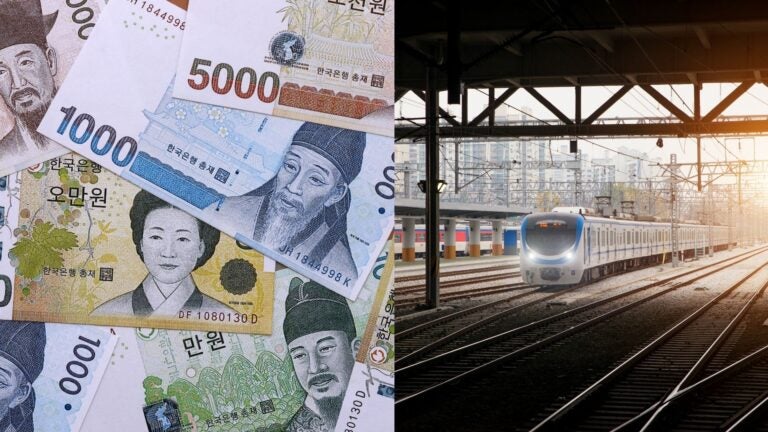
Public transport: metro, buses, and passes
Public transport in South Korea is efficient, fast, and very convenient. Despite the quality, it’s affordable. In Seoul, Busan, and Incheon, metro and bus fares are integrated.
- Single metro or bus ticket in Seoul: ₩1,400–1,800 ($1.10–1.40 | €1.00–1.30).
- Monthly transport pass (Tmoney or Cashbee card): about ₩55,000 ($41 | €38).
Cards like Tmoney and Cashbee make it easy to pay. They also give transfer discounts and can be topped up in stations and shops.
Petrol and EV charging
If you drive, keep in mind fuel and electricity prices for electric cars. Petrol isn’t very cheap, but charging stations are common:
- Petrol price per litre in 2025: 1,750 KRW ($1.34 / €1.25).
- Electric car charging at public stations: ₩260 per kWh ($0.20 | €0.19).
Bike rentals
Shared bikes are widely available. Seoul’s public service, Ddareungi (Seoul Bike), offers affordable plans:
- One-day rental: ₩1,000 ($0.77 | €0.71).
- Monthly subscription: ₩5,000 ($3.85 | €3.57).
- Annual subscription: ₩30,000 ($23.10 | €21.40).
Uber and taxis
Uber operates in South Korea, but in Seoul most taxis work through local apps like Kakao T. Estimated fares:
- 5 km taxi ride (standard): ₩6,000–8,000 ($4.60–6.20 | €4.20–5.70).
- 10 km Uber ride: ₩11,000–15,000 ($8.50–11.50 | €7.80–10.60).
- Base fare (Seoul taxi): 4,800 KRW ($3.70 / €3.40).
Buying a car and insurance
Planning to stay longer and buy a car? Here are average costs:
- New car (Hyundai Avante 2025, Elantra equivalent): from ₩18,500,000 ($14,230 | €13,120).
- Basic car insurance (third-party): ₩600,000–1,000,000 annually ($460–770 | €420–710).
And the annual vehicle tax is about ₩300,000 ($230 | €210).
Healthcare costs in South Korea
Foreign residents typically pay around $115 monthly for public health insurance, while private coverage costs approximately $55–170.
Employees enroll through their Korean employer, while most other eligible residents join after six months. Public insurance covers consultations, tests, treatment, and hospitalization, although copayments apply.
Private insurance supplements this coverage by helping pay for excluded treatments, private hospital rooms, critical illnesses, and remaining out-of-pocket expenses. Seoul and Busan offer more specialists and English-speaking clinics than rural areas.
Expats on r/Living_in_Korea generally report quick access to local clinics but note that major hospitals may require appointments and referrals.
Healthcare is affordable by US standards, but confirm your eligibility and coverage with NHIS and a licensed insurance broker.
Internet and mobile plan prices in South Korea
Connectivity in South Korea is excellent and globally recognised. The country offers some of the fastest speeds worldwide. Despite this, tariffs remain affordable and there are options for every budget.
Fixed internet: prices and speeds
Main providers offer fibre optic plans with speeds up to 10 Gbps. Some examples:
- KT (1 Gbps): ₩41,800 ($31.40 | €29.50) per month.
- SK Broadband (2.5 Gbps): ₩57,200 ($42.98 | €40.40) per month.
- LG U+ (10 Gbps): ₩99,000 ($74.40 | €69.80) per month.
Mobile plans: calls and data
Looking for a mobile plan with unlimited calls and data? Here are some available options:
- SK Telecom: 10 GB of data and unlimited calls for ₩33,000 ($24.80 | €23.40) per month.
- KT: 50 GB of data with unlimited calls for ₩60,000 ($45 | €42.50) per month.
- LG U+: Unlimited data and unlimited calls for ₩88,000 ($66 | €62.30) per month.
Global internet plans
Planning to travel across Asia? Then Holafly global plans may be ideal. They let you avoid changing eSIM every time you cross a border. With prices from $49.90 (€45.41) for 25 GB or $64.90 (€59.06) for unlimited data, you’ll connect in more than 160 countries. Activate your eSIM in seconds from the app, enjoy 5G in compatible destinations, and share data with your devices.
Cost of living in South Korea: leisure
We can’t finish this cost of living guide without mentioning leisure expenses. South Korea offers endless activities and places to visit. Let’s see how much you’ll spend in 2025 on cinema, attractions, and streaming services.
Cinema and theatre
You’ll find many cinemas, from standard halls to premium experiences with recliners and catering service.
- Standard cinema ticket: ₩12,000 ($9 | €8.30).
- Premium cinema (IMAX or 4DX): ₩15,000–20,000 ($11–15 | €10–13).
- Theatre or musicals in Seoul: ₩50,000 ($38 | €35) to ₩150,000 ($115 | €105), depending on show and seat.
Parks and zoos
Some of Asia’s most famous theme parks are in South Korea, like Lotte World and Everland. Typical ticket prices:
- Everland (general admission): ₩64,000 ($49 | €44).
- Lotte World (full-day pass): ₩62,000 ($48 | €43).
- Seoul Grand Park and Zoo: ₩5,000 ($3.80 | €3.40) per adult.
- Busan Aquarium: ₩29,000 ($22 | €20).
Streaming and TV
Prefer staying at home? Here are the main streaming service fees in South Korea:
- Netflix (standard plan): ₩13,500 ($10 | €9.40) per month.
- Disney+: ₩9,900 ($7.50 | €6.90) per month.
- Spotify Premium: ₩10,900 ($8.30 | €7.60) per month.
- Cable TV (basic package): ₩30,000 ($23 | €21) per month.
Entry to major tourist sites
Don’t leave without exploring temples, palaces, and cultural landmarks. Here are some of the most visited sites in 2025:
- Gyeongbokgung Palace (general entry): ₩3,000 ($2.30 | €2.10).
- Bulguksa Temple (UNESCO, Gyeongju): ₩6,000 ($4.60 | €4.20).
- Namsan Seoul Tower (observatory): ₩16,000 ($12 | €11).
- DMZ (guided tour from Seoul): ₩80,000 ($61 | €56).
Music events and festivals
South Korea is home to K-pop and major Asian festivals. Prices vary, but here are examples:
- K-pop concerts (standard ticket): ₩100,000 ($76 | €70) to ₩250,000 ($190 | €175) for VIP zones.
- Ultra Korea (EDM festival): ₩180,000 ($137 | €126) per day.
- Seoul Jazz Festival: tickets from ₩110,000 ($84 | €77).
And that’s the end of our review of South Korea’s cost of living in 2025. In short, it’s not a cheap country. Especially when compared to its neighbors. Still, living here is more affordable than in many developed nations.
Monthly budget breakdown: What does life in South Korea actually cost?
Your spending will depend mainly on location, housing standards, and whether you follow local or Western habits.
- Low-spender: At $900 per month, expect an older apartment in a non-expat neighborhood, mostly home-cooked Korean food, public transport, minimal entertainment, and basic public healthcare. This may suit someone receiving US Social Security or a modest pension, provided they have separate savings for the housing deposit.
- Average-spender: At $1,850 per month, you can afford an apartment in an expat-friendly neighborhood, combine cooking with local restaurant meals, take occasional taxis, enjoy regular entertainment, and maintain standard private insurance. This is realistic for many remote workers earning in US dollars or retirees combining Social Security with a pension.
- Big-spender: At $2,650 per month, you can choose a newer Western-standard apartment, dine out frequently, buy imported groceries, use regular rideshares or maintain a car, and purchase comprehensive private healthcare. This best suits higher-paid remote workers or retirees with substantial pension or investment income.
Is South Korea cheaper than the US?
Yes, South Korea is generally cheaper than the US. OECD comparative price data indicates that an equivalent consumer basket costs roughly 42% less in South Korea, although individual spending patterns vary.
Public transport, local restaurant meals, healthcare, and many services are considerably cheaper. For a clearer comparison, our guide to the cost of living in the US breaks down typical American expenses across housing, food, transport, and healthcare.
Groceries are not always cheaper, as fruit, imported food, and Western brands may cost as much as or more than they do in the US.
If you earn in US dollars, exchange rates can also affect your budget: your income will cover more when the won is weaker. Keep some extra room in your budget for these changes.
Stay connected in South Korea and beyond with Holafly
Moving to South Korea means arranging reliable internet for banking, navigation, work, and everyday communication from the moment you arrive.
Holafly Plans provide coverage in more than 160 destinations through a flexible monthly subscription.
The Unlimited Plan includes:
- Unlimited data
- Hotspot access
- A local US, UK, or Canadian number for bank confirmations and verification codes
The Light Plan suits moderate data users, and both options are contract-free and can be cancelled at any time.
Each plan also includes Always On, providing 1GB of free backup data that refreshes automatically each month. For local connectivity, choose an eSIM South Korea or explore the full range of Holafly options.

FAQ: Cost of living in South Korea
How much does a family of four need per month in South Korea?
A family of four should budget approximately $3,500–4,500 per month, including rent. International school fees, childcare, and frequent purchases of imported goods can increase this considerably.
What is the cost of living in South Korea for a student?
Government guidance estimates student living expenses at around $540–720 per month, excluding tuition. Dormitories, university cafeterias, and a scholarship in South Korea can help reduce the overall cost.
Can you live in South Korea on $1,000 per month?
Yes, but this requires an older apartment or shared accommodation, mostly home-cooked meals, and limited entertainment. It is more realistic outside central Seoul, and you will need separate savings for the rental deposit.
Can Americans work remotely from South Korea?
Americans can work remotely from South Korea if they hold an appropriate immigration status, such as the country’s digital nomad visa. Eligibility requirements include minimum income and private health insurance, so check the latest official rules before applying.
Sources and methodology
Figures draw from Statistics Korea, the Ministry of Employment and Labor, NHIS, Seoul Metropolitan Government, OECD, and Federal Reserve data. Each persona total combines one median estimate for housing, groceries, transport, utilities, dining, and healthcare. Reddit discussions supplement these figures with clearly identified resident experiences.
- Statistics Korea: Household Expenditure Trends
- NHIS: Guidance for foreign residents
- Seoul Metropolitan Government: Transport costs
- OECD: Comparative price levels
- Federal Reserve: KRW–USD exchange rate
- Reddit: Real monthly costs in Seoul