Language
How to start a business in Spain? Requirements, taxes & more
Take the next step in your career and find out how to start a business in Spain: requirements, taxes, and types of companies.

Spain is an attractive place to start a business thanks to its strategic location, access to the EU market, strong infrastructure, and high quality of life. However, whether you’re a Spanish resident or a foreign entrepreneur, knowing where to start can be confusing. This guide explains the process step by step so you can get your business up and running with confidence.
Starting a business, whether at home or abroad, involves several legal, tax, and administrative requirements. In this article, you’ll learn about the different types of companies, the requirements, the documents you need, and the expected costs. We’ll also explain the main taxes you may have to pay and share some practical tips to help you manage everything from the start.
How much does it cost to start a business in Spain?
The total cost of starting a business in Spain depends on the type of company you choose, the services you need, and whether you handle the registration yourself or hire a professional. For example, registering as self-employed can cost between $0–330, setting up a Limited Liability Company (SL) costs about $550–2,750, and a Public Limited Company (SA) costs around $1,650–4,400. In practice, the SL is the most common option for foreigners and residents. You should also keep in mind these additional costs:
- Minimum legal capital: $1
- Recommended capital: $1,100–3,300. This money is deposited into a company bank account and can be used for business operations.
- Name certification: $16–22
- Notarized deed: $165–660
- Commercial Registry: $110–440
- Administrative fees: $33–66
In addition to the initial costs of setting up an SL, you should also consider expenses like a business license ($110–3,300, depending on the activity), a business bank account ($0–165), and a registered business address for tax purposes and official paperwork. If you work online, you can use your home address or rent a business address service for around $33–165/month.
Need help? If you open a company in Spain by yourself, the cost can be around $330–660. It’s cheaper, but the process can be more difficult. If you’re not familiar with the Spanish system, a consultant can help you handle the paperwork and avoid mistakes. This usually costs around $660–2,200 at the start, plus $99–330/month for ongoing support.

What types of companies can you set up in Spain?
The best type of company in Spain depends on your business, investment, and risk level. Spain offers several business structures for local and foreign entrepreneurs. The table below compares the main options and their key features to help you choose the right one.
| Type of Business | Characteristics | Recommended |
| Self-employed | No initial capital required. Easy to manage | Freelancers or small businesses |
| Limited liability company (SL) | Minimum capital of one euro. Liability limited to the capital contributed | Small and medium-sized businesses. Foreigners who wish to operate in Spain. |
| Public limited company (SA) | Minimum capital: $68,000; Ability to issue shares | Large companies. Projects with investors |
| Civil partnership or community property | Shared liability. Simple structure | Small projects involving several partners |
| Branch of a foreign company | Reported to the parent company | Foreign companies looking to establish in Spain |
| Subsidiary (independent company) | Separate legal entity | International expansion with a solid structure |

Requirements for starting a business in Spain
Once you know the best type of company for your business in Spain and the estimated costs, you need to understand the legal, tax, and administrative requirements. The process can be straightforward, but preparing the required documents in advance will help you avoid delays. These are the main requirements:
- Identification document: A Spanish ID (DNI) for Spanish citizens or a foreigner’s ID number (NIE) for non-Spanish individuals. The process usually takes around two to six weeks and, if you are a foreigner, it must be requested at the immigration office.
- Tax address: This can be a physical office, your home address, or an external virtual address.
- Opening a bank account: Required to deposit the company’s share capital and manage business operations. The bank must provide a certificate confirming the initial deposit so you can set up the SL.
- Minimum capital: From as little as a dollar for an SL to $68,000 for an SA. This money is deposited into your business bank account and remains available for you to use in your company.
- Articles of Incorporation and corporate structure: You must define the company’s activities, internal structure, and whether it will have partners or shareholders.
- Registration and tax filing: To make the company official, you must register it with the Commercial Registry, obtain a tax identification number (NIF), and register with the tax authorities using form 036 so you can issue invoices and operate legally.
- Identification of the beneficial owner: This is required to prevent fraud and money laundering. You must identify who actually controls the company, whether it is the owner or the shareholders.
- Licenses and permits: If you have a physical location, you will need an opening license and, depending on your business activity, additional permits for areas like hospitality or healthcare.
For many of these steps, you will need a digital certificate, which makes managing the company setup process easier. The Spanish government helps entrepreneurs through free systems like CIRCE and PAE, where you can register as self-employed (24–48 hours), create a company (3–10 days), and complete other paperwork.
Taxes on starting a business in Spain
When starting a company in Spain, it’s important to understand the tax system to avoid fines and pay your taxes correctly. One of the main taxes is corporate tax, which is normally 25% of your profits, with a reduced 15% rate during the first two years.
You should also keep in mind that all companies must collect VAT (Value Added Tax). This means you need to add VAT to the final price of your products or services. You can deduct VAT paid on business expenses and pay the remaining amount to the tax authorities through your quarterly return. There are three VAT rates:
- Standard rate: 21%, applied to most goods and services.
- Reduced rate: 10%, for food, hospitality, and passenger transportation.
- Super-reduced rate: 4%, for essential goods such as basic food items, medications, and books.
If you have employees or invoice clients, you may need to withhold IRPF, usually around 15%. If you share profits with partners, dividend tax may also apply (19%–23% depending on the amount). You should also consider local taxes, such as the IAE, IBI, and other municipal fees depending on your business activity and location.
For foreign companies or international businesses with a branch in Spain, taxes only apply to the income generated in the country. Double taxation agreements help prevent companies from paying taxes twice on the same income.

5 steps to start a business in Spain
Now that you know the company types, requirements, and costs, it’s time to start setting up your business in Spain. The process is straightforward, but you need to follow the right steps. With everything prepared, your business can be ready to operate in just a few days.
1. Obtain your identification and establish the company
Before starting the process, you need to get your identification number: NIE for foreign individuals or NIF/DNI/CIF for companies and residents. Then, choose your company name, select the right business structure, set your tax address, and prepare the company documents with a notary, including the business details, partners, and activity.
2. Open a bank account and deposit the required capital
You’ll then need to open a bank account in Spain, either for your company or for yourself if you are self-employed. For an SL, you need to deposit at least $1 (although a higher amount is recommended). For an SA, the minimum capital is $68,000. Once the deposit is made, you must request a bank certificate confirming it.
3. Sign the incorporation documents before a notary
Once you have all the key documents ready, you need to visit a notary to officially set up your company. You’ll need to provide your ID, company name, articles of association, and bank certificate. At this stage, the company’s public incorporation deed is signed.
4. Registration and tax filing
If you don’t have a digital certificate yet, you should apply for one through the official FNMT website. It allows you to complete paperwork online and speed up the process. Then, register your company with the Commercial Registry, get your final NIF, and register your activity with the tax authorities using form 036 or CIRCE. After this, you can legally invoice and operate your business.
5. Get your final licenses and start operating
The final step is to get any required licenses if you have a physical location. You can apply through the local town hall, although some businesses may also need extra regional permits. Common licenses include opening, construction, activity-specific permits, and declarations for low-risk businesses.
Internet access for business trips to Spain
For any foreign entrepreneur or professional starting a business in Spain, having internet from day one is essential to work without interruptions. With Holafly, you can manage paperwork, communicate with clients, check orders, update your website, and use online tools without depending on unreliable public WiFi.
If you only need internet for a few days, Holafly’s Spain eSIM gives you unlimited data from $3.90 per day. For longer stays, Holafly’s monthly plans offer 25 GB or unlimited data with 5G speed and no roaming fees. You can connect multiple devices, use the same eSIM in over 160 destinations, and get 1 GB free every month with Always On after cancelling.
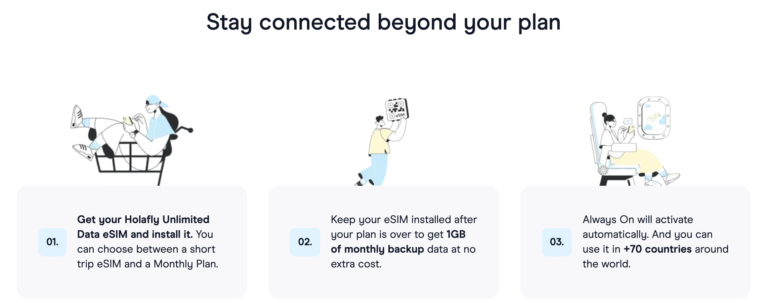
Get 1GB of monthly backup data, no extra cost
Frequently asked questions about starting a business in Spain
Yes, if you have a digital certificate, you can complete procedures online with the Tax Agency and the Commercial Registry, as well as through the CIRCE system, for self-employed individuals and limited liability companies (SL).
You don’t need to live in Spain to own a company. If you’re from the EU, you don’t need a residence permit, but if you’re from outside the EU, you’ll need a specific visa to start a business.
It’s not necessary, as you can set up a limited company (SL) with just one owner.
The most common business structure for foreigners in Spain is the SL, as it is more flexible, easier to manage, does not require a large amount of capital, and allows the company to operate throughout the EU.
It’s not required, but a professional advisor can make tax and legal procedures easier and help you avoid common mistakes. It’s especially recommended if you’re a foreigner and unfamiliar with the Spanish tax system.
Plans that may interest you


Hi! I'm a Spanish-English copywriter working with Holafly, helping bring travel content to life for curious travelers. As a digital nomad with a passion for exploring, I'm always adding new spots to my bucket list. If you love to travel like me, stick around because you're in the right place to find inspiration for your next trip! ✈️🌍