Language
Buy a house in Cyprus as a foreigner: Requirements & tips
Enjoy your new home in the Mediterranean! Here’s a guide to the steps and requirements to buy a house in Cyprus as a foreigner.

Buying a house in Cyprus is a dream for many foreigners, whether as a holiday home, an investment, or a place to retire by the Mediterranean. But before you start looking for property, it’s important to know the legal rules and restrictions for foreign buyers.
That’s why we’ve created this guide to help you understand what you need, the types of homes you can buy, and the rules for non-residents. We’ll also go over prices per square meter in different cities and the taxes you’ll need to pay as an owner. Finally, we’ll explain step by step how to find the right home and how the process works until you sign the contract. Move into your new home in Cyprus safely and easily!
Requirements for foreigners to buy a house in Cyprus
Foreigners can buy property in Cyprus, but the rules and procedures differ depending on whether the buyer is an EU citizen or a non-EU national. There are also key differences between the northern part of the island, which has limited international recognition, and the southern part, which is an EU member. We’ll break it down for you below.
1. Types of properties available to foreigners
Foreign buyers can purchase property in Cyprus either as a primary residence, a holiday home, or an investment. In general, EU citizens face fewer restrictions than buyers from outside the EU. You can buy freehold houses with land or apartments, although non-EU buyers may face limits on land ownership. It’s usually safer to look in the southern part of the island, as being in the EU means stronger legal protection.
2. Required documentation
You don’t need to be a resident to buy a home in Cyprus, but it can help you get a residence permit through investment programs. You’ll need a valid passport, proof of income, proof of funds, the purchase contract, property registration, and the title deed.
3. Financial terms
If you’re applying for a mortgage, you’ll need to show proof of stable income, such as a job contract or client invoices, to prove you can afford the monthly payments. You’ll also usually need a cash down payment of around 20% to 30% of the property’s value.
4. Purchasing through a local company or partner
Buying with a Cypriot partner can make things easier with the bank, since one of the mortgage holders is a resident. On the other hand, buying through a company can give you more options, especially for larger investments and possible tax benefits.
5. Hiring a notary, agent, or lawyer
It’s best to use a licensed agent or a lawyer who knows the local property laws. They will check the contracts, handle translations, make sure the property has no debts or legal problems, and help with the deal. In Cyprus, lawyers are more important than notaries for legal checks.

How much does a house cost in Cyprus?
The price of buying a house in Cyprus depends on the city, how close it is to the sea, tourist demand, the condition of the property, and nearby amenities. Homes with sea views or in central areas are usually much more expensive, while smaller towns or rural areas tend to be more affordable. Here are some examples of prices per square meter:
- Limassol: $3,530–7,060 per square meter
- Nicosia: $2,350–4,705 per square meter
- Larnaca: $2,120–4,120 per square meter
- Paphos: $2,350–5,290 per square meter
- Secondary cities: $1,410–2,940 per square meter
- Rural areas: $820–1,765 per square meter
For an average Cypriot earning about $1,764–2,590 per month, homes on the Limassol coast are often too expensive. A modern apartment can cost between $353,000–823,500, so people usually look outside the city, where prices are lower. For example, a family house in Ypsonas costs about $211,800–411,800. The cheapest homes are in rural areas like Platres or Troodos, starting around $105,880. On top of the price, you also need to think about yearly costs:
- General maintenance: $600–2,350
- Community fees: $700–2,950
- Utilities and services: $1,410–3,530
- Home insurance: $235–700
Property taxes in Cyprus
Now that you know current property prices, you should also know that buying a house in Cyprus comes with taxes. Some are paid when you buy, some every year while you own the property, and some when you sell. The table below shows the initial taxes you’ll need to pay.
| Tax | Approximate cost |
| Transfer tax | 3% to 8% of the value |
| Registration and notary fees | $590–2,350 |
| Stamp duty | Approximately 0.15% to 0.20% |
| Appraisal fee (if you apply for a mortgage) | $116–290 |
| Origination fee | 0.5%–1% |
| Mortgage interest | Between 3% and 6% per year |
| Example: a home priced at $117,647 | Between $5,350–9,590 |
As for yearly costs, Cyprus no longer has a national property tax, but there are still local fees. These include municipal taxes, about $120–590 per year, and sewage or rubbish fees of around $60–350. These are higher in places like Limassol and private developments, and lower in rural areas.
When you sell the property, you’ll also need to pay capital gains tax, which is around 20%. For example, if you make a profit of $117,650, you’d pay about $23,530 in tax. It’s important to check whether your country has a double taxation agreement with Cyprus, like Mexico, Colombia, or Argentina, so you don’t end up paying tax twice on the same income.
Steps for buying a house in Cyprus
As you’ll see below, buying a house in Cyprus is a fairly straightforward process, similar to other European countries. That said, it’s important not to skip any legal or financial steps and to watch out for potential scams. Here’s a quick guide to help you get started.
1. Search for properties and compare options (1–4 weeks)
Take time to compare several properties before making a decision. It’s important to compare options so you don’t overpay. First, decide what you want and your budget, then look at online property sites like Bazakari Real Estate or Cyprus Property News. You can also contact local agencies like Fox Smart Estate Agency or Danos International Property Consultants.
If you’re interested in new-build homes, check out the websites of major developers in the country, such as Leptos Estates or Aristo Developers, which offer a wide range of properties both under construction and ready to move into.
2. Verify the legal status of the property (1–2 weeks)
If you’re interested in a property, ask the agency, owner, or developer for the title deed, building permit, and proof it has no debts or legal issues. Do this before signing anything to avoid problems later.
3. Negotiate the price and sign the initial agreement (3–7 days)
It’s common to make an offer to the owner when buying a resale property and negotiate details like the payment method, move-in date, and the condition the home will be handed over in. Once both sides agree, an initial contract is signed that sets out the final price.
4. Sign the preliminary contract (1 week)
After negotiating, you sign a preliminary contract and pay a deposit, usually 10% to 30% of the price. For a $200,000 home, that’s about $20,000 to $60,000. This holds the property for you until the final sale is completed.
5. Legal review of the documentation
At this stage, a lawyer checks all the property documents. They confirm the seller is the legal owner, there are no hidden debts, and everything is properly registered. If you’re a non-EU buyer, the lawyer also handles the required authorization, which is a normal part of the process.
6. Final signing and property registration (1–4 weeks)
Once everything is ready, you set a date for the final signing. You pay the remaining balance, along with taxes and legal fees. Then the property is registered in your name with the Cyprus Land Registry, usually by your lawyer or agent, and the home is yours.

How do I pay for a house in Cyprus?
Most property purchases in Cyprus are completed through local or international bank transfers. Opening a bank account in Cyprus can make payments easier and help you arrange services such as insurance, electricity, and water accounts for the property.
You’ll need to prove where your funds come from, since large international transfers are subject to financial checks. It’s also worth keeping in mind bank fees, exchange rates, and currency conversion costs, as these can affect the final price you pay for the property.
Mortgages in Cyprus are stricter for foreign buyers. Banks usually lend 50% to 70% of the property’s value, with interest rates of about 3% to 6%. Because of this, many foreigners pay in cash or get a loan in their own country for better conditions.
Tips before buying a house in Cyprus
Most property searches and paperwork are done online now, so you need a good internet connection. If you’re visiting Cyprus to view homes, an eSIM from Holafly is a simple option with unlimited data from $3.90 per day.
On the other hand, if you plan to live in Cyprus and enjoy your new home, you can choose Holafly’s monthly plans with 25 GB or unlimited data. You’ll have stable, secure 5G coverage across the island and can also use the same eSIM in over 160 destinations. Plus, if you ever cancel your subscription, Always On gives you 1 GB of free data forever in more than 70 countries, so you’ll never be completely without connection when it matters.
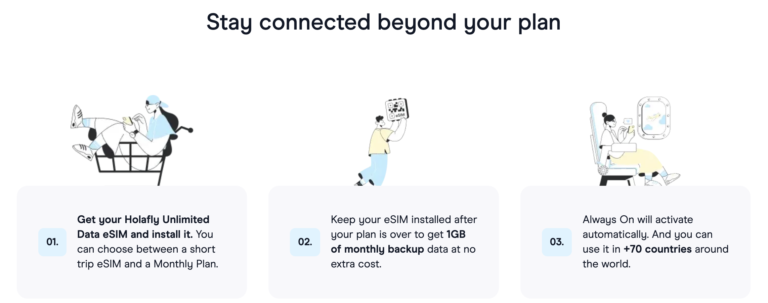
Get 1GB of monthly backup data, no extra cost.
Tips for buying a house in Cyprus
- Review the documentation: Before signing, check the property title, permits, and any outstanding liens or mortgages.
- Hire a local lawyer: A lawyer who specializes in Cypriot property law will give you greater peace of mind and help you avoid legal issues later on.
- Research the area before buying: Beyond the condition of the property, it’s also important to consider whether the area has good transport links, safety, medical services, supermarkets, and how close it is to the city centre or the sea.
- Assess the market: Compare different areas to help you find better opportunities and avoid overpaying.
- Be aware of legal risks for foreigners: Some common mistakes include buying properties without a clear title, signing contracts without legal advice, or failing to check building permits.
- Be on the lookout for common signs of fraud: These may include being rushed into a purchase, a lack of documentation, and prices that are too low.
- Rent before you buy: If it’s your first time in Cyprus, try spending a few days or weeks in the area you’re thinking about. This will help you see what daily life is like and what services are available.
Frequently asked questions about buying a house in Cyprus
Yes, although non-EU citizens may need government authorization for certain types of properties.
It is highly recommended to review the title deed, contracts, and permits to avoid legal risks in the future.
The entire process, from the moment you start looking for a home until the day you sign the contract, can take anywhere from one to four months.
The most popular area is Limassol, known for its luxury homes and modern developments by the Mediterranean. Another seaside city that’s more relaxed is Paphos, while Larnaca is a more affordable option with lower property prices.
You can buy an apartment, a house, or a villa in the southern part of the country.
Plans that may interest you


Hi! I'm a Spanish-English copywriter working with Holafly, helping bring travel content to life for curious travelers. As a digital nomad with a passion for exploring, I'm always adding new spots to my bucket list. If you love to travel like me, stick around because you're in the right place to find inspiration for your next trip! ✈️🌍