


 Language
How many days in Japan? The ideal trip length for 2026
Find out how many days in Japan you need, with realistic 5, 7, 10, and 14+day itineraries, city-by-city advice, costs, and tips for Australian travellers.
If you’re wondering how many days in Japan you need, the short answer is 10 to 14 days for a first trip. Seven days in Japan is a workable minimum if that’s all the leave you can get, and five days is best treated as a focused trip to Tokyo or the Kansai region rather than a tour of the whole country.
Travelling from Australia to Japan, the day count on your itinerary isn’t quite the same as the days you’ll actually spend sightseeing. A Japan trip booked from Sydney or Melbourne often loses a day or two to the overnight flight, jet lag, and getting from Narita or Kansai Airport into the city.
This guide walks through what’s realistic for 5, 7, 10, and 14+ days, how many days to give each city, and what to sort out specifically as an Australian traveller: flights, time zones, and visa rules.

An eSIM you can rely on
Join over 10 million Holafly customers and get connected with our trusted, global services.
How many days do you need in Japan?
As a quick guide: 10 to 14 days is the ideal length for a first trip to Japan, 7 days is a solid minimum, and 5 days is the bare minimum if you’re keeping to one region. The more cities you want to string together, the more days in Japan you’ll need, since train travel and check-in/check-out add up fast even on the fastest Shinkansen lines.
Because you’re flying from Australia, factor in travel and jet-lag days on top of your sightseeing days. Direct flights from Sydney, Melbourne, and Brisbane to Tokyo run at around 9 to 10.5 hours, so even with an efficient arrival, you’ll likely lose most of day one to travel. Build that into how many days in Japan you book off work, not just the nights you’ll spend in hotels.
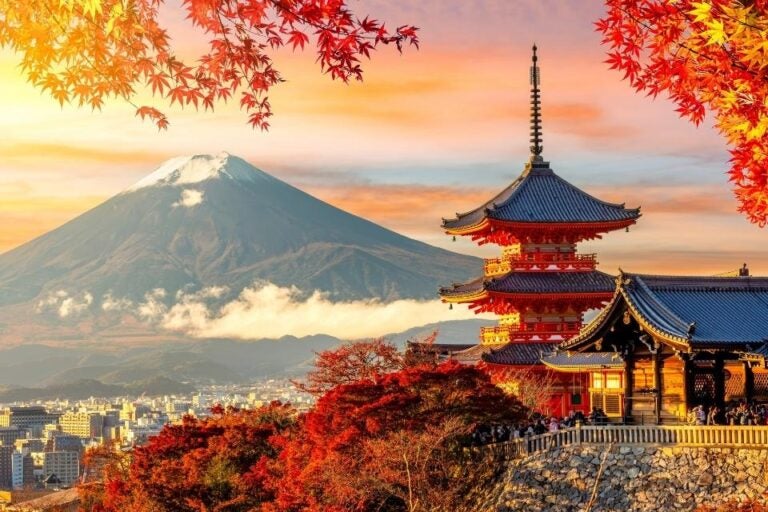
5 days in Japan: Choose one region
Five days is short for Japan, and it’s genuinely not enough time to combine multiple regions without spending half the trip on trains. If five days is what you’ve got, pick one of these instead of trying to squeeze in everything:
- Tokyo and surrounds: base yourself in Tokyo for the whole trip. How you divide the five days will depend on how many days you want in Tokyo versus a day trip to Hakone or Nikko.
- Kyoto, Osaka, and Nara: a compact Kansai loop. These three cities sit close together, so you can day-trip between them without changing hotels.
Either option means you’ll actually see a region properly, rather than rushing through Tokyo, Kyoto, and Osaka all in one go and remembering none of it.
7 days in Japan: Tokyo and Kyoto
Seven days is when a first Japan trip starts to feel like a proper holiday rather than a taster. It’s enough time for the classic Tokyo and Kyoto combination, usually split as roughly 3 to 4 days in Tokyo and 3 to 4 days in Kyoto, with Osaka added as a day trip or an overnight stop on the way through.
If you’d rather not switch hotels mid-trip, a slower alternative is to spend the whole week in one region, Kanto (Tokyo) or Kansai (Kyoto and Osaka), and use day trips to fill out the itinerary.
Whichever version you choose, fly into Tokyo and out of Osaka (or the reverse) rather than looping back to your starting city. It saves a full day of backtracking on the Shinkansen and is easy to arrange with Qantas, Japan Airlines, or ANA, all of which fly Australia–Tokyo and connect onward within Japan.
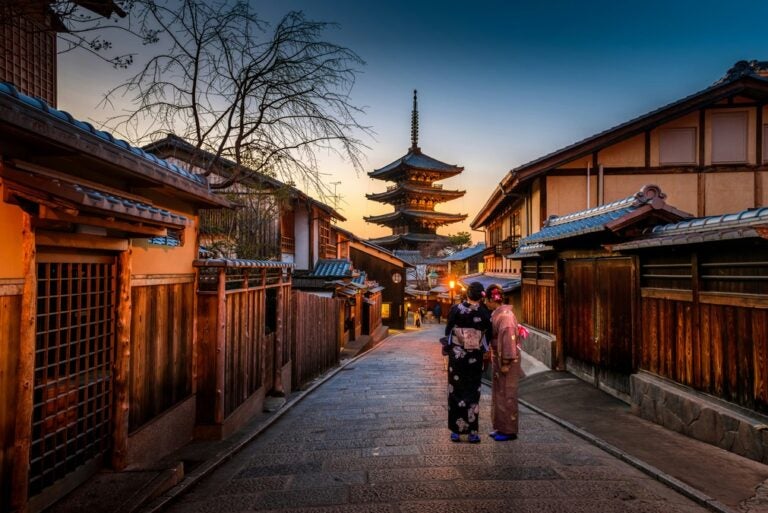
10 days in Japan: the classic Golden Route
Ten days is the shortest trip length that comfortably covers the “Golden Route” — Tokyo, Kyoto, and Osaka — while still leaving room for one scenic or onsen stop, such as Hakone or Kinosaki.
Each of those three cities deserves at least two to three full days, and the Shinkansen legs between them still eat into a day once you factor in luggage and hotel check-ins.
A night in Hakone or Kinosaki also breaks up the pace between big cities and gives you a very different side of Japan, from temples and department stores, without costing much extra travel time if it sits on your route between Tokyo and Kyoto.
A typical 10-day split looks like:
| Days | Where | What it adds |
|---|---|---|
| 3–4 | Tokyo | City sights, day trip option |
| 1–2 | Hakone or Mt Fuji area | Onsen, views, slower pace |
| 3–4 | Kyoto | Temples, Arashiyama, Gion |
| 1–2 | Osaka | Food, Dotonbori, and other things to do in Osaka |
Lean the extra day toward Tokyo for more neighbourhood or day-trip flexibility, or toward Kyoto if temples and a slower pace matter more than ticking off a big city.
2 weeks in Japan: The ideal first-timer itinerary
Fourteen days is the sweet spot for a first visit. It’s enough time to follow a classic Japan travel guide through Tokyo, Kyoto, and Osaka, while also spending a night or two near Mt Fuji or in an onsen town and adding Hiroshima and Miyajima without turning every second day into a transfer day.
A two-week trip typically covers Tokyo, an onsen or Mt Fuji stop, Kyoto, Osaka, Nara, and Hiroshima, with Miyajima, at a pace where you spend at least two nights in almost every place.
If this is your first time travelling to Japan, two weeks is a particularly good length to aim for. The one to two days you lose to the flight and jet lag matter far less when they’re spread across 14 days rather than 7, so you get proper use out of nearly all of them.
It’s also a length that suits families well, since it’s long enough to build in slower days for kids without cutting a region, and it lines up neatly with the summer school holidays over December and January, when a Japan trip can double as an escape from the Christmas heat back home.
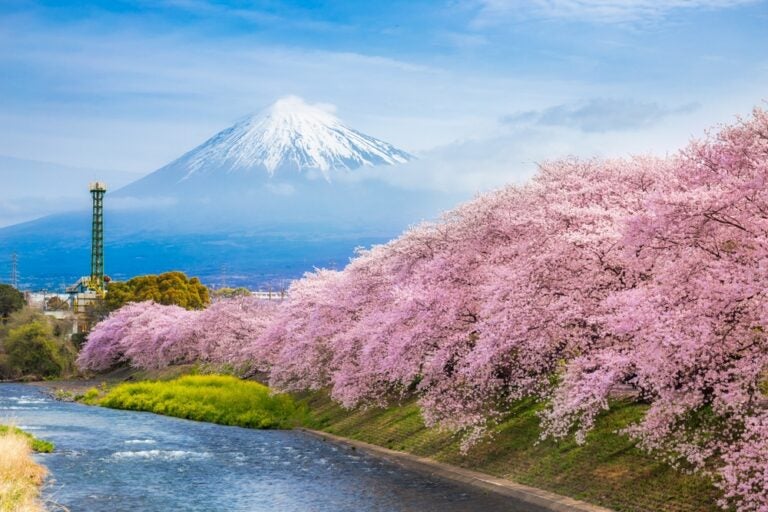
3 weeks or more in Japan: Go beyond the Golden Route
Three weeks or more gives you enough time to explore some of the best places to visit in Japan beyond Tokyo, Kyoto, and Osaka, or simply travel more slowly and stay several nights in each place.
This is also where the season should shape your route more than the cities do. Skiing in Hokkaido or Nagano, hiking in the Japanese Alps, and island travel in Okinawa all need a different route from the standard itinerary, and usually a domestic flight or two, since they sit well outside the main Shinkansen corridor.
How many days should you spend in each Japanese city?
If you’re building your own route rather than following a set itinerary, here’s a rough guide to how many days each popular first-timer stop is worth:
| City | Recommended days | Why |
|---|---|---|
| Tokyo | 3–4 | Large, spread across several distinct districts |
| Kyoto | 2–3 | Temple-dense, walkable, worth slowing down for |
| Osaka | 1–2 | Compact, food-focused, easy as a short stop |
| Hiroshima and Miyajima | 1–2 | Peace Memorial Park plus the island, doable as an overnight |
| Hakone | 1–2 | Onsen and Mt Fuji views, a good pace-breaker |
| Nara | Half to 1 day | Easily done as a day trip from Kyoto or Osaka |
What affects the ideal length of a Japan trip?
The trip lengths above are a solid starting point, but the right number of days for you still comes down to a few personal factors, mainly when you travel, how you like to travel, and what you’re comfortable spending per day.
Season and crowd levels
The best time to travel to Japan depends on the weather, crowds, prices, and experiences you want to prioritise. Cherry blossom season (late March–early April) and autumn foliage (November) are Japan’s busiest and most beautiful periods. They’re worth an extra planning buffer, since popular sights and restaurants get booked out.
Travelling outside these peaks, or in winter, generally means fewer crowds and more flexibility with a shorter itinerary. For example, if you’re after a quieter, more budget-friendly window instead, term 3 school holidays in September and October fall in Japan’s shoulder season, after the summer humidity but before the autumn foliage crowds and price hikes set in.
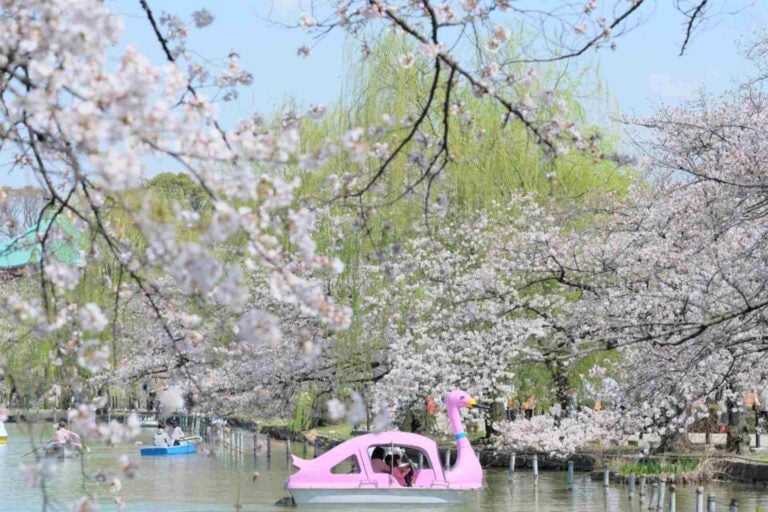
Travel pace and interests
If you’re museum-hoppers, foodies, or want a day trip out of every city, add extra days accordingly. Faster-paced travellers who are happy with one or two highlights per city can cover more ground in fewer days.
If you’re travelling with kids, it’s worth padding the itinerary with slower mornings and fewer city changes, since a pace that suits a couple travelling light can wear a family out fast.
Budget and daily cost
Surprisingly, Japan is more affordable than you’d expect, but the total cost of travelling to Japan rises quickly as you add more days and destinations. A mid-range daily budget, including hotel, meals, local transport, and one paid activity, typically runs somewhere around AU$220–AU$330 per person per day, excluding flights.
A 7-day JR Pass and a 14-day JR Pass are priced differently as well, so it’s worth mapping out your city order before deciding whether a rail pass is worth it for your specific route.
Planning trips to Japan from Australia
Once you’ve settled on the length of your itinerary, the next step is working out how to plan a trip to Japan around flights, entry requirements, transport, and annual leave. Here are a few specific things to look at:
- Flight time: Direct flights to Tokyo run around 9h 50m from Sydney, 10h 10m from Melbourne, 9h 15m from Brisbane, and 9h 35m from Perth. Cairns has shorter options at 7–8 hours where available.
- Mobile data: To access internet in Japan, try setting up an eSIM for Japan before departure if you want data ready for airport transfers, train navigation, and hotel check-ins when you land.
- Time zone: Japan is only 1 hour behind AEST and 2 hours behind AEDT during daylight saving, so jet lag is minor compared with flying to Europe or the US.
- Packing: What you bring will depend heavily on the season and route, so plan what to pack for Japan around the weather, walking-heavy days, and any mountain, ski, or island stops.
- Visa: Australian passport holders can enter Japan visa-free for stays of up to 90 days for tourism, but always confirm the visa requirement on Smartraveller before departure.
Stay connected in Japan with Holafly
After a 10-hour flight from Australia, the last thing you want is to queue for a SIM card at Narita or Kansai Airport, or come home to a roaming bill. With an eSIM for Japan, you set everything up before you leave home and connect the moment you land — unlimited data at speeds up to 5G, so airport transfers, train navigation, and hotel check-in all work from the tarmac, and 24/7 customer support is on hand whenever you need it.
Even on a longer Japan itinerary, your connection shouldn’t be something you have to think about. Keep your Holafly eSIM installed and Always On: 1 GB of monthly backup data gives you 1 GB that refreshes every month at no extra cost.
Get an unlimited data eSIM
Use code MYESIMNOW5 for 5% off at checkout
Plans that may interest you

哈囉我是來自台灣的 Wen,平常最喜歡旅遊,也喜歡將旅遊的種種化成文字跟大家分享,希望大家能在我的文章中找到有用的資訊,加上 Holafly 的 eSIM,讓你的旅程更美好!✈️✈️✈️ Hi! I'm Wen, a passionate content writer and travel enthusiast from Taiwan. I transform my wanderlust adventures into engaging stories and practical guides, helping fellow travelers make the most of their journeys.Through my articles, I strive to provide travel tips while introducing how our eSIM technology can enhance your travel experience - keeping you connected wherever your adventures take you!