So we went looking for the places where that kind of trip is easiest to pull off. The Holafly research team counted live Airbnb listings around the world in eight unusual property types: caves, castles, treehouses, houseboats, windmills, lighthouses, earth homes, and domes. Then ranked them by the numbers: total listings first, then how many you’ll find per person, then category by category.
Key Findings
- France is the world capital of unusual stays, with close to 3,000 listings spread across every category, more than any other country.
- Greece is the surprise of the study, ranking second in the world for unusual stays per person and running away with the global cave-stay crown, despite being a fraction of the size of the markets above it.
- Costa Rica has the most unusual stays per person of any country we looked at, powered by a jungle-treehouse and dome boom.
- Greece and Turkey own the world’s cave stays. Between them, Santorini and Cappadocia leave everyone else behind.
- Latin America is the glamping-dome capital of the planet, led by Colombia and Chile.
The Countries With The Most Unusual Stays
The simplest way to read the data: which countries have the most unusual listings overall? We added up every live listing across all eight categories, for all 66 countries. Big tourism markets have the obvious advantage here, but the top five aren’t quite the ones you’d guess, and two of them sit firmly in Latin America. Here’s who came out on top.
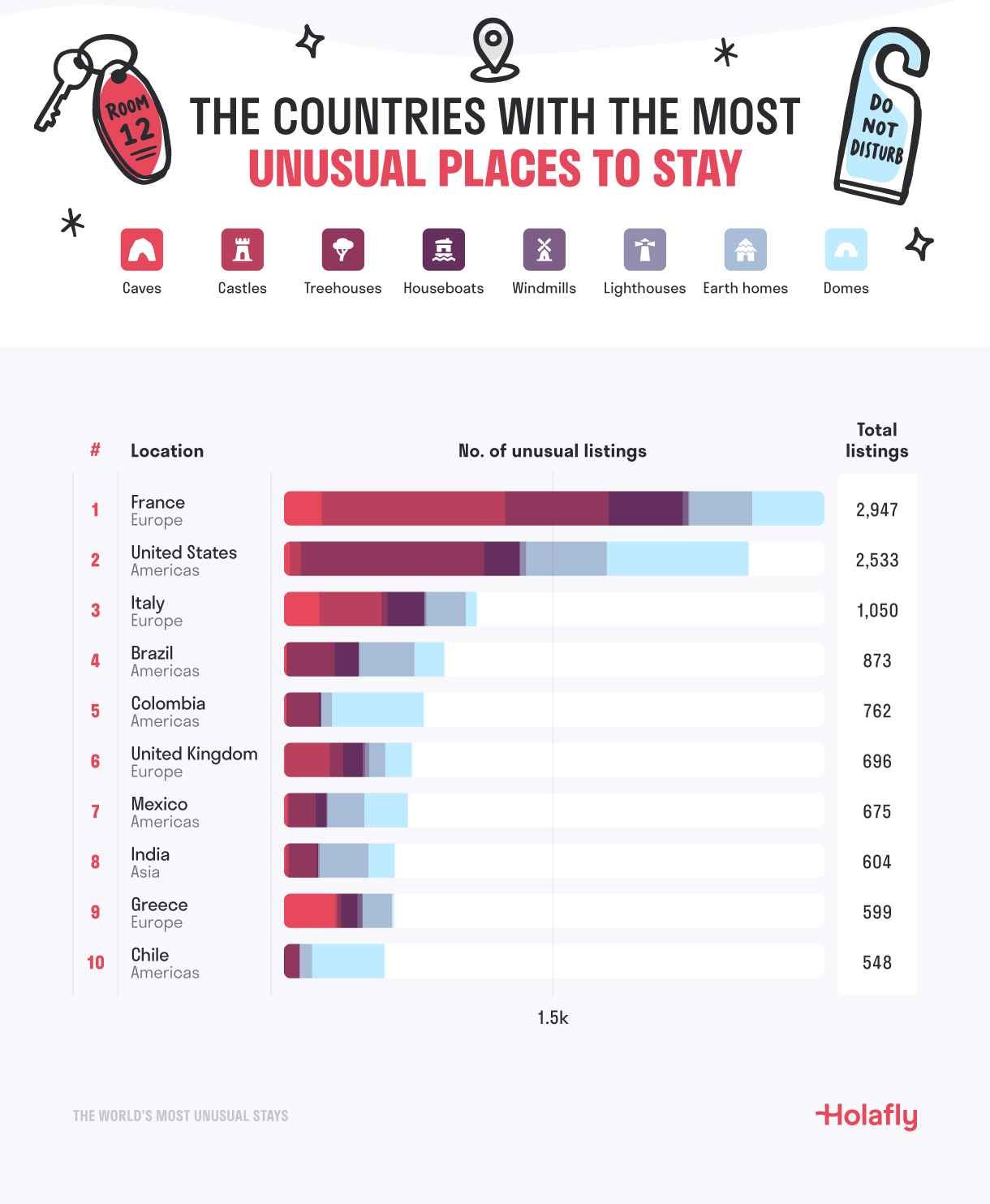
1. France (2,947+ listings). No contest at the top. France has more than a thousand castle stays, over 500 treehouses, 400-plus houseboats, and hundreds of domes, earth homes and cave houses besides. It’s the only country that’s a genuine heavyweight in almost every category at once. If you can imagine an unusual place to sleep, France has a few hundred of them.
2. United States (2,533+ listings). Second on volume, and the runaway leader for treehouses and glamping domes: over a thousand of the former, nearly 800 of the latter. What holds it back from the top spot isn’t scarcity. It’s that a few categories Europe takes for granted, like castles and windmills, barely exist stateside.
3. Italy (1,050 listings). Castles in Tuscany, the trulli of Puglia (those cone-roofed stone huts count as earth homes), cave dwellings in Matera, plus a healthy fleet of houseboats. Italy’s unusual-stay scene is old, and it shows.
4. Brazil (873 listings). The first real surprise of the ranking, and proof the unusual stay isn’t just a European habit. Brazil’s strength is in the trees and the earth: more than 250 treehouses and over 300 rustic earth homes, most of them scattered through rainforest and countryside rather than the cities. Add a fleet of houseboats and a fast-growing dome scene, and it clears every big European market except France and Italy.
5. Colombia (762 listings). Rounding out the top five, almost entirely on the back of one category: domes. Colombia has over 500 glamping domes, second only to the USA, most of them pitched at stargazers in the coffee country and the hills around Medellín and Bogotá. Throw in nearly 180 treehouses and it edges out far bigger tourism markets.
The Countries With The Most Unusual Stays Per Person
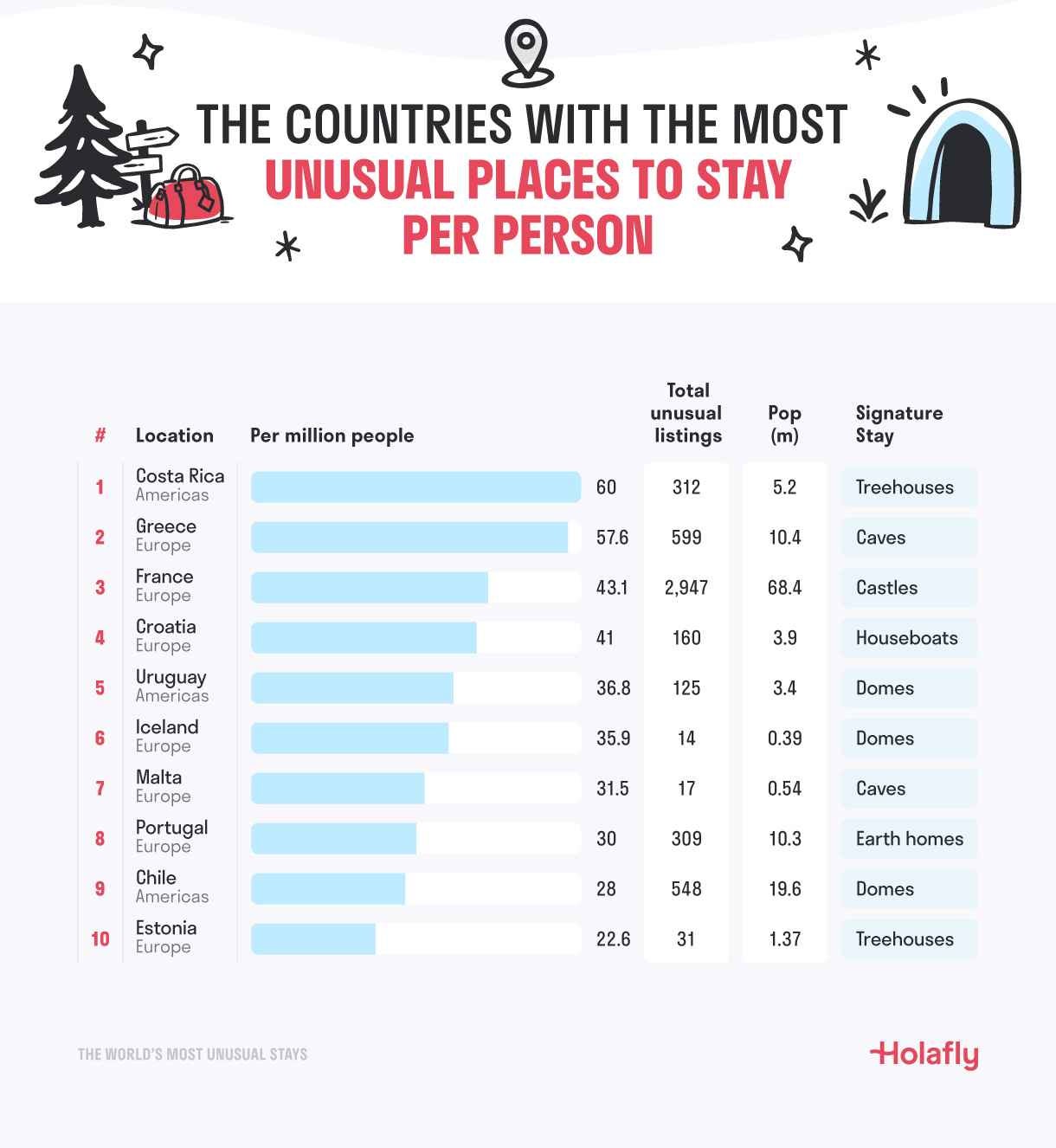
Density tells a different story. Rank countries by unusual stays per million people and the giants slide down the list. Costa Rica comes first, then Greece, France, and Croatia, all smaller nations where the unusual isn’t a niche corner of the market but a real share of it. Costa Rica has leaned hard into rainforest treehouses and domes, and for a country its size the concentration is remarkable.
The Category Champions
Totals are one way to read the data. The other is to go category by category and ask a simpler question: if you want this specific kind of stay, where do you go? Here’s who leads each of the eight.
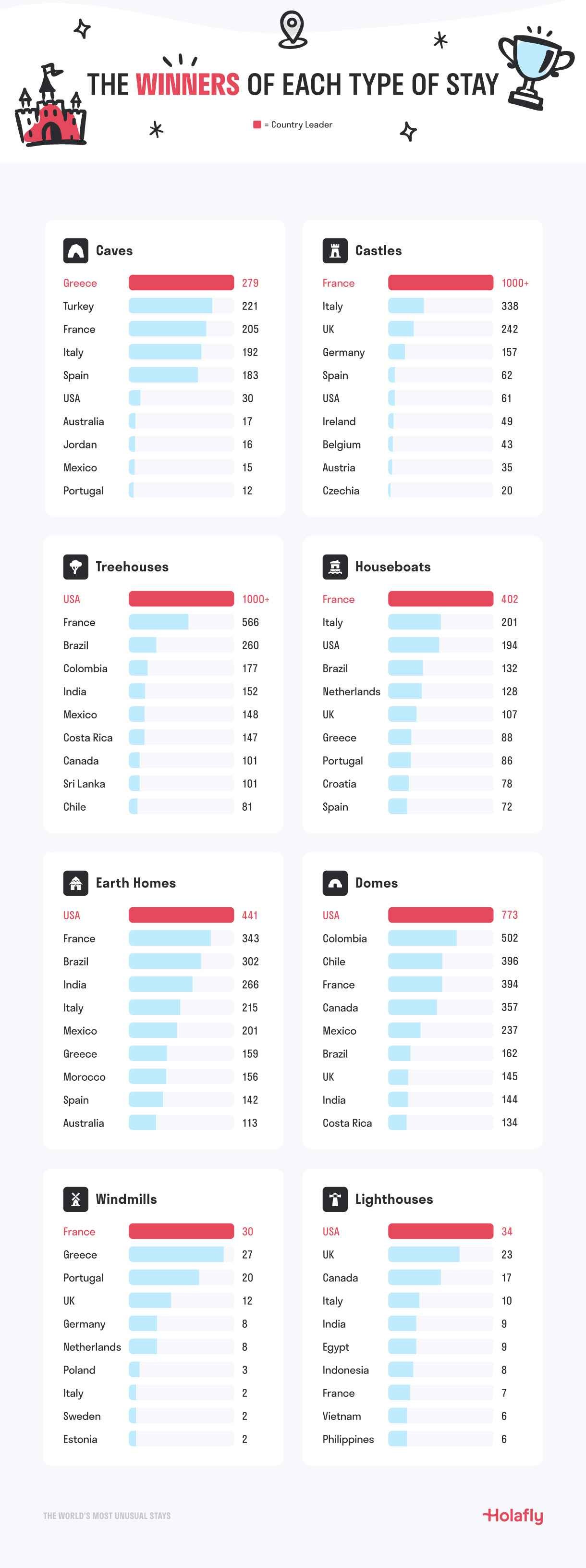
Caves: Greece (279), then Turkey (221). The two Mediterranean cave capitals, and it’s not close. Greece’s are the whitewashed Santorini kind; Turkey’s are carved into the fairy-chimney rock of Cappadocia, where you wake up, roll over, and watch a hundred hot-air balloons go up. France, Italy, and Spain fill out the top five.
Castles: France (1,000+), then Italy (338). France blew past our counting cap here, which tells you everything. Italy and the UK trail at a respectful distance, with Germany’s Rhine and Bavaria strongholds close behind.
Treehouses: United States (1,000+), then France (566). The Americas dominate. After the USA and France come Brazil, Colombia, India, Mexico, and Costa Rica. The best treehouse regions track rainforest, not wealth.
Houseboats: France (402), then Italy (201). A twist most people won’t guess. Amsterdam is the world’s houseboat icon, and the Netherlands (128) is right up there, but in sheer numbers France’s canal and river boats take it, with Italy second and Brazil third.
Windmills: France (30), then Greece (27). A small category everywhere, which makes the leaders sharper. Greece’s are the classic Cycladic windmills of Mykonos and Santorini; Portugal (20) rounds out the podium.
Lighthouses: United States (34), then the UK (23). Coastlines win here. The USA edges the UK, with Canada’s Atlantic provinces third. If you want to fall asleep to a foghorn, North America is your best bet.
Earth homes: United States (441), then France (343). A broad category spanning adobe, cob, trulli, and Moroccan pisé. The USA and France lead on volume, but the most distinctive versions are elsewhere: Italy’s Puglian trulli (215), Morocco’s mud-brick kasbahs (156), and India’s traditional earthen houses (266).
Domes: United States (773), then Colombia (502) and Chile (396). The fastest-rising unusual stay of the lot, and Latin America is where it’s exploding. Colombia and Chile have built serious glamping-dome scenes, usually pitched at stargazers, and between them nearly rival the much larger US market.
How To Actually Book a Good One
A few things we learned digging through thousands of these listings.
-
Photos flatter, so read the reviews for the practical stuff. A cave stays cool in August but can feel damp in winter, a lighthouse might mean a lot of stairs, and “off-grid dome” sometimes means “no hot water.”
-
Book the standout properties early. The genuinely special ones in Cappadocia, Santorini, and the Loire go months ahead in high season. And check what’s actually nearby. A windmill an hour from the nearest town is a very different trip from one in a walkable village.
-
The best unusual stays tend to be rural, remote, and light on signage, which is exactly where you’ll be leaning on your phone for directions, check-in codes, and the host’s “the gate sticks, push hard” message. Landing with a travel eSIM already active means you’re online the second you step off the plane, with no hunting for a SIM kiosk when you’ve still got a two-hour drive to a treehouse ahead of you.
The unusual stay has gone from novelty to genre. There are now enough caves, castles, and domes scattered across the world that you can plan a whole trip around where you’ll sleep, and the map of where they cluster is more surprising than you’d expect. France wears the crown, but Greece punches so far above its weight it’s arguably the better story. And if you measure by how unusual a country is relative to its size, a rainforest nation of five million takes the top spot. The room isn’t the afterthought anymore. More and more, it’s the whole point.
Methodology
We analyzed the number of live Airbnb listings in eight unusual accommodation categories (caves, castles, treehouses, houseboats, windmills, lighthouses, earth homes, and domes) across 66 countries, collected via Airbnb’s category search in August 2026. Countries were ranked by total unusual listings across the eight categories, with listings per capita reported as a secondary measure. Two figures reached Airbnb’s “1,000+” display limit (France’s castles and the USA’s treehouses) and are recorded as a floor of 1,000, so France’s and the USA’s totals are, if anything, understated. Listing counts are a snapshot and change over time. China was excluded because Airbnb operates differently there.