Key facts
- Role: CX Data Lead
- Background: Self-taught programmer and data analyst
- Impactful project: Refund Automation
Kelvis has a thought he comes back to often: he wants a life story worth telling. It’s part of why he left his hometown and moved abroad in the first place, and it’s the same mix of curiosity and drive that, years later, led him to test an automated solution on a stuck refund case, just to see what would happen. That one small experiment is what eventually grew into the process that reshaped how Holafly handles refunds.
Nowadays, Kelvis leads a data team of four people inside Holafly’s Customer Experience department. But the road here wasn’t a direct path, and most of it comes down to the same instinct: noticing something, then teaching himself how to fix it.
Turning every rejection into an action plan
Kelvis talks about his journey in a way that inspires. It’s the kind of story he says he wants to have ready for his kids and grandkids someday: not just “I worked, I lived,” but an actual meaningful life.
A big part of that journey is a positive mindset, and learning from rejection instead of letting it discourage him. He applied to customer service companies across Colombia and got turned down many times, though he never tells it like a disappointment.
“Each time I’d get rejected, I already knew what I was going to study next,” he says. A recruiter’s question, a phrase he mispronounced, became homework for the following month. The rejections told him exactly where to look.
By the time Holafly hired him as a support agent, he already had a background in fixing computers and working with software, plus an old ambition to become a developer. Within a year, he’d moved to a role combining workforce management and subject-matter expertise, before becoming a data analyst. A year later, he was CX Data Lead.
He credits it to the same habit that got him through those rejections: start with whatever you’ve got, even if it’s incomplete, and fix it as you go. “I’m very much a start small, but start kind of person,” he says. "You optimize later.”
What happens when curiosity meets a real problem
That philosophy was about to get tested on a bigger scale. In 2025, the refund queue started to build up. What usually took four days stretched to a week, then to a month or two for some cases. At the time, every refund was processed manually, and the backlog was growing faster than the team could keep up.
Kelvis was teaching himself how to use APIs to connect different platforms when he decided to test one on a refund that was still pending. He ran the case, and it went through.
“I thought, this actually works,” he says. He took the idea to the Customer Care Manager who was leading refunds at the time. He didn’t have a finished solution to present, just a hunch that part of the process could be automated.
“I told her, ‘look, we can build something for a piece of this,’” he says. That conversation marked the beginning of a process that would eventually clear the backlog of pending refunds. It started with a single test on a case that wasn’t even his to solve.
Bringing teams together to build a shared solution
Kelvis knew that scaling from one successful case to something departments could rely on meant pulling in teams that didn’t report to each other. Data, IT, and Customer Care needed to bring their expertise together, with each one responsible for a different part of the process.
The first version was largely manual: Customer Care would send Kelvis a list of customers, the Data team would verify their usage, and the refunds would then be processed. It was a starting point that proved the process could work and showed what would be needed to make it more efficient.
About six months into the project, IT had built the infrastructure needed to support automation, giving Kelvis the tools to bring the different steps together into a more structured process.
The project also helped strengthen collaboration between departments. With teams contributing to the same outcome, regular communication became essential to keeping each part aligned with the others. A dedicated Slack channel, daily or weekly syncs, and regular conversations helped everyone understand how their work fit into the bigger picture.
For Kelvis, this was an important part of making the project work. The solution depended not only on connecting systems, but also on connecting the people behind them.
Starting matters more than getting it perfect
The impact was big: refunds now go through in three to five days, down from what used to be weeks. Refund-related complaints in NPS feedback and Trustpilot reviews dropped, and Finance had a reliable number to plan a budget around.
None of that happened in one go. Of everything this project taught him, Kelvis keeps coming back to one line: nothing comes out perfect the first time. “It’s not going to be organized, there’s not going to be perfect documentation, and everyone is going to execute their own piece,” he says.
The system he and his colleagues across Data, IT, and Customer Care eventually built wasn’t the plan they started with. It was a manual workaround, refined in stages, until each department’s piece clicked into place.
“If you try something with intention, you immediately understand what’s missing,” he says. “That’s how you learn what to fix next.”
This project is what convinced Kelvis to point his career toward data engineering. “I built something with a measurable impact, something you could see in the numbers,” he says. “That defined where I want to go.”
His advice to anyone sitting on an idea they’re unsure about pitching is to take the first step: “If you can build something, even if it’s very small, do it,” he says. “Don’t overplan it. Execute.”
Fear is just another reason to jump
When asked how he switches off after work, Kelvis describes himself as someone who can get completely absorbed in a problem. “I’m the kind of person that when I get into something, I forget about everything else,” he says.
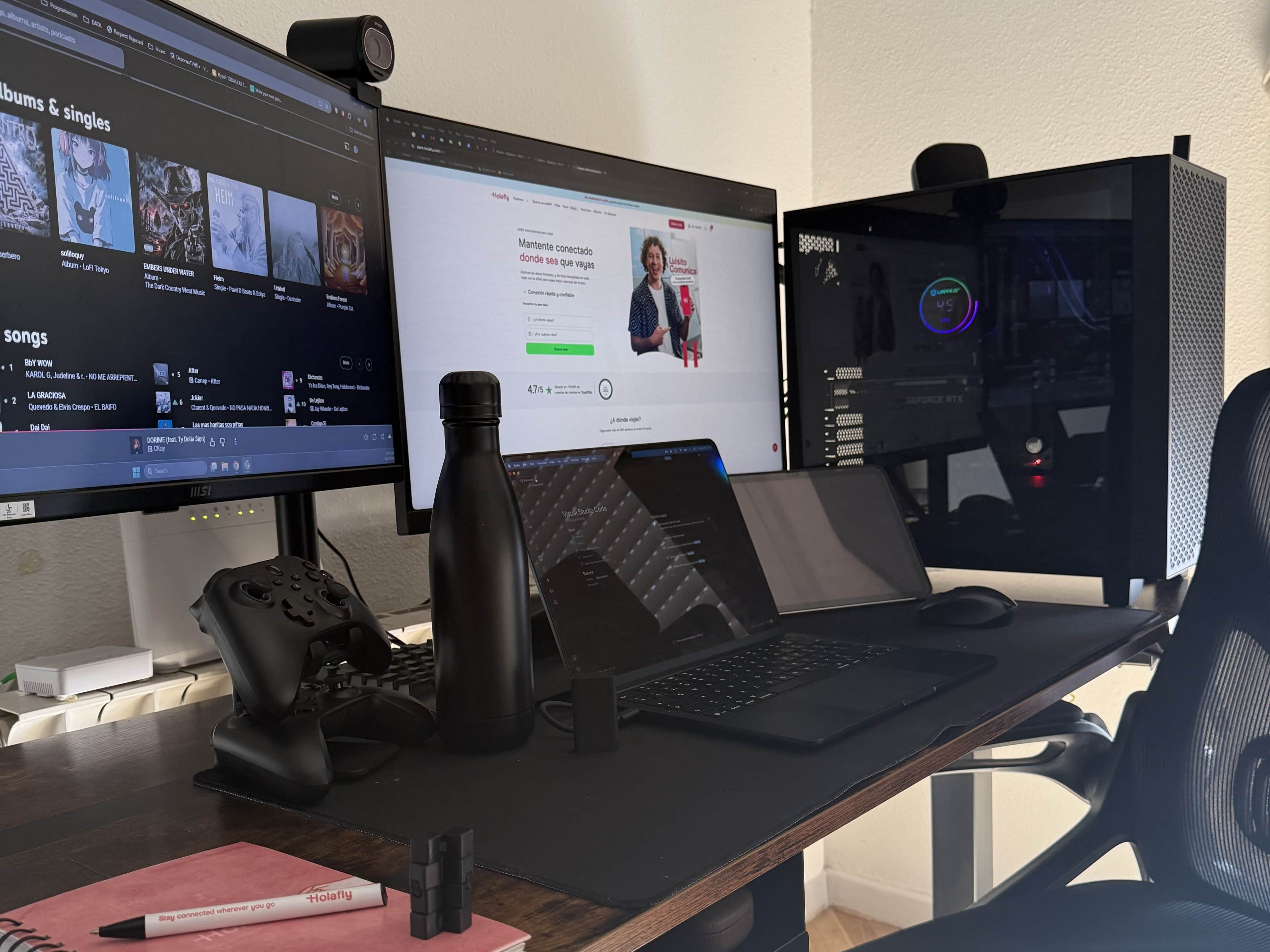
Even when he’s deep in thought, he likes to find ways to stay present. His go-to is a small fidget toy his partner gave him, an everyday object that has become part of how he works through his thoughts.
Off the clock, that same focus shows up in smaller ways. He dances, cooks (“badly, but I like it,” he says with a laugh), and has recently gotten back into visiting small towns and going to the beach.
And then there’s the skydiving. A friend came up to him with the idea, fully aware that Kelvis is afraid of heights, and he said yes before he’d really thought it through. “In the moment of the jump, I actually wondered if I was going to pass out from the fear,” he says. “It almost happened. But I jumped anyway.”
That same bravery carried him through the refund project: stepping into a room full of people with more seniority, pitching an idea, and trusting he’d figure out the rest along the way. Fear doesn’t disappear before you act. For Kelvis, it just stops being the reason you don’t.

Taking the leap isn’t always easy, especially when you don’t know exactly what comes next. But sometimes, that’s where the best opportunities begin. If you’re ready to take your next step, explore our open roles on the Careers Page.