Eclipse chasing has quietly become one of travel’s fastest-growing reasons to book a flight, and 2026 is the year the calendar rewards it twice. But not every spot under an eclipse is created equal. A 100 percent total eclipse behind a wall of cloud is worth less than a near-total one under clear skies, and a moon low on the horizon is easy to miss behind the neighbor’s roofline.
So, the Holafly research team ran the numbers. We scored locations on the two things that decide whether an eclipse becomes a memory or a missed chance: how good the viewing conditions are (cloud cover, how high the sun or moon sits, how long the event lasts) and how dramatic the eclipse itself is (how much of the disc disappears).
Here is where the numbers point.
Key Findings:
- Miranda do Douro, Portugal tops the solar ranking, pairing a near-total 99.89 percent eclipse with low August cloud cover and the sun sitting higher in the sky than its rivals.
- Zaragoza, Spain is the pick for totality purists: a clean 100 percent eclipse in a major, easy-to-reach city.
- Marrakech, Morocco has the clearest skies of any contender on either list, with an average cloud cover of just 7 percent.
- Erie, Pennsylvania leads the lunar ranking, the standout choice for viewers in the eastern United States.
- The solar eclipse peaks in the early evening Eastern time on August 12, while the lunar eclipse peaks just after midnight ET on August 28.
Part One: The Total Solar Eclipse
For a little over two minutes, the day will turn to dusk. This is the headline event of the summer and the first total solar eclipse visible from mainland Europe in more than a quarter of a century. The Moon’s shadow races roughly 5,000 miles across the planet in about 96 minutes, beginning near the North Pole and tracking south through Greenland and Iceland before making landfall in northern Spain and the northwestern tip of Portugal in the golden hour before sunset.
One thing worth setting straight: while the whole eclipse plays out over roughly 110 minutes from first contact to last, the moment of full totality is brief, reaching a maximum of about 2 minutes and 18 seconds anywhere on the path. Everywhere else in the Northern Hemisphere, including a broad slice of the United States from Alaska to North Carolina, sees a partial eclipse.
The Best Locations To Watch The Solar Eclipse
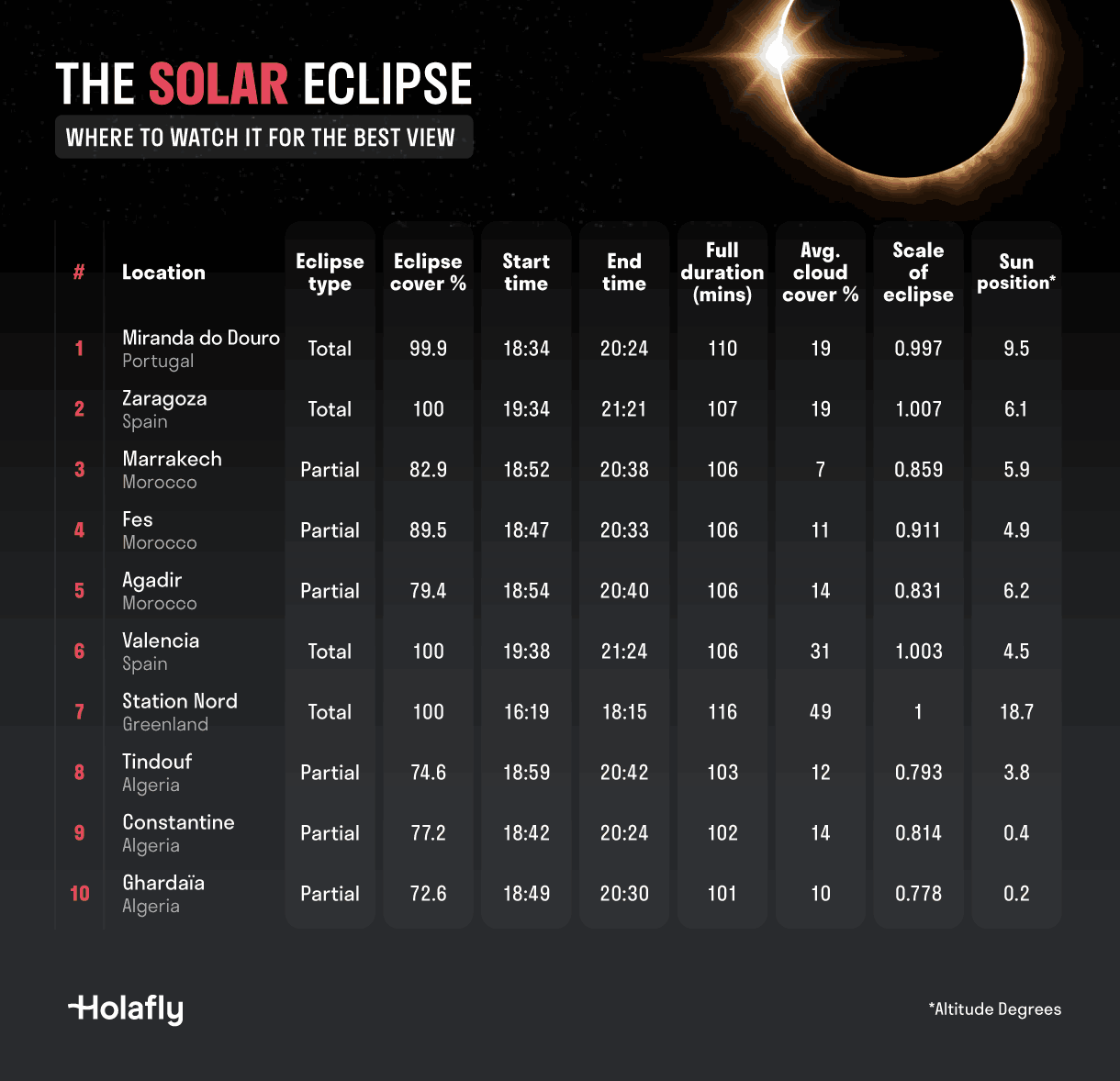
Miranda do Douro in northeastern Portugal is the sweet spot. Its eclipse is a whisker short of total at 99.89 percent, but it wins on the details that matter. Average cloud cover is just 19 percent for mid-August, and with the sun sitting at a comfortable 9.5 degrees above the horizon at maximum, it’s higher than almost any other European contender.
The peak arrives around 7:31 p.m. local time (2:31 p.m. ET). If you want a guaranteed 100 percent, point yourself at Zaragoza, Spain - the second best place. It delivers full totality in a large, well-connected city with flights, trains, and hotels already in place, peaking near 8:29 p.m. local (2:29 p.m. ET). The trade-off is a lower sun, at 6.1 degrees, so you will want a clear western horizon with no hills or buildings in the way.
For the best odds of a cloudless sky anywhere on the list, look south to Marrakech, Morocco. Its historical cloud cover is a remarkable 7 percent. The catch is that Marrakech sits off the path of totality. You’ll still see an 83 percent partial eclipse, with its peak at around 7:46 p.m. local (2:46 p.m. ET).
And for the adventurers, there is Station Nord in Greenland, one of the most remote inhabited places on the planet. It offers a full 100 percent eclipse, the highest sun of any location on the list at 18.7 degrees, and the longest event window. Skies are a coin flip at 49 percent average cloud, and getting there is a genuine expedition.
Before you go: totality lasts seconds, not minutes, so scout your spot and your horizon in advance, and check the local forecast in the final 48 hours.
Part Two: The Partial Lunar Eclipse
Sixteen days later, the moon takes its turn. This is a deep partial lunar eclipse. The moon’s face slips into the darkest part of Earth’s shadow, leaving only a thin bright sliver along one edge.
The good news for viewers is that a lunar eclipse asks almost nothing of you. There is no narrow path of totality to chase and no special glasses required. If the moon is above your horizon and the sky is reasonably clear, you can watch the whole thing with your own eyes. The event peaks at 04:12 UTC, which is just after midnight for the US East Coast, so this is a late-night show on the 27th rolling into the small hours of the 28th.
The Best Locations To See The Lunar Eclipse
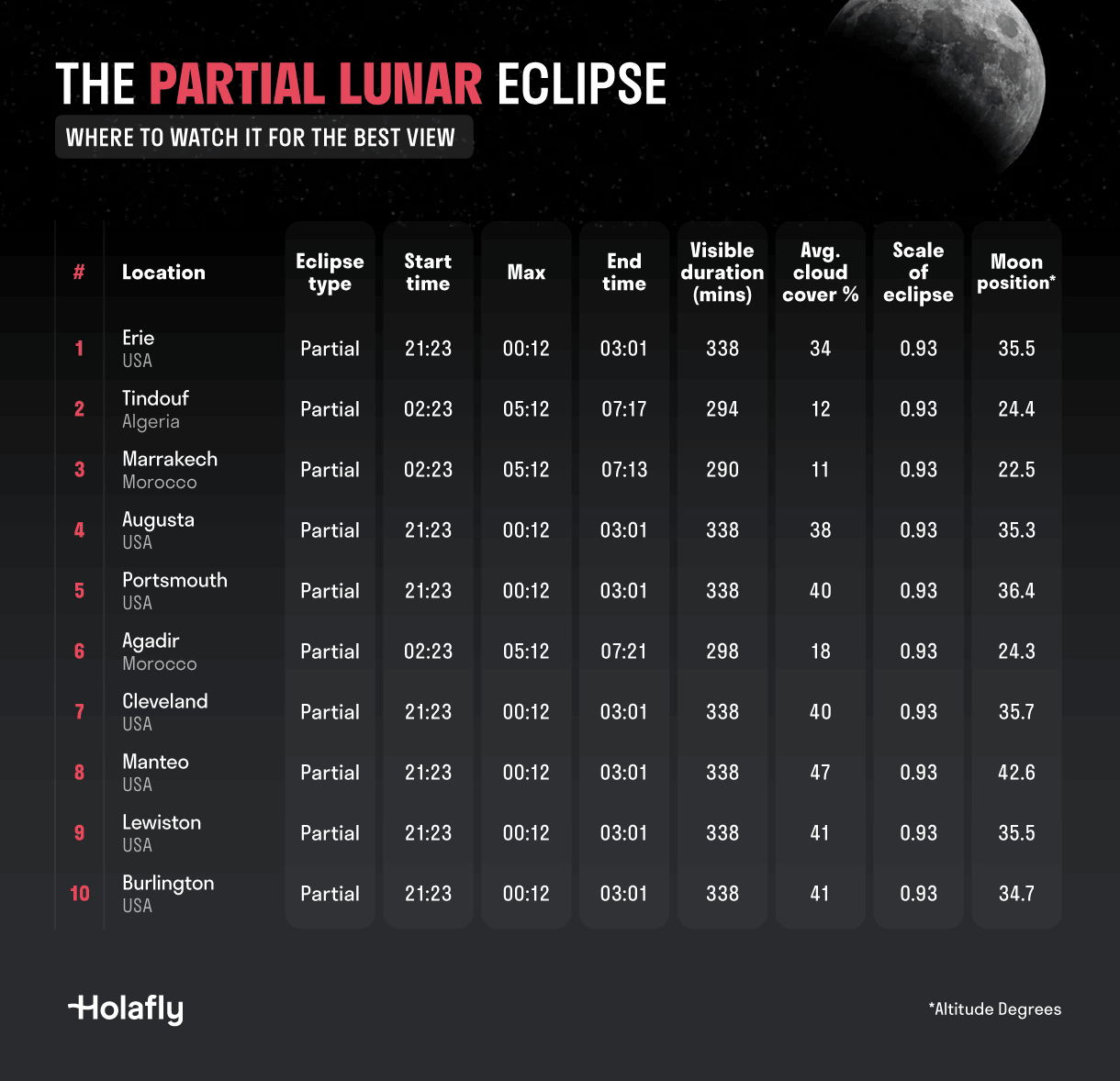
Our top-ranked spot, Erie, Pennsylvania, is the standout for US viewers. It combines a long visibility window with a comfortable Moon altitude of about 35 degrees and better-than-average clear-sky odds, with the peak landing around 12:12 a.m. ET on August 28. It headlines a strong showing across the eastern and northeastern US, with Augusta, Portsmouth, Cleveland and Lewiston all making the top ten. Wherever you are in that band, you get one of the longest and highest views of the eclipse anywhere in the world.
For the clearest skies, the story again runs through North Africa. Tindouf and Marrakech both pair the same partial eclipse with low historical cloud cover of around 11 to 12 percent. The event peaks at roughly 5:12 a.m. local time (12:12 a.m. ET). If you happen to be traveling in the region, these are arguably the safest bets on the planet for an unobstructed view.
Don’t Let a Dropped Signal Be the Thing You Remember
The best eclipse trips are planned to the minute, and almost every part of that plan lives on your phone: the timing app counting down to totality, the satellite cloud maps you refresh on the drive to your spot and the group chat coordinating where everyone parks. Being able to stay connected enables you to make travel choices before and during the event, removing any unplanned worries.
Without having a connection, you can risk missing vital information and updates, and therefore many the chance to miss the eclipse. Make sure to activate your travel eSIM as soon as you arrive, so you’re ready to navigate and capture the best moments in any city.
Methodology
We built our rankings from the per-location eclipse data published on timeanddate.com, pulled in July 2026. For every location we recorded the start, maximum, and end times in local time, the length of the visibility window (end minus start), the average historical cloud cover for that date, the eclipse magnitude, and the altitude of the Sun or Moon at maximum. For the solar eclipse we also recorded obscuration, the share of the Sun covered.
Because these metrics use different units, we normalized each one onto a common 0 to 1 scale, comparing every location against the best and worst in the set, then weighted and combined them into a single score out of 100. For the solar eclipse, the weights were: duration of visibility 30 percent, average cloud cover 30 percent, obscuration 15 percent, Sun altitude 15 percent, and magnitude 10 percent. For the lunar eclipse: duration 30 percent, average cloud cover 30 percent, magnitude 25 percent, and Moon altitude 15 percent.
Lower cloud cover scores better, so that metric was inverted. One note on the data: the “average cloud cover” figure is a long-run historical average for the date, not a live forecast, so always check the real forecast as the day approaches.