Short international breaks are one of the fastest-growing ways US travelers are using their passports but pick the wrong destination and half of it vanishes into a two-hour airport transfer, a jet-lagged first morning, and the dinner reservation you couldn’t get.
In order to find out the best destinations to spend your weekend, the research team at Holafly scored some of the most popular international city-break destinations for US travelers, recording how much you can realistically pack into a weekend getaway, taking a look at how densely packed the restaurants and attractions are, what a room actually costs, how cheap it is to get around, and how easy each place is to reach in the first place, from nonstop flights to jet lag.
Key Takeaways:
-
Lisbon finished first overall. It isn’t the cheapest or the densest, but nowhere balances price, walkability and things to do as well, and its airport is roughly a 15-minute ride from the center.
-
Paris packs in the most of anywhere on the list: 209.5 restaurants and 43.5 attractions per square kilometer. Three nights accommodation costs around $606, so that density comes at a price.
-
Cancún is the single easiest international escape for Americans. 44 US airports fly there nonstop, and the East Coast lands with no time change at all.
-
Cartagena has the shortest airport run of all 37 cities: 3 km from runway to the walled town.
The Best Destinations For a Weekend Getaway, Overall
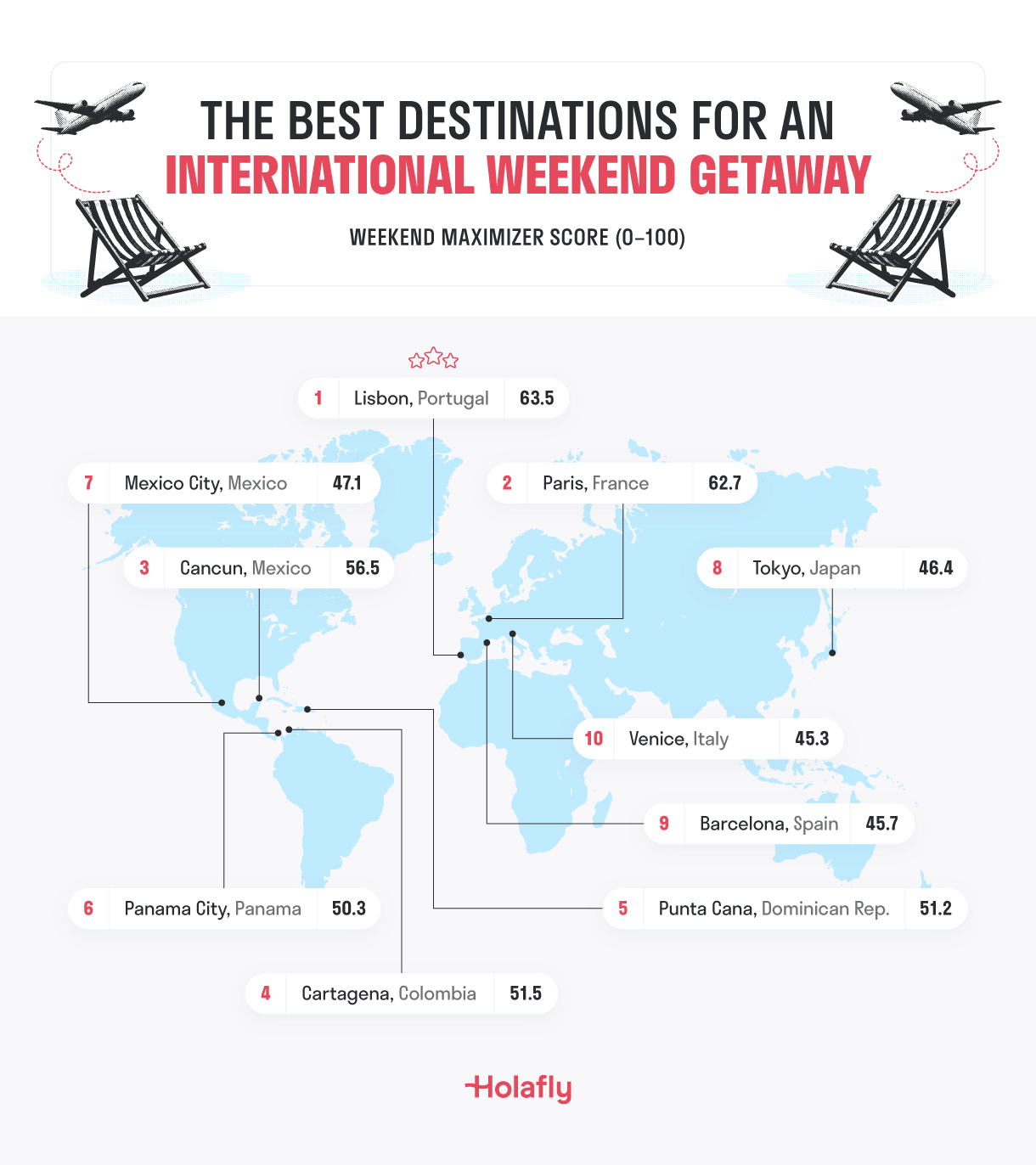
Lisbon wins by not losing anywhere. It has genuinely dense dining (72.9 restaurants per square kilometer), some of the cheapest rooms in Western Europe at roughly $306 for three nights, and an airport barely 7 km from downtown, so you can drop your bag in Alfama and be eating pastéis de nata within the hour. Nothing else on the list gives back as much of your weekend.
Paris makes the opposite case: go for sheer volume. Its restaurant and attraction density are both the highest we measured, and you could spend the entire trip inside the Marais and never run out of things to do. It costs more than the rest of the top tier, and it’s a long flight from most of the US, but if the goal is to maximize what you see rather than how easily you get there, nothing beats it.
What’s striking is how much of the top ten sits close to home. Cancún, Cartagena, Punta Cana, Panama City and Mexico City all make it. That points to the real tension in the data: the cities that are most rewarding to visit and the cities you can realistically do in a weekend are often not the same place. So we ranked them separately.
The Best Short-Haul Getaways
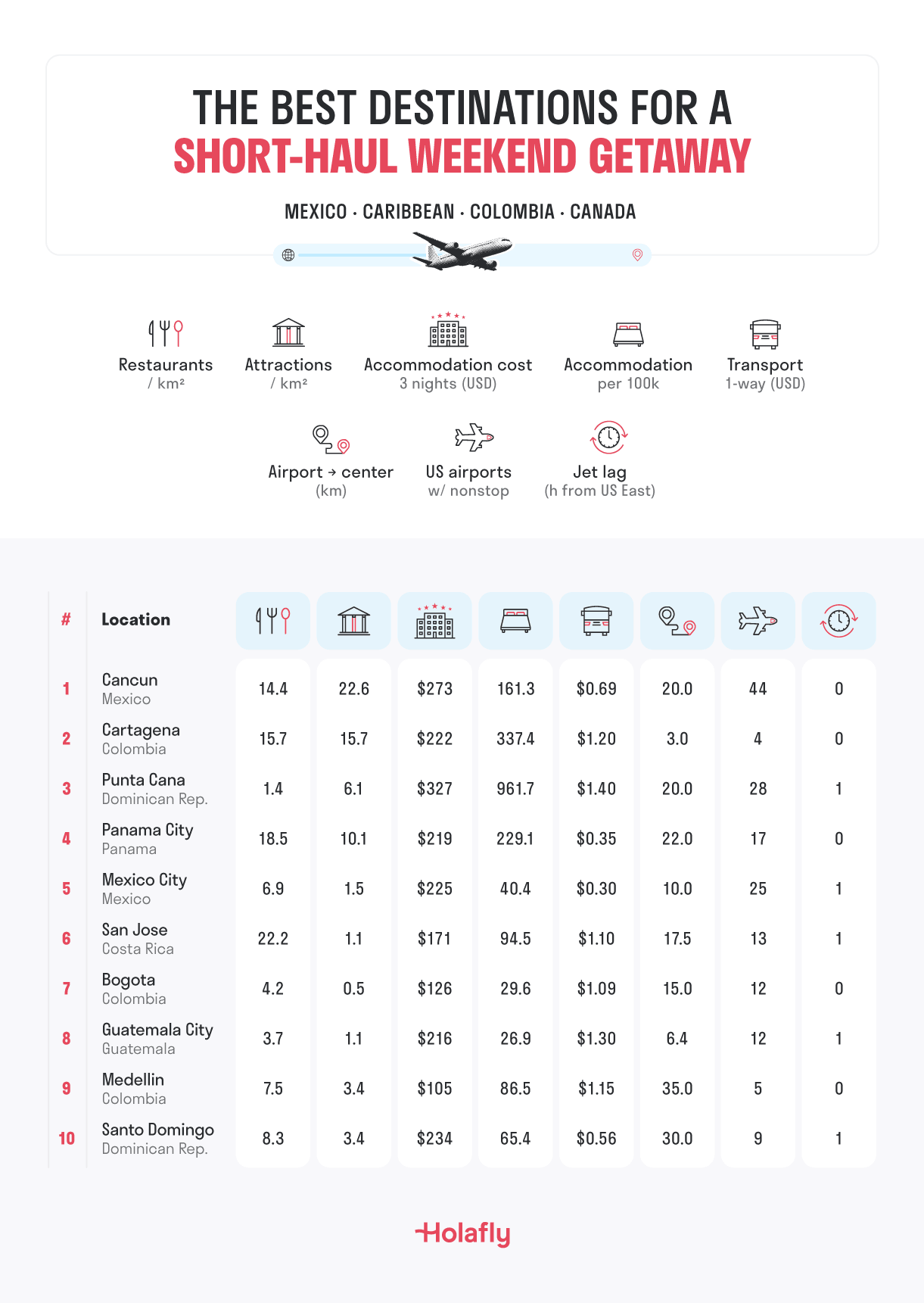
If you’re booking an actual long weekend, this is the list to read. Short-haul here means a nonstop flight from the US of roughly five hours or less. You’re checking in while the transatlantic crowd is still over the ocean.
Cancún tops it, mostly on reach. 44 US airports serve it nonstop, more than anywhere else on the index, the East Coast has no jet lag to sleep off, and three nights averages a manageable $273. Use it as a base and Isla Mujeres, Tulum and the cenotes are all day trips.
Cartagena comes second, and it’s the one to beat on logistics. The airport is barely 3km from the walled city, the shortest airport run of anywhere we measured, and Colombia keeps the same clock as New York. You can land, drop your bag in Getsemaní, and still make lunch.
Panama City and Mexico City are the value picks: both give you a proper big-city weekend, and their local transport is the cheapest on the whole list, at $0.35 a fare in Panama and $0.30 in Mexico City. The pattern holds across the group. Short flights, little or no time difference, low prices once you land. These are the trips you leave for on a Friday and are home from on Monday.
The Best Long-Haul Getaways
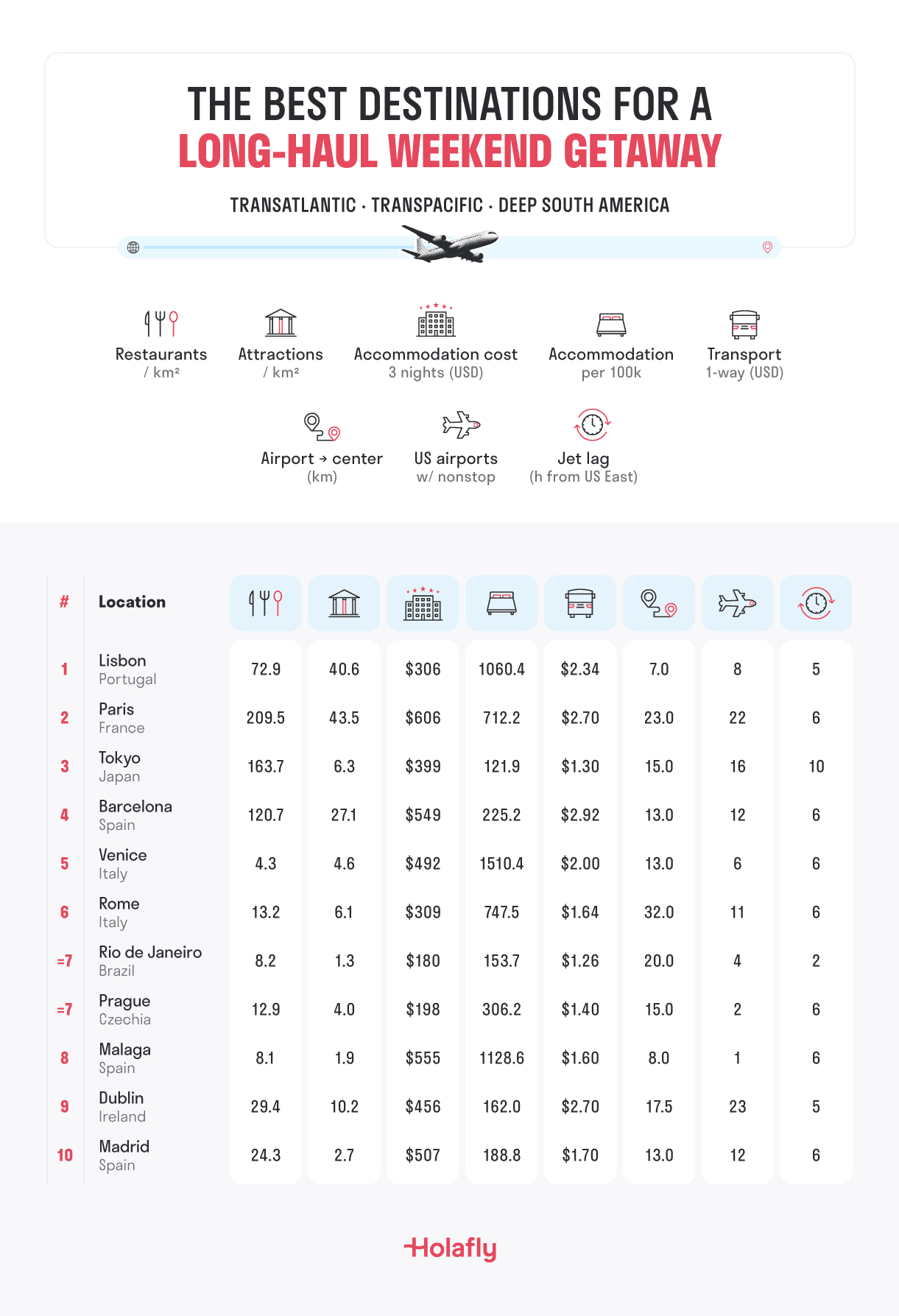
Some cities are worth the flight and the jet lag. Lisbon and Paris top the long-haul list as well as the overall one, which is the clearest sign of how strong they are: they win even while carrying a transatlantic flight and a five-to-six hour time change. If you’re crossing an ocean anyway, they give you the most to show for it.
Tokyo is third, and probably the single most rewarding city on the whole index to actually explore. Its restaurant density is second only to Paris, and you could spend three days working through Shinjuku, Shibuya and the backstreets in between without eating the same thing twice. The catch is the ten-hour time difference. Tokyo is the one destination on this list that genuinely needs another night or two, to pay off.
Barcelona and Venice complete the top five, for almost opposite reasons. Barcelona is the density pick: Gaudí, the Gothic Quarter and one of the highest concentrations of restaurants and sights on the list, with an airport just 13 km from the middle of town. Venice earns its place a different way. It’s small, entirely walkable, car-free, and has more places to stay per resident than anywhere else we ranked, so even a full weekend never turns into a commute. You step off the water taxi and you’re already there.
How To Make The Most Of A Short Break Abroad
A good micro-cation is mostly about protecting your hours. A few things that help:
-
Match the destination to the days. For a straight 48-hour trip, stay short-haul. A nearby city with no jet lag gives you two full days instead of a day and a half. Save Tokyo and the long-haul splurges for when you can give them a few more nights.
-
Fly out the night before. An evening or red-eye departure means you wake up in the city with the first day intact, instead of watching the morning disappear at 35,000 feet.
-
Travel carry-on only. Skip the checked bag and you skip baggage claim, which is 30 to 45 minutes gone at the other end. On a weekend trip that’s real time back, and it makes a night-before flight much easier to run for.
-
Book the hotel near the middle. The closer you are to both the airport and the sights, the less of the trip you spend in transit. In Cartagena or Lisbon that’s worth close to an hour a day.
-
Get ahead of jet lag on anything long-haul. Nudge your sleep earlier for a couple of days before you go, get out in daylight when you arrive, and take the first evening slow.
The whole point of a micro-cation is that time is the scarce thing, not money or distance. The cities at the top of this index aren’t the biggest names or the obvious bucket-list picks. They’re the ones that hand back the most of your trip. Whether that’s a Friday hop to Cancún or Cartagena, or a longer haul to Lisbon or Tokyo, the best trip is the one that wastes the least of itself.
A weekend this tight also leaves no room for logistics going wrong. From making a tight connection to finding your way to dinner, a short trip runs almost entirely on your phone.
The best trips start the second you land - not an hour later, hunting for signal. Set up your travel eSIM before you leave and you’ll arrive fully connected, with everything you need already on your phone. All that’s left to figure out is where to go first.
Methodology
To identify the best international destinations for US travelers to make the most of a “micro-cation” we scored and ranked 37 city-break destinations across eight metrics. The metrics cover both how much a visitor can realistically pack into a short trip (how densely packed the dining and attractions are, how affordable and available the accommodation, how cheap it is to get around) and how easy the destination is to reach from the US (distance from the airport, nonstop flight access, and jet lag).
All figures were collected in July 2026, using one consistent source per metric: restaurant and attraction counts from Tripadvisor (divided by each city’s administrative area to give a density per km²); accommodation cost from published mid-range (3-star) hotel rates, taken over three nights; accommodation availability from the total number of properties listed on Booking.com per city (expressed per 100,000 residents); local transport fares from Numbeo, or the official transport operator where Numbeo was unavailable; airport-to-city-center distances from published travel sources; nonstop US flight connections from FlightConnections; and jet lag calculated as the number of hours a city’s time zone differs from US Eastern Time.